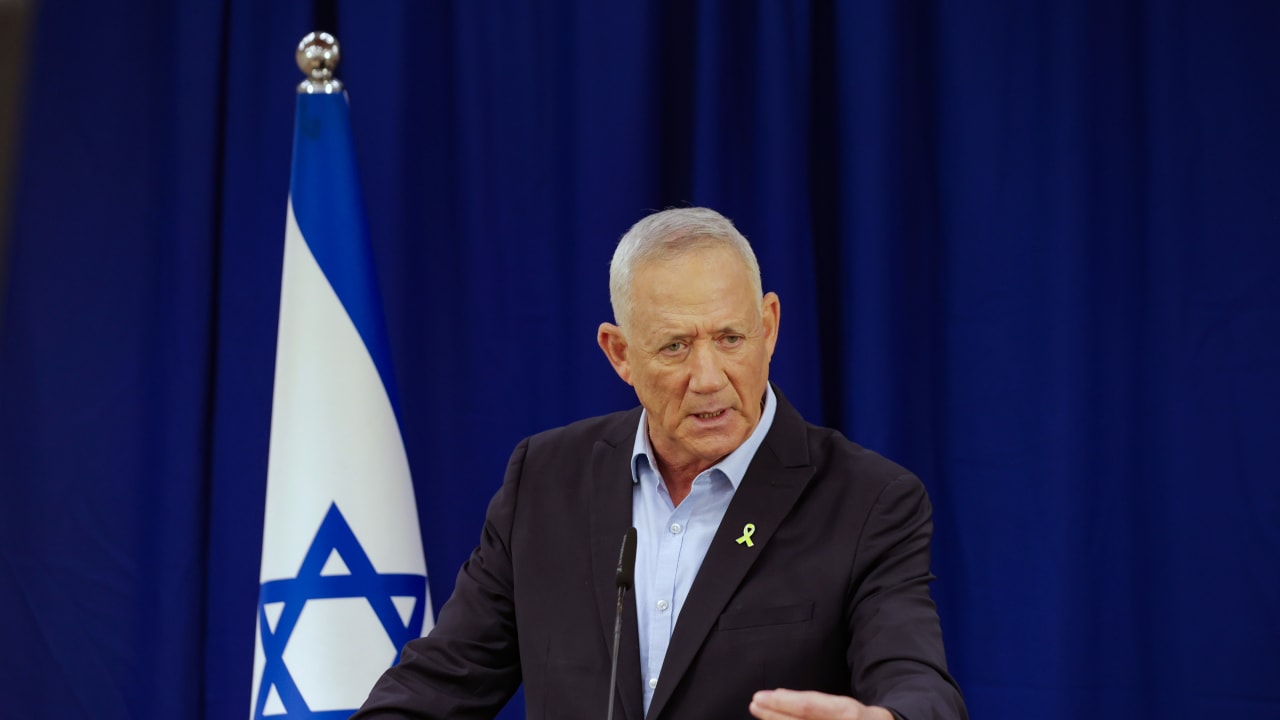
For a brief moment after October 7, Benny Gantz – then head of the National Unity Party – seemed poised to inherit the mantle of national leadership. Less than a year later, he is teetering on the edge of political oblivion.
This trajectory – from national savior to political casualty – illustrates a harsh Israeli political truth: decency is rarely rewarded. Or, more bluntly, nice guys seldom finish first.
And Gantz, by most accounts and judging from his actions over the years, is a decent man and a patriot – both his political allies and his opponents have said as much. But what he has in decency, he lacks in charisma, decisiveness, and political acumen.
Those missing traits have led him from being champion of the polls on November 11, 2023 – when the weekly Maariv survey gave him 43 seats, more than triple the 12 his party won in the last election – to falling below the 3.25% electoral threshold, were elections held today – again according to a Maariv poll.
In that November 2023 poll, 52% of respondents said he was more suited to be prime minister than Prime Minister Benjamin Netanyahu. Today, his name is rarely even listed as an option when pollsters ask about suitability for the premiership. As late as March 2024, Gantz’s party was polling at 36 Knesset seats, double Likud’s tally at the time. A year ago, he still stood at 21 seats. Today, his projected number is zero.
That collapse explains his dramatic appeal Saturday night to Yesh Atid’s Yair Lapid and Yisrael Beytenu’s Avigdor Liberman to join him in forming a unity government with Netanyahu – one the prime minister has not publicly sought – to free the hostages and pass legislation conscripting the haredim (ultra-Orthodox). Gantz’s idea was for a six-month unity government that would also set a date for elections.
Predictably, there were no takers. The other opposition parties, with elections required by October 2026 but almost certain to be held earlier, dismissed it as a desperate gambit that would throw the prime minister a lifeline. Netanyahu himself showed little enthusiasm, and his right-wing coalition partners, fearing the move would dilute their influence, lobbied hard against it.
So what happened? How did Gantz soar like a rocket two years ago, only to fall like a rock today?
He soared following October 7 because he did what the public, reeling from the trauma of the Hamas attack, wanted: he joined Netanyahu in forming an emergency government. His decision at the time was not met with cynicism, as if he were trying to save his own political skin, but with relief. He looked statesmanlike, embodying sobriety and calm when the country desperately needed it. He represented military experience and centrist moderation during a national emergency.
Gantz once represented the face of national unity to many
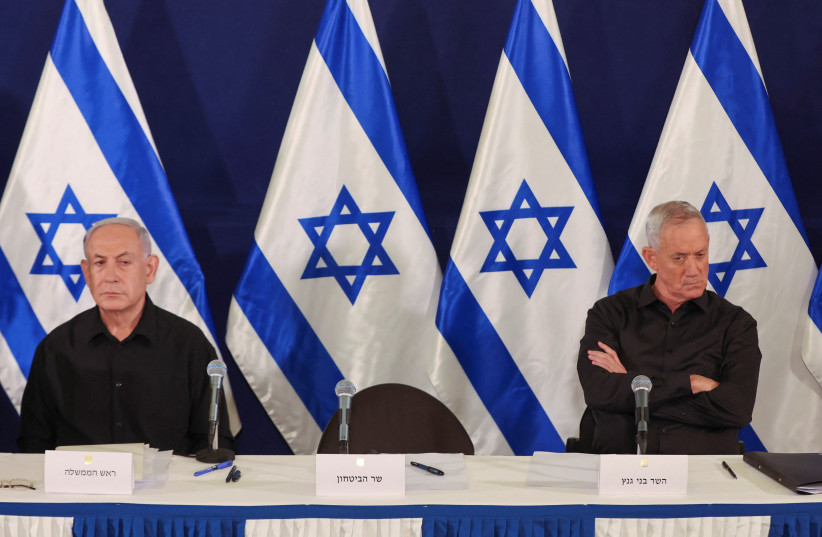
For many, Gantz became the face of national unity: the former general who put political considerations and his fraught past with Netanyahu aside for the good of the country. His conditions were clear – that far-right ministers Itamar Ben-Gvir and Bezalel Smotrich be excluded from the war cabinet. The cabinet was instead made up of Netanyahu, Gantz, his ally and fellow former chief of staff Gadi Eizenkot (who has since left the party), and then-defense minister Yoav Gallant. His numbers skyrocketed to 43 seats. The country rewarded him for being the “responsible adult in the room.”
His steep decline since then can be traced to June 9, 2024, when he resigned from the government after issuing an ultimatum a month earlier demanding that Netanyahu present a post-war plan.
When Netanyahu failed to do so, Gantz pulled his party out. In retrospect, it was a monumental political error with unintended consequences.
While he couched the move in moral terms – accusing Netanyahu of “preventing us from progressing to real victory” and of prioritizing politics over all else – it backfired. By leaving, Gantz lost the ability to moderate policy from within while failing to topple the government, which continued in its pre-October 7 constellation of 64 MKs.
Gantz had hoped his departure would spark early elections. It did not. The coalition rallied around Netanyahu, the opposition failed to lure away Likud defectors, and Netanyahu emerged more dependent on Smotrich and Ben-Gvir than before – precisely the outcome Gantz had tried to prevent.
Among the public, the move was also not received well. Some faulted him for not leaving sooner; others castigated him for leaving while the war was ongoing. What was meant to be a principled stand became instead another example of Gantz’s poor timing. A Maariv poll on June 6, just before his announcement, gave him 27 seats. Two weeks later, that same poll gave him 23, a drop of nearly 15%.
Even when his numbers were sky-high, there was always the lingering question: what did Gantz actually stand for? His entire political career has been built on being the centrist alternative, above the fray and beyond ideology.
But as the conflict dragged on and Israelis demanded sharper answers, his cultivated ambiguity became a liability. Was he pressing – like Netanyahu – for total victory in Gaza, or was he looking for a ceasefire to free the hostages?
Did he align with the hostage families who were willing to compromise, or with those saying only military pressure would do the job? Gantz straddled these divides with vague calls for “responsibility” and “unity.” To the Left, he seemed too hawkish, to the Right too cautious, and to the middle as someone afraid to take risks.
Soon, allies began jumping ship. Gideon Sa’ar left with three MKs, portraying Gantz as too weak and unfit for the moment. Then Eizenkot followed.
His political fortunes were also not helped by the fact that soon after he left the government, the overall tide of the war began to shift: Israel killed Hamas leaders Ismail Haniyeh in Iran and Yahya Sinwar in Rafah, as well as Hezbollah head Hassan Nasrallah in Beirut. It then exploded beepers in the hands of thousands of Hezbollah members, a central act in the overall decapitation of the Lebanese terrorist organization.
The former military chief prevented himself from being able to share the credit for all of those military successes.
Part of Gantz’s problem is also structural. Unlike the Likud or the haredi parties, Gantz’s parties – and they have changed names over the years – have never had a deep base or organizational machinery.
The Likud, even at its lowest point after October 7, was still polling 18 seats – its hardcore constituency intact. Gantz’s party, by contrast, was always a vehicle built on his personal popularity. That worked when he first burst onto the political scene in 2018, and it worked again in 2023 when the public saw him as the “responsible adult” in wartime.
But once that shine wore off, there was nothing underneath to hold voters. And he hemorrhaged them, shedding the support of roughly 1.5 million Israelis in less than two years – again, assuming the polls are accurate.
Gantz’s Saturday night call for unity – framed as a way to save the hostages and pass a haredi draft bill, although he didn’t spell out how this move would achieve either – was widely interpreted as a last-ditch attempt to regain relevance, if not an act of outright desperation. The harsh political truth is that what Gantz lacked was not decency, but strong political instincts – the kind his chief rival, Netanyahu, has in abundance.
Gantz’s trajectory is a cautionary tale about the harsh nature of Israeli politics. He rose when the public longed for unity, but fell because he never translated that quality into leadership that could endure beyond the moment. In a system that rewards cunning over courtesy, maneuvering over moderation, and survival over sincerity, he never stood a chance.