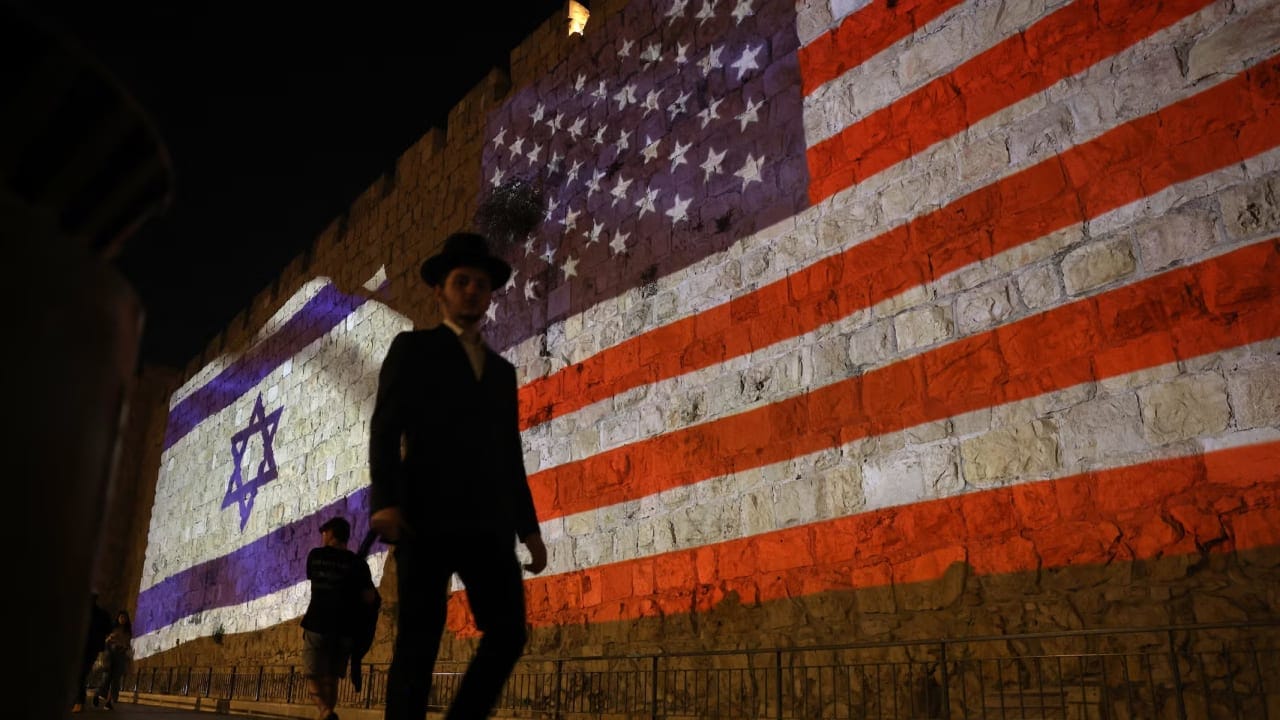
The US Pentagon’s National Defense Strategy, released Friday, described Israel as a “model” US ally worthy of America’s unequivocal support.
The paper, described by The Washington Post as a guiding military document shaping US global priorities, barely made news in Israel.
The television and radio news shows did not devote extensive coverage to the paper, and – as an example of how little media attention it generated – Yediot Ahronot did not even devote a headline to it in Sunday’s edition.
But imagine if this paper had been critical of Israel. Imagine if, instead of praising Israel as an ally, it questioned its utility as an American asset given its settlement policies. Then the NDS would have been analyzed and dissected ad nauseam on the TV and radio news programs, and Yediot would have plastered a bold black-lettered headline across its front page.
This is a textbook example of how, when Washington scolds, Israel obsesses for fear that it is losing its most important ally, but when the US administration praises Israel, the political class and the media seem to take it as a given and barely take notice.

And, by the way, this is no mere mental exercise. In addition to the National Defense Strategy signed by the defense (now, war) secretary, each administration issues a National Security Strategy, signed by the president, that sets out the administration’s overall views on threats, priorities, and foreign policy objectives. The NDS’s job is to translate these objectives into force planning, priorities, alliance burden-sharing, and budgets.
What did past administrations' NDS look like?
These papers put out during the Obama and Biden presidencies were much cooler toward Israel, often pairing support for its security with sharp criticism of settlements or Israeli policies on the Palestinian issue.
In the papers produced by the Obama administration, Israel was one important partner among several others and folded into a broader “two-state solution framework.” For instance, the 2010 NSS spoke of Israel’s security as a US interest, but this was accompanied by strong, repeated statements calling settlements illegitimate and counterproductive.
The Israeli – and world – media jumped on this language.
They had the chance to do the same after Biden released his administration’s NSS in 2022, which framed Israeli settlement policy as an obstacle to US aims – regional integration, normalization, and preserving a two-state horizon.
Because this critical language played into Israeli anxieties about abandonment and delegitimization, it was obsessively covered.
But a document that makes no mention of settlements or the Palestinians and confirms Israel’s self-image – tough, self-reliant, and indispensable to the US – does not generate any drama, so it goes under-reported.
And that is what happened with the Pentagon’s latest NDS. There was none of the “on the one hand, on the other hand” rhetoric relating to Israel. Rather, it elevated Israel to a place it has never had in a major US strategic document: the yardstick for how US allies should behave.
Instead of pairing this language of Israel as a “model ally” with “buts” about settlements or Palestinian rights, it singled out Israel’s willingness to fight on its own “with critical but limited support from the United States,” setting up the Jewish state as no less than the benchmark for allies “who do not ask the US to fight on their behalf.”
“Israel is a model ally, and we have an opportunity now to further empower it to defend itself and promote our shared interests,” the paper read.
The paper singled out Israel in a way it did not do to other US allies in the region – the Saudis, Qatar, UAE, and Turkey – none of whom were even mentioned in the document. The reason this paper is significant is that it elevates Israel from being one important ally among many others in the region to the paradigmatic ally in the new US burden-sharing doctrine.
It places Israel – not Turkey, Qatar, or Saudi Arabia – at the center of US strategic thinking in the Middle East. The document spells out that the US is looking for self-reliant allies who can carry their own security burden, thereby freeing the US to address more pressing threats on its home front.
For Israel, this document is reassuring that, despite all the talk – including within President Donald Trump’s own Republican Party – that the time has come to reassess ties with Israel, this administration views it as an indispensable ally.
As Saudi Arabia is slowly moving away from normalization with Israel – both because of the Palestinian issue and a concern that Israel might become too strong regionally if the ayatollahs fall in Iran – this paper signals to Riyadh that Jerusalem, not Riyadh, is America’s main strategic ally in the region.
This puts the Saudis in a rather awkward position vis-à-vis the administration: it is currently distancing itself from Israel, while the US is portraying Israel as a model ally and strategic pillar. The message here is that if Riyadh chooses to distance itself from Israel, Washington has no intention of pivoting away from Jerusalem.
Turkey, too, is surely paying attention to this document, even as Israel’s role in it is underplayed in the international media – not only in Israel. The bottom line for Turkey: Washington is elevating Israel’s importance to its own national security, while not even nodding at Turkey – a member of NATO, an alliance whose relevance overall is, in this paper, declining.
That this document barely registered in Israel reflects a familiar reflex: criticism from Washington commands a lot of attention and warnings of an “unprecedented rift,” while affirmation of Israel’s value to the US is taken for granted and underreported. But in this case, what went unnoticed was a significant strategic signal.
By elevating Israel to the status of a “model ally,” Washington signaled where it intends to anchor its Middle East strategy: in self-reliant partners willing to fight for their own security. The Israeli media may not have obsessed over this document precisely because it was reassuring, but it is arguably one of the most consequential endorsements Israel has received from Washington in years.