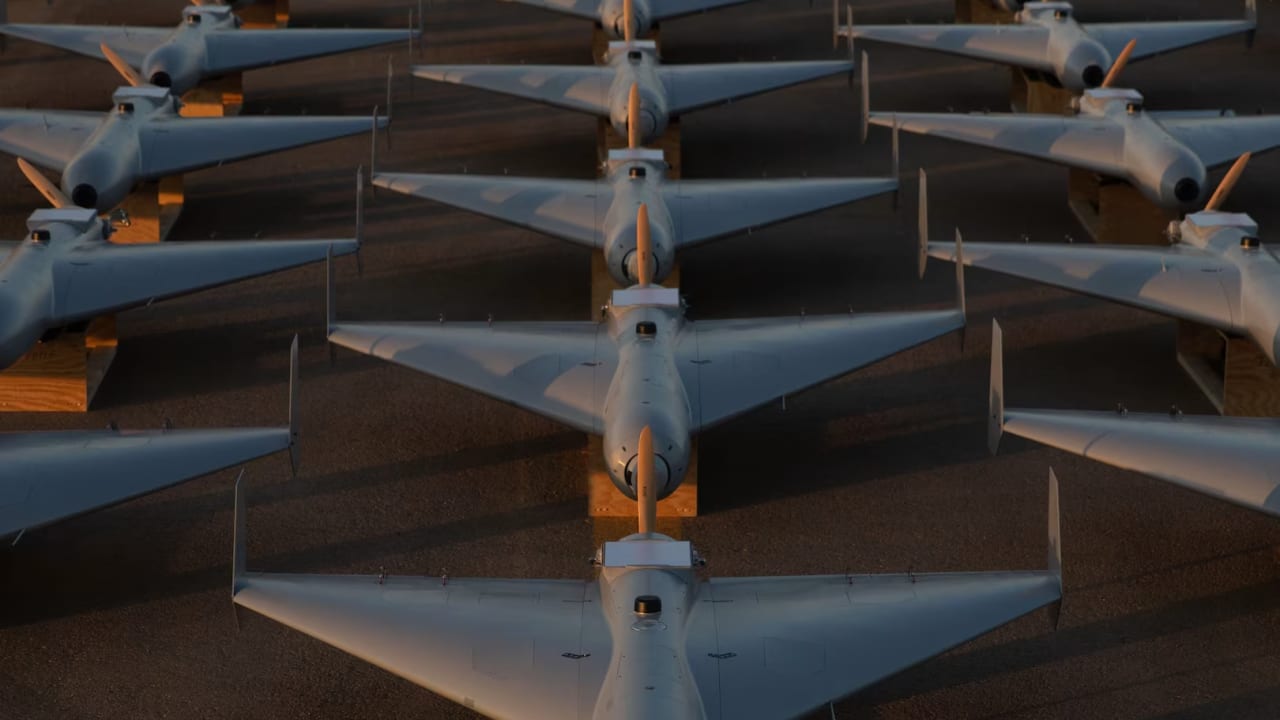
US Central Command (CENTCOM) said this week that it has a “new task force for the US military’s first one-way-attack drone squadron based in the Middle East.”
Most reports say the new images put out by the drone force appear to show V-shaped drones that are modeled on the Iranian Shahed 136. The Iranians have provided this drone to Russia, and Moscow has used it in the thousands to strike Ukraine. The US has been attempting to rapidly acquire more drones, putting up billions of dollars in funding to keep up with other countries.
Iran’s simple Shahed 136 drone has a long range and a warhead such that it can fly into a target. It doesn’t appear to have a way for someone to guide the drone once it is launched, meaning it has no “man-in-the-loop.” It also doesn’t appear to be able to “loiter” over a target. As such, it behaves more like a cruise missile or a German V-1 flying bomb from the Second World War.
Iranian drone clone?
Has US Central Command basically cloned the Iranian drone and is now standing up a drone clone army?
CENTCOM says that it “launched Task Force Scorpion Strike (TFSS) four months after Secretary of War Pete Hegseth directed acceleration of the acquisition and fielding of affordable drone technology. TFSS is designed to quickly deliver low-cost and effective drone capabilities into the hands of warfighters.” The report says, “the new task force has already formed a squadron of Low-cost Unmanned Combat Attack System (LUCAS) drones currently based in the Middle East.”

US Central Command goes on to say that the new drones have “an extensive range and are designed to operate autonomously. They can be launched with different mechanisms to include catapults, rocket-assisted takeoff, and mobile ground and vehicle systems.” Adm. Brad Cooper, head of CENTCOM, said, “This new task force sets the conditions for using innovation as a deterrent... equipping our skilled warfighters faster with cutting-edge drone capabilities showcases US military innovation and strength, which deters bad actors.”
This is important and meets the needs of the Rapid Employment Joint Task Force (REJTF), which is led by Central Command’s chief technology officer, to fast-track processes for outfitting deployed forces with emerging capabilities. “The joint task force is coordinating innovation efforts among Service components in three focus areas: capability, software, and tech diplomacy. TFSS’s efforts to build the one-way-attack drone squadron are led by personnel from Special Operations Command Central and align with REJTF’s capability focus area,” CENTCOM added.
What to make of the new initiative?
First of all, the Iranian attempt to build a kind of flying delta-wing type drone was already modeled on Israeli success in this field. Israel’s IAI has produced the Harpy and Harop sophisticated drones over the last decades. These are expensive, and they go far beyond the simple type of drones the Iranians built. The Israeli drones were designed to go after relatively high-value targets such as radar installations, to blind an enemy’s command and control and detection systems.
Iran wanted a cheap knock-off. The Iranians have been building drones since the 1980s. In the last decade, their drones have grown exponentially in number, type, and capabilities. They have a long range of up to 2,000 km. They have been trafficked to Iranian-backed militias in Iraq, Lebanon, Yemen, and elsewhere. Some Iranian drones can carry munitions. Iran has modeled some on the US Predator and other foreign systems. Iran usually makes a model of a foreign drone, but can’t put in the satellite communications and other things that other hi-tech countries have. As such, Iran’s drones are much simpler and cheaper. This has met Russia’s needs and also helped the Houthis and others spread terror in the region.
Years ago, US CENTCOM became aware of the drone threat, with one commander saying enemies could get drones cheaply off the shelf and then re-purpose them. This was during the heyday of ISIS drones and China’s DJI. Now things have changed. The Ukraine war has shown that militaries need hundreds of thousands of small drones.
US Central Command is trying to fill the niche. As such, it is relying apparently on these types of drones that have some history in the region, from Iranian and Israeli designs. The US appears to be creating a larger drone army. However, it’s unclear how CENTCOM will use these smaller packs of drones. Will they swarm enemies, and if so, which enemy? Who is the likely target? US foes in the region could include Iran or its proxies. Cheap drones aren’t necessarily good against terror groups. They are better against infantry in trenches or enemy vehicles strung out on a road. Instead of the “highway of death” where Iraqi vehicles were destroyed, leaving Kuwait in 1991, drones could now destroy columns of vehicles without needing warplanes.
The big question with CENTCOM’s drone clone army is whether these drones will have more capabilities than the Iranian types and how the vision is to use them in warfare. If they can achieve swarming capabilities using AI and autonomous systems, the way Israel has begun to think about autonomous systems, then we might be seeing CENTCOM move into the future to point the way for the world in the new drone world order that is emerging.