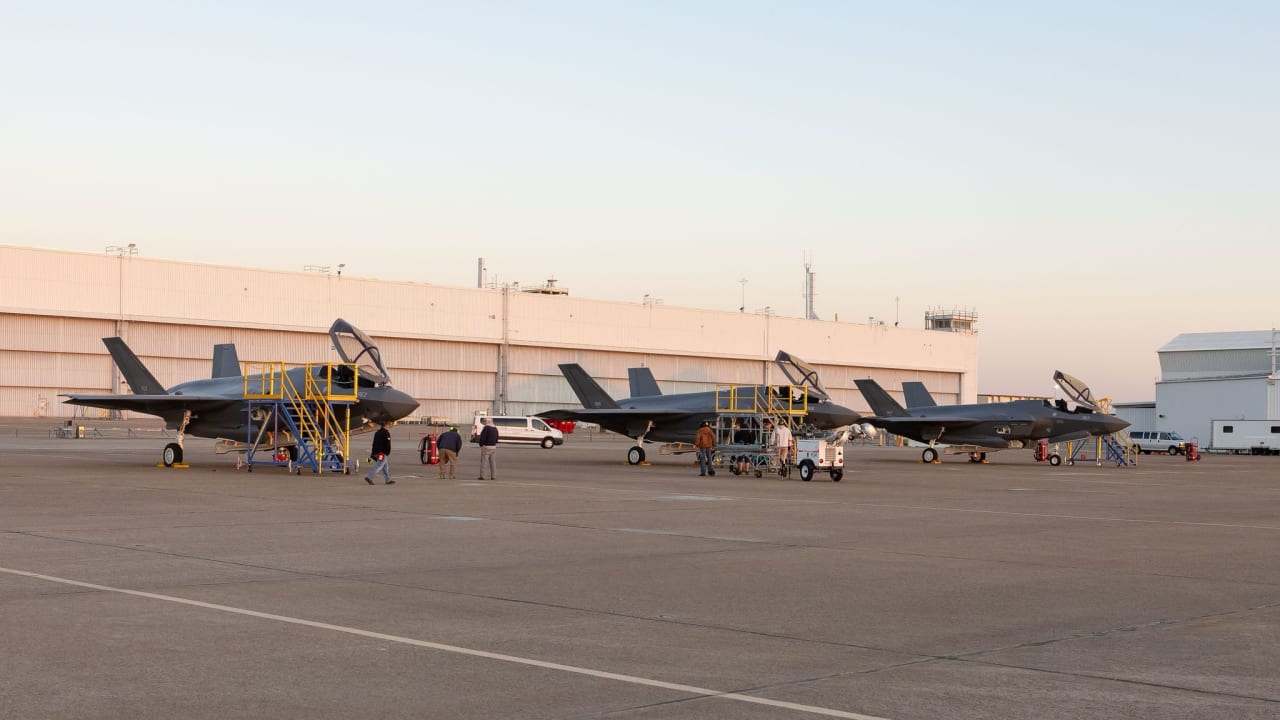
The June 13 to 24 Israel-Iran war brought home, more than ever before, how crucial Israel’s air advantage over its enemies is to its present and future security.
Decades and billions upon billions of dollars, which the mullahs invested in ballistic missiles and a nuclear program, were shattered in a matter of days by Israel’s F-35s, F-15s,and F-16s fighter jets.
In that light, there are top Israeli defense officials who want to increase the air force’s supply of these critical airplanes for the near future and the long-term.
And yet, some of these desires may run into some stark realities in the area of inflation.
A day before the Israel-Iran war, the US Pentagon announced it was scaling back by half its request to the US Congress for the US Air Force’s Lockheed Martin F-35 jets, from 48 down to 24.

How will inflation affect the air force?
The Air Force said it planned to seek $3.5 billion for the F-35 aircraft, and another $531 million for advance procurement of materials for it.
The Pentagon also requested 12 of the Navy’s carrier version of the F-35, lower than the 17 that Congress approved for this fiscal year, while the Marines would also see a reduction or two from this year’s funding.
Lockheed Martin delivered a total of 110 F-35 fighter jets to the United States and its allies in 2024. Lockheed’s F-35 program accounts for around 30% of the company’s revenue.
Other countries have also faced grave ups and downs regarding the cost of procuring F-35s, with Canada at times considering canceling their order, though eventually sticking with it.
Writing for National Security Journal, Andrew Latham described in June how Canada’s F-35 acquisition is expected to cost almost 50% more than originally advertised.
“According to Auditor-General Karen Hogan, the price tag has jumped from 19 billion Canadian dollars to 27.7 billion Canadian dollars – an $8.7 billion surge driven by inflation, foreign exchange pressures, and an overheated munitions and aerospace market,” Latham reported.
How will this impact upcoming and future Israeli purchases of these expensive fighter jets in an era when Israel has not manufactured its own fighter jets for decades?
Sources told The Jerusalem Post that the cost of inflation should not come into play for the upcoming 25 F-35 aircraft which Israel has purchased to add to its already 50 F-35s, with delivery spread out starting from 2027-2028 at a rate of three to five per year.
The transaction is valued at approximately $3 billion, funded by US Foreign Military Financing (FMF).
This is because the initial moves in the Israeli deal for F-35s 51-75 were signed in 2023 and locked certain costs into place.
In contrast, countries such as Greece, Romania, and others who may have signed subsequent deals and may receive their F-35s later, may face a different situation.
Also, sources recalled that since the Israel air craft deal is not just with Lockheed Martin, but is government to government and has huge implications for US military aid to Israel, the chances of Jerusalem canceling the deal are practically nonexistent, whereas the Pentagon has much greater freedom as a US entity, and the top defense entity, to dictate terms to Lockheed.
Against this backdrop, sources also recalled that Israel’s current Memorandum of Understanding (MOU) for aid from the US is slated to expire in 2028, which normally would mean serious negotiations between the countries over the next 10-year or so MOU to begin in early 2026.
With Israeli Air Force sources denying any notion of Israel canceling F-35 deals, this puts the spotlight on the issue of the defense and finance ministries, who may be looking to set out positions on a variety of issues leading into negotiations with the US.
This could also mean that either the F-35 rumors are posturing to try to secure specific add-ons to the F-35s or some other concession, or that the real issue is not the F-35s 51-75 but whether Israel might abandon the idea of buying F-35s 75-100, something which has not been discussed to date.
Regarding such a fourth F-35 squadron, supporters would note how crucial the F-35’s stealth capabilities were in disabling advanced Iranian air defenses, such as the S-300 anti aircraft missile systems.
However, some sources would argue that Israel could manage future attacks by further increases in its F-15 EX purchases from Boeing.
As things stand, aspects of the F-15 EX contractual process were signed in 2023, but Israel must sign additional documents, and then delivery would be expected in the 2028-2030 period.
According to Boeing, the F-15 EX “carries more weapons than any other fighter in its class, and can launch hypersonic weapons up to 22 feet long (6.7 m.) and weighing up to 7,000 pounds (3,175 kg.).”
The IAF currently operates 50 F-15 A/B/C/D variants and 25 F-15 I variants, with special Israeli-made adaptations.
The air force sources were very positive about the F-15’s performance during the war with Iran in bombing a wide variety of targets, even as the F-35 was needed to clear out anti-aircraft threats initially – since the F-15 EX lacks stealth capabilities.
Israel has been operating older F-15s for decades and some F-35s since 2016. Its 2023 decision to purchase F-15 EXs and more F-35s was based on the potential need to strike Iran. This included multiple waves of aircraft to take out both of the Islamic Republic’s improved air defense systems, followed by its nuclear facilities – something which, in fact, played out last month.
It is possible that some of the rumblings of Israeli officials about pricing also come as Jerusalem could be close to new moves regarding the F-15 EXs, which it was on track to buy, as well as potentially deciding to buy more F-15 EXs – depending on how friendly Boeing is regarding the terms of purchase.
One more element which could impact Israel’s negotiating posture is its long desire to purchase additional KC-46 refueling aircraft from Boeing.
Sources indicated that Israeli delays on moving forward aspects of its purchasing process allowed Japan and Italy to jump ahead of it, in terms of receiving additional KC-46 aircraft.
The bottom line with Boeing is that Israel needs multiple different kinds of advanced aircraft from Boeing, which could reduce its negotiating leverage.
None of this really clears up the broader picture of what final decisions Israel will make regarding the future of its air force. However, with the Iran war showing that Israel is more dependent than ever on having the most advanced air force in the region, it will need to find a way to cope with increasing inflationary costs.
All this comes just as Jerusalem will need to negotiate with Washington over its broader military aid package, reaching deep into the 2030s.