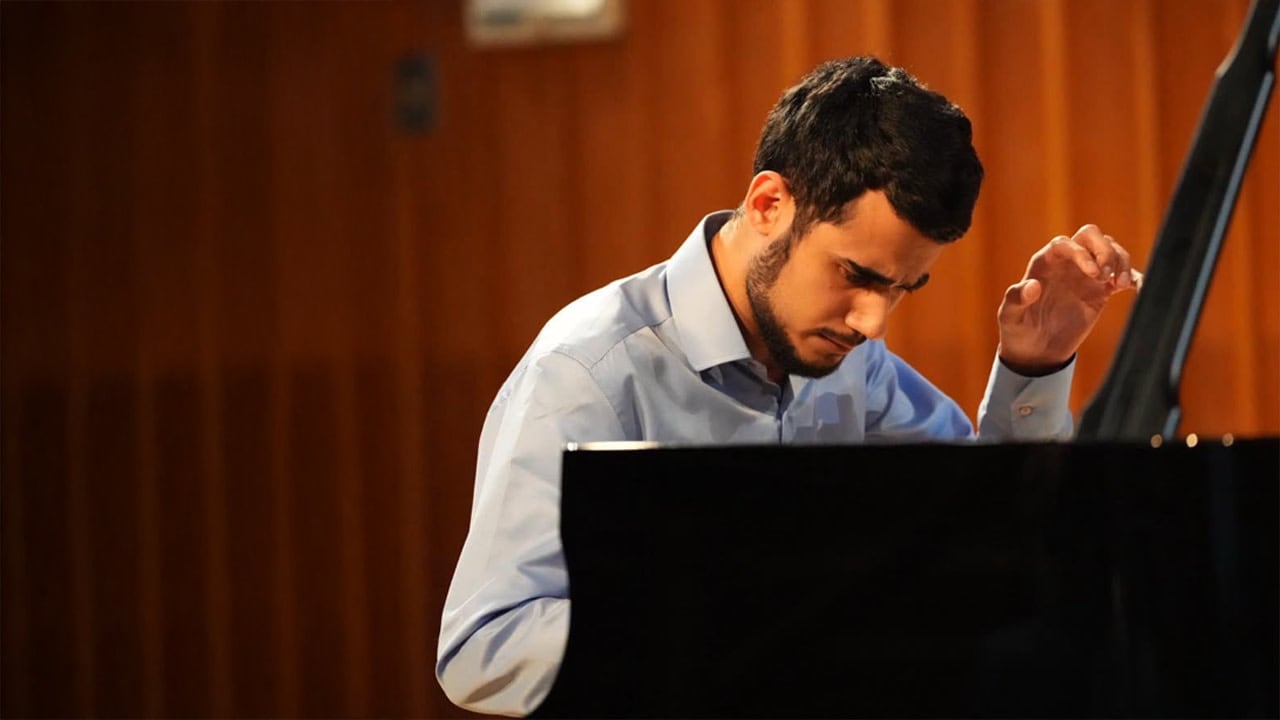
The piano was an unexpected presence at a recent high-level conference that brought together American and Israeli leaders. The setting was designed for speeches, policy discussions, and strategic exchanges, not for Schubert. Yet as pianist Ido Shalom took his seat at the keyboard, the room briefly shifted from its usual rhythm. “There was a sense that music could open something up,” Shalom recalls. “I wasn’t there just to perform, I was there to add a different kind of voice.”
A classical pianist currently pursuing a doctoral degree in the US, 25-year-old Ido Shalom was born in Israel and arrived at classical music by a decidedly nontraditional route. “My musical journey didn’t start in the usual way,” he says. “But once I discovered classical music, I devoted myself to it completely. It truly changed my life.” After studying initially in Israel at the Academy of Music in Jerusalem, and currently under renowned pianist John O’Conor, Shalom’s turning point came not through a grand symphony or virtuosic showpiece, but through a deceptively simple work: Beethoven’s Für Elise. What struck him was not technical brilliance but emotional possibility. “I was amazed that a single instrument could create such a wide range of feeling,” he says.

Finding home in Schubert
If Beethoven served as an initial influence, Franz Schubert became his guiding light. When asked which composer feels closest to him, Shalom responds instantly: “Schubert.” “Always Schubert,” he affirms. The bond goes beyond mere musical preference. For Shalom, Schubert embodies a kind of artistic honesty that seems increasingly rare. “He never tried to impress,” Shalom notes. “He simply wrote what he felt. Sometimes his music isn’t comfortable to perform, but his melodies are among the most beautiful you’ll hear.”
Schubert’s life story also holds significance. His brief, prolific career and lack of widespread fame during his lifetime resonate strongly with the young pianist. “He accomplished so much in such a short span,” Shalom states. “And one of his key values was friendship; he often composed for friends and remained dedicated to his art. That authenticity is important to me.” This inward, genuine approach, more personal than grand, more reflective than declarative, was what Shalom brought with him to the conference stage.
At the event, Shalom performed the national anthems of Israel and the United States, both arranged by him, and the opening movement of Schubert’s Piano Sonata in A major, D. 664. These choices were made carefully. “The anthems were essential,” he explains, “as they hold deep significance for both nations. But with Schubert, I aimed to share something personal.” Due to time limits, he played only one movement, prioritizing accessibility. “I selected something that anyone could relate to,” he notes, “a clear melody with warmth and openness.”
Unlike his usual concerts, the audience wasn’t mainly musicians. “In my career, I often assume my audience is familiar with classical music,” Shalom says, “I wanted to create a direct, human connection with listeners, regardless of their musical background,” he explains, “to show that classical music isn’t distant or elite, it’s human.” Therefore, he chose to introduce the piece verbally, providing context and framing the experience, turning it into a different kind of conversation. “Talking to musicians feels like speaking the same language,” he says. “With a broader audience, it’s about telling a story from the start.”
Despite years of training and disciplined practice, Shalom emphasizes that performance should always feel immediate. "I can practice a piece a thousand times,” he says, "but on stage, I try to experience it as if for the first time.” He believes this mindset is crucial for authenticity. "Playing exactly as I do in practice on stage would make me lose the audience,” he explains. “In practice, no one listens; on stage, everything is about communication.”
Honor and contribution
The invitation to perform arrived just a week before the conference, and Shalom vividly recalls his reaction. “First and foremost, I felt honored,” he states. “It’s a rare chance to share music in a setting where decisions and ideas truly matter.” This sense of duty motivated him to personally arrange the national anthems. “I wanted to offer something unique,” he explains. “Not merely repeat what people already know.”
Reflecting on the moment, Shalom describes the experience with two words: honor and contribution. “Being invited was an honor,” he says. “And introducing artistic expression into a space mostly filled with speeches and analysis – that felt meaningful.” His performance provided a moment of pause amid a busy schedule, emphasizing that culture and emotion remain relevant alongside policy and power. “It felt like a breath of fresh air,” noted the interviewer. “That’s exactly how it felt to me,” Shalom confirms.
After the conference, Shalom returns to his regular musical routine: upcoming concerts, competitions, recording sessions, and doctoral studies. However, achievements and milestones are less important than the process itself. “I enjoy the preparation,” he explains. “Trying different styles, honing interpretations, sharing music. That’s what drives me.” At the heart of his approach is a simple conviction. “To me, music is about conveying emotions,” Shalom states. “It’s about creating moments that resonate with people.” In a space designed more for diplomacy than for art, those moments quietly and persistently found their place – reminding listeners that, beyond strategy and speeches, beauty still has a role.