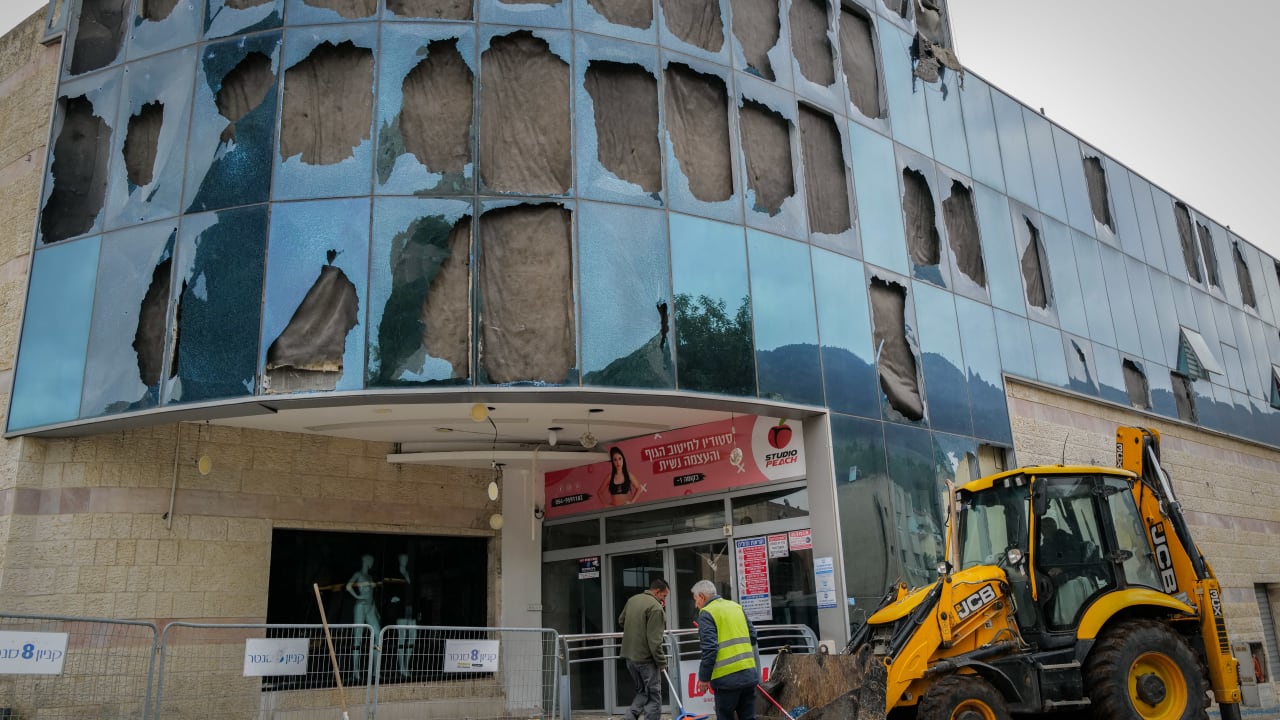
“Before the war,” says Tali Beri, owner of a clothing shop in Kiryat Shmona, “I had a good business and a decent salary to live on. Then the war broke out.” The residents of Israel’s North were evacuated, and Beri’s business was dormant for a year and a half.
In March 2025, Beri returned to Kiryat Shmona and took out loans to restart her business. The shop and merchandise had deteriorated, and she had to rebuild it from scratch. The nearby mall had taken a direct hit from a Hezbollah rocket, and the blast wave struck her shop – shelves fell and windows shattered. “Everything has since been repaired, but the real damage is that there are no people. Customers have hardly returned,” she laments.
In early 2024, the Kiryat Shmona Municipality, together with the Rashi Foundation, one of Israel’s leading private philanthropies, promoting social mobility in Israel’s geo-social periphery, commissioned accounting firm Ernst and Young Israel to prepare a damage report assessing the economic damages caused by the war in Kiryat Shmona.
Michal Cohen, Rashi’s CEO, says: “We realized that in order to begin developing a model for economic recovery, we first needed to understand the scope of the damage. We needed to generate the data to base the planning of relevant responses for business reopening and economic rehabilitation.”
The report found that the direct financial loss to Kiryat Shmona alone was estimated at NIS 1.5 billion, while business activity in the city had been reduced by 75%. This phenomenon had repeated itself throughout Israel’s North.
Yarden Erlich, head of the Department of Industry, Business, and Tourism of the Kiryat Shmona Municipality, says: “Following the report, we realized that we needed to develop a unique intervention aimed at bringing businesses back home to Kiryat Shmona – a solution that would provide them with full support in order to rebuild trust and reopen their businesses.”
To meet this challenge, a broad cross-sector coalition of foundations, regional and local authorities in the Galilee, and partners from the public and business sectors joined forces to establish the Business Hub, whose goal is to provide comprehensive support to small and mid-size businesses in the Eastern and Western Galilee.
The goal of the Business Hub, explains Ruthie Kellner-Elton, its director, “was to create a one-stop shop to provide local businesses with the support that they need in order to reopen. We want anyone who previously had a business or who wants to open one, and is currently in a difficult situation, to know that we are the address for them.”
The hub helps small and mid-size businesses realize their rights, develop business plans, and improve marketing processes. It also provides operational consulting, legal, and accounting support; translates needs into policy and budget allocation through communication with the Tnufa Directorate, municipalities, and government ministries; and works with government offices to lower the bureaucratic hurdles that small business owners frequently encounter. It attracts new companies to the region, fostering a supportive ecosystem for entrepreneurship.
After seeing significant demand and demonstrable positive impact, the initiative evolved to help businesses in the Eastern Galilee and, recently, also in Western Galilee, becoming a model for regional development.
The Business Hub is powered by a coalition of partners, namely the Rashi Foundation, the Beyachad Foundation, the Russell Berrie Foundation, the Jewish Federations of North America (JFNA), Bank Hapoalim, EY, the Bloomberg Regional Initiative – CIVIX, JDC, Eastern Galilee Municipal Cluster, and the Western Galilee Municipal Cluster.
Commenting on the importance of the hub, Jeffrey A. Schoenfeld, vice chair of the Board of Trustees and chair of the Israel Emergency Response Committee, Jewish Federations of North America, says, “After October 7, Jewish Federations quickly understood that small businesses would be hard hit with many owners and employees evacuated, drafted into the reserves, or otherwise impacted by the war. In response, Jewish Federations launched the Israel Emergency Loan Fund, which has already provided over NIS 560 million to 3,200 businesses. Revitalizing the local economy is essential to bringing families back and restoring daily life. Our partnership with the Rashi Foundation, the regional clusters in the North, and the city of Kiryat Shmona through the Business Hub is meeting this challenge and giving businesses across Northern Israel the tools not just to survive, but to thrive again.”
“Revitalizing and strengthening the North is a national mission and crucial to Israel’s resilience,” Rashi CEO Cohen concludes. “Many more challenges remain, and we are committed to this partnership to continue strengthening the northern economy.”
“The Business Hub was a lifeline for me,” Beri says. “I’ve received personal attention and genuine care. They call, they ask, they update me on everything I’m entitled to. They connected me with an accountant who helped me file a claim with the Tax Authority, and have accompanied me every step of the way. There’s not much work at the moment, but there’s someone who listens and understands, and that gives me hope. In the end, this is my livelihood, and although it’s hard to be optimistic, thanks to them, I manage to hold on to hope.”
This article was written in cooperation with the Rashi Foundation.