Art can evoke a variety of emotions in us, the viewers. It can provide visual pleasure, comment on political and social issues, provoke dialogue and diverse reactions, and sometimes even catharsis. Art can be experienced in very different ways, by both its audience and its creators, as evidenced by this column.
This October is a month full of Jewish holidays, happy days; but it is also the second anniversary of the dramatic beginning of the Israel-Hamas war. For many of us in Israel, it has been hard to find an emotional balance.
The need for something positive seems to recur in everyday conversations, so this month I was drawn to art that moved me positively or simply made me smile. I chose artists whose artwork can have precisely that effect but also leaves viewers with deep reflections.
I interviewed the artists while we were still holding our breaths for the return of the 20 living hostages. My search for positive emotions in art happily matched the joy on the streets of Israel upon the hostages’ release.
The exhibitions I selected are currently on view in Herzliya, Ramat Gan, and Tel Aviv.

Three Israeli artists agreed to answer my three questions:
- What inspires you?
- What do you call art?
- What, in your opinion, makes your artwork different from that of other artists?
Hanoch Piven
Hanoch Piven is an award-winning illustrator, renowned caricaturist, mixed-media artist, author of a series of children’s books, and creator of apps, TV shows, interactive exhibitions, and advertising campaigns. He was born in 1963 in Montevideo, Uruguay.
When he was 11 years old, he and his family moved to Israel, where he grew up in Ramat Gan. He received his art education in New York, where in 1992 he graduated from the School of Visual Arts. In 1996, he returned to Israel. For the past 24 years, he has been dividing his time between Tel Aviv and Barcelona.
In his artwork, Piven uses everyday objects, giving them a new meaning. His art is playful and makes the viewer smile (as I experienced firsthand). He combines bold colors and profound symbolism, fusing them with irony, even sarcasm, and wry humor with a sharp critical eye.
Another aspect of his work is therapeutic. He uses it in his workshops with evacuees, the wounded, and those coping with mental health challenges after Oct. 7, 2023.
Over the decades, Piven’s work has been published in newspapers and magazines worldwide, such as Time Magazine, Newsweek, Rolling Stone, The Times, Der Spiegel, and many Israeli publications.
Using his unique artistic language, he has been capturing world-famous figures of politics and pop culture, such as Yitzhak Rabin, Yasser Arafat, Barack Obama, Madonna, and Steven Spielberg.
Some of these works are on view as part of his comprehensive solo exhibition reFORM, which opened on October 17 at the Herzliya Museum of Contemporary Art. The exhibition’s title captures both the essence of the artistic act and its inherent potential for transformation and rectification. The artist invites viewers to a dialogue.
Inspiration: “The face, human expressions. The emotions it creates.
“I have always drawn the human face. For many years, it was about drawing portraits, caricatures. Using the caricature as a tool for satire, for social commentary.
“Throughout 35 years of drawing faces, I’ve come to realize that the face is a bridge to our emotions. It not only broadcasts our own emotions, but when we look at another’s face it connects us to our emotions, to our intuition. There is no other common trigger to emotion than the face and its expressions. And that is why throughout history, the portrait has been the reigning expression of artistry.”
Meaning of art: “I like to think that art is, in its essence, a means of communication, a way to tell or express something in an interesting way.
“But the more important communication happens between the artist and him/herself. These who are creating are in an inner dialogue that teaches them about themselves and about their lives. The art space is a protected space, a lab for life.”
Piven’s art: “One unique quality of my artwork is that I use few traditional art tools like pencils, brushes, and paint. The essence of my art is made using everyday objects rather than drawing and painting.
“I believe these recognizable objects create an immediate bridge to the viewer. A painting or drawing created with a wonderful technique creates, at times, a barrier between itself as a greater-than-life creation and the ‘earthly’ viewer.
“I believe that in my art, there is less of that barrier, and that creates more engagement, more active participation. The familiarity of the used objects creates instant communication. It humanizes the art, creates a road map that suggests to the viewer how it was made, humanizes it, and somehow brings the artist to a place that can be relatable to the viewer.
“I feel that there is a demystification of art that happens through my work, which I believe is in itself a positive phenomenon.”
https://www.pivenworld.com
Meital Katz-Minerbo
Multidisciplinary artist Meital Katz-Minerbo was born in 1974 in Jerusalem and was raised in Venezuela. She returned to Israel in 1995. After five years in a kibbutz in northern Israel and later living in various parts of the country, 15 years ago she settled in Tel Aviv.
She has a diploma in illustration from Instituto de Diseño de Caracas, Venezuela (1994); a BA in art and education from Beit Berl College of Art (2000); and an MFA from the Bezalel Academy of Arts and Design (2007). Her artwork is found in many collections and has been exhibited widely in group and solo shows.
Katz-Minerbo works in various media, such as painting, drawing, print, collage, engraving, photography, sculpture, video, experimental fashion design, and large three-dimensional installations.
In her works, she relates to the ideas of mobility, territory, the body, women, and nature. Her artwork is also very much influenced by the shadow of being an immigrant.
Born in Israel to a family of new immigrants from Peru and South Africa, she moved to Venezuela as a baby after her father, who fought in the 1973 Yom Kippur War, completed his military service. There, she spoke Hebrew at home, so when she turned 21, it felt natural to go back to her birthplace.
“I never had Venezuelan citizenship. I am an immigrant in both places. There [in Venezuela] I was the Israeli, and here I am the South American,” she said.
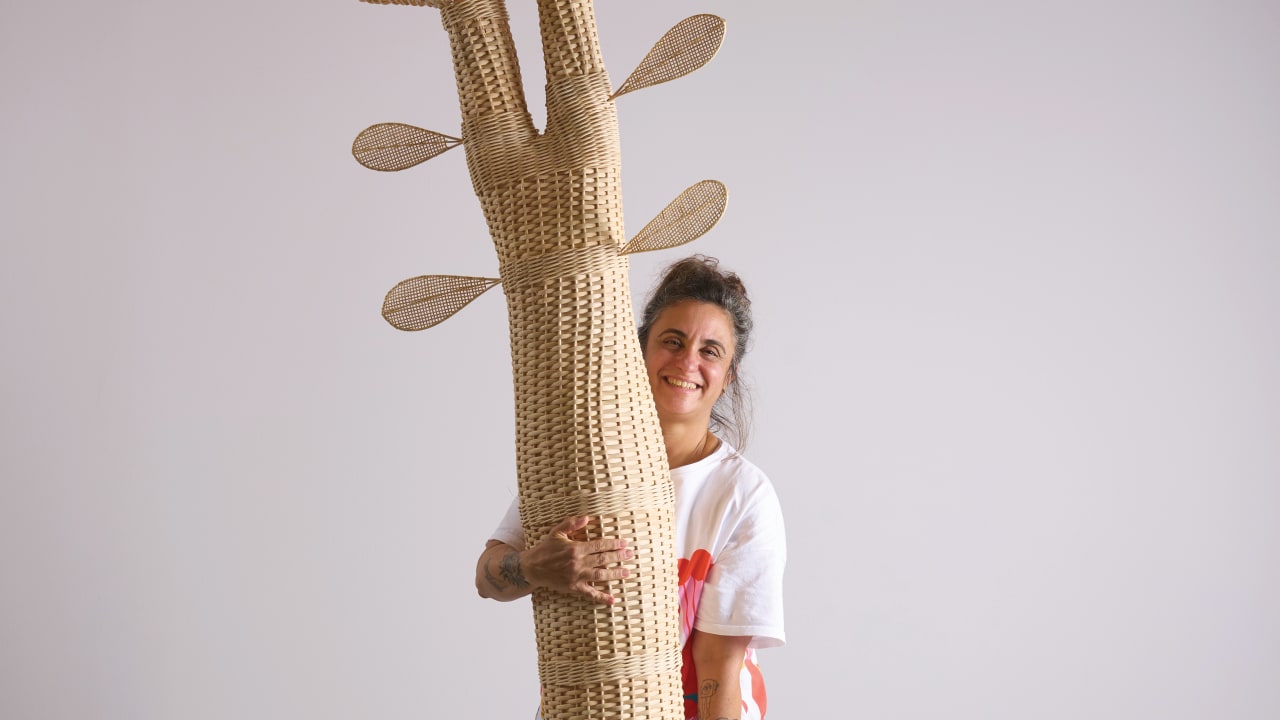
The identity of an immigrant, a female, and her passion for nature have driven her to create the current exhibition Field Work at the Ramat Gan Museum of Israeli Art.
Katz-Minerbo, together with five assistants, worked on it for over a year, creating a life-size botanical garden, a multi-layered installation entirely handwoven using a traditional rattan braiding technique. “It’s the biggest handmade installation of rattan in Israel,” she said.
She connected it to the story of female pioneers: “It’s a story of the Second Aliyah. I invented plants and gave them names of women pioneers. Many visitors find the names of their families and tell me new stories. This is a connection I didn’t expect,” she said.
Inspiration: “First of all, I feel inspired after a good night’s sleep.
“I am inspired by craft and craftsmanship in a very bizarre way. I need to try a certain craft when I see it, and then I dig and study it. Then I practice until I master it.
“After Oct. 7, I haven’t slept properly, and the definition of inspiration changed completely. I have been questioning art and making art during times of war. Then... it became more like a drive that pushes me toward an idea or an issue that bothers me or has something unresolved.
“Other issues that keep me busy are gender and nature.”
Meaning of art: “Art, for me, is the act of asking questions and giving unexpected answers. Never functional but always changing the way of seeing things, and giving an alternative to an issue that looks unsolvable.
“The work of art has to have (1) a real question – even if it’s not clear to the viewer, it must be clear to the artist; (2) a real feeling as part of the process and the making of the artwork; and (3) sincerity, even if it means being vulnerable.”
Katz-Minerbo’s art: “My art deals with color. I grew up in South America, Venezuela, a place rich in color that affected the way I see the world and create my art. I think this is the strongest influence on my work and what makes it unique.
“Although I am a painter, through academic and medium research I approach painting as a wide idea, always stretching its limits in form and medium and breaking its conceptual boundaries through enigmatic installations. I create paradigmatic and encoded artistic events filled with recognizable imagery, together with a sense of secrecy or a hidden statement.
“There are two questions that I always ask, and the answers differ every time: What is your nature? Where is your garden? The question of identity, and of location – physical or spiritual.
“A garden can be defined in endless ways, connecting its variations through sincere self-expression and self-made geography, a garden that can be shared.”
https://www.mkminerbo.com

Lilith Chambon
Lilith Chambon, born in Ramat Hasharon in 1969, has been based in Tel Aviv for 30 years. She is a painter with a background in textile design, having studied it at Shenkar College (1991-1994).
For many years, she worked in the film industry as a costume designer; she also designed a line of children’s textiles, which included bedding and toys. In 2007, she developed a television series that integrated textiles and animation, which was showcased at the MIP content festival in Cannes, France.
From 2010 to 2013, Chambon studied figurative painting at the Hatahana school in Tel Aviv. She paints traditionally with oil paint, oscillating between figurative and abstract art.
Her trademark colors are vibrant and intense. Chambon told the Magazine that she draws inspiration from the masters of European modernism while creating her own contemporary visual language.
During the interview, she also spoke about her creative process: “I spread the canvas flat on the table; only at the end, I lift it and see the whole painting. Order is important – it emphasizes color and form, creates gradations of shadows.” She added that this offers, for example, a chance to see light “like glowing screens in the darkness of night.”
She has had two solo shows and participated in several group exhibitions in museums and art institutions throughout Israel.
In her latest exhibition, In the Dead of Night, which opened on October 23 at the Litvak Contemporary Gallery in south Tel Aviv, Chambon presents paintings depicting women in quiet, domestic spaces, immersed in an introspection that echoes in the landscapes. Her figures – self-reflective and meditative – embody peace and presence, inviting viewers to a moment of suspension between the inner and outer worlds.
Her works combine spirituality and sensuality. Through her paintings, Chambon aims to invite viewers “to abandon the need for meaning, to participate in the comfort of being – a rare luxury these days.”
Inspiration: “Color and light are my inspiration. Color cannot exist without light. A subtle change in the angle of light changes the color; therefore, they are inherently connected.
“Color inspires me on two levels. On the material level: pigments. I work with pigment powders and mix them in my studio with linseed oil; and I also add pigments to existing paint pastes. Preparing the color myself activates me and sets me in motion – this is the earthly side of inspiration.
“The experience of having my worktable serve as an experimental lab enriches the act of painting; it turns it into a total experience.
“When color becomes hue (it connects to the act of painting itself, and the richness of shades), it stirs me into action.
“I am also inspired by seeing art and paintings in museums and galleries, both in Israel and around the world, as well as in the digital space.”
Meaning of art: “Art offers a different order to reality – emotional, sensory, and symbolic.
“It is a possible point of view for the one who created the work. Therefore, every act of creation – whether in painting or in other media – is a work of art. Some works are more unique or more intriguing, but an artwork can come into being at any age and in any place.
“Cultural influences are also fascinating elements within the creative process, as is, of course, the artist’s surrounding environment.
“An artist is someone who is committed to their creation and is not bound by limitations.”
Chambon’s art: “What distinguishes my work is the fact that it is mine – I am present within it, often depicted in it.
“Another defining aspect is my treatment of color. The luminous color fields and the figures together create rhythmic compositions that are characteristic of my paintings.”
https://www.instagram.com/lilith_chambon/?hl=en