As we move from year to year and reflect on the significance of experiencing Rosh Hashanah 5786 during these difficult times for the Jewish people, I spoke with Israeli artists who, despite the current circumstances, continue to create in Israel and abroad.
By so doing, they transcend the boundaries of various artistic disciplines and draw inspiration from their professional experience and education. In their hands, the visual arts undergo a creative process similar to that in other fields.
This month, the 20th since the beginning of my “Three Artists, Three Questions” journey, I have selected artists who have moved to the visual arts, from fashion and jewelry, classical music, photography, and film. Their new exhibitions are currently on view in Jerusalem and Tel Aviv.
Three Israeli artists answered my three questions:
What inspires you?
What do you call art?
What, in your opinion, makes your artwork different from that of other artists?
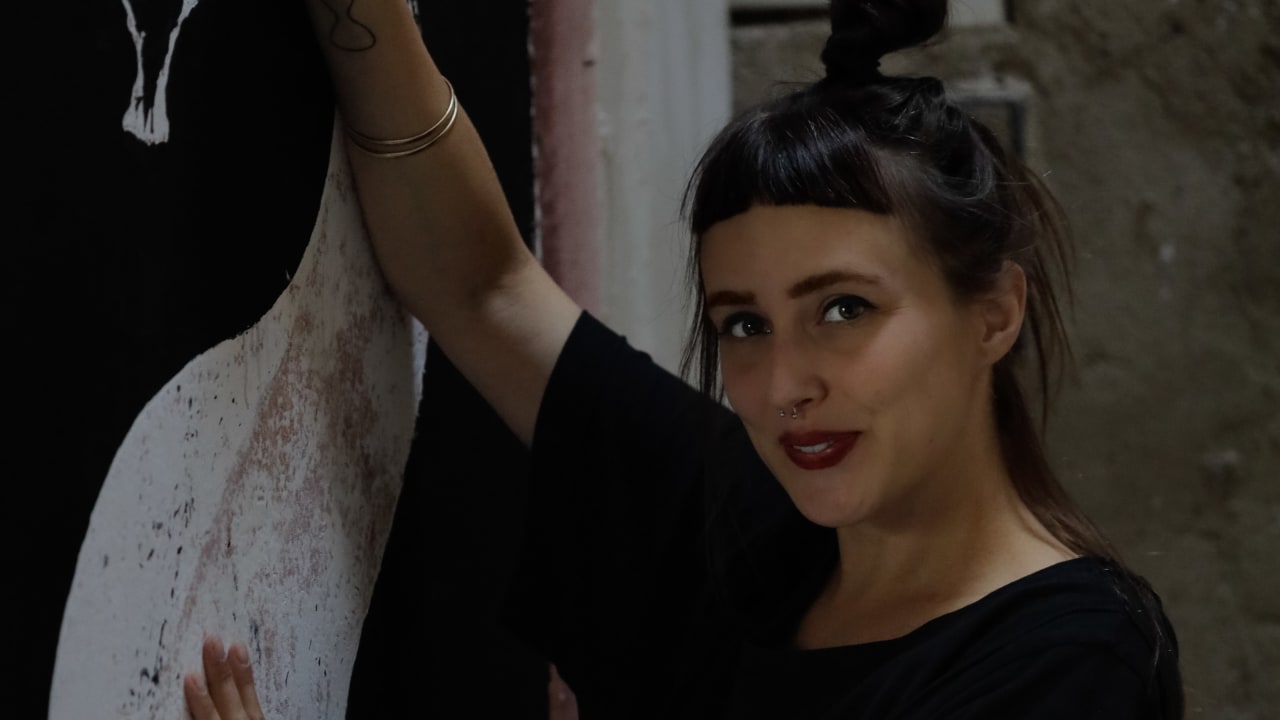
Katrin Tolkovsky
Katrin Tolkovsky was born in Jerusalem in 1991 to a family with Czech-Israeli traditions. As a child, Tolkovsky spent considerable time in the Czech Republic, her mother’s native country. That, she said, was crucial to her development and sensibility. Currently, she is based in Tel Aviv.
Tolkovsky is an artist and filmmaker with a classical music education (flute). After graduating from the Rubin High School of Music and Dance in Jerusalem (2009), she attended music master classes in Prague. While studying there, she understood that although she loved music, she didn’t want to dedicate her entire life to a musical career.
“I wanted to create something with my own hands,” she said.
At 19, she returned to Israel, where she continued her musical education; however, she also decided to study at the Bezalel Academy of Arts and Design in Jerusalem, where she earned a BFA from the Department of Screen Arts (2014) and an MFA from the Department of Fine Arts (2022).
Tolkovsky works interdisciplinarily; she composes music for films and documentaries, works as a cinematographer and editor, and creates visual art. She works with plaster and water-based pigments on canvas. “I create layers of material, which I then engrave,” she said.
On September 18, Tolkovsky opened her solo exhibition Sand & Grace at the Braveman Gallery in Tel Aviv, which includes examples of this technique. Looking at her works, with that specific technique, they seemed reminiscent of antique wall paintings, discovered after thousands of years.
Inspiration: “The unpredictability is what keeps me engaged. It allows me to surprise myself and discover new forms that feel honest and unforced.
“I also draw deeply from my personal life. My family, my greatest love and constant support, is a major source of inspiration. I grew up in a creative home, surrounded by music, art, and nature. That environment shaped how I view the world and how I express myself. Nature, in particular, has always been a wellspring of my inspiration.
“My background in classical music also influences my work. I spent years practicing musical pieces, repeating phrases over and over until they finally felt right. That same rhythm, that repetition, exists in my creative process today.
“There’s always a search for harmony, for a sense of ‘rightness’ that only comes after much struggle and refinement. That discipline has stayed with me, and I carry it into everything I create.”
Meaning of art: “To me, art is anything that communicates a deep emotional truth. It’s not about perfection or aesthetics; it’s about authenticity.
“Art is also a language, a way of telling stories when words fall short. It’s how we express what’s happening inside us and how we connect with the world around us. Like music, it has its own tone and rhythm. It doesn’t need to explain itself; it just needs to feel real.”
Tolkovsky’s art: “What sets my work apart is the personal narrative that runs through it, combined with the specific techniques and materials that I use.
“One example is my use of sgraffito, a traditional technique that I’ve adapted for canvas using a method I developed myself. This approach allows for layered storytelling.
“But technique is only part of it. Much of what makes my work unique comes from my background. I grew up in Israel, but every summer I spent time in a small Czech village, in a farmhouse my parents restored. That place, with its crumbling facades and simple beauty, shaped me in ways I understood only later. My closest friends there were Roma children, and the world we shared, both joy and fragility, left a lasting impression on me.
“That duality (the sense of brokenness and celebration) still informs my work. The textures, the surfaces, the hidden stories behind weathered walls – they’re all reflections of that early experience.
“At the same time, my life in Israel contributes just as much. The desert’s soft, faded colors – its sun-bleached light and earthy tones – are present in my palette. Something is grounded in those colors. They feel like home.
“Right now, as Israel goes through such a painful period, I find myself holding on to the memories of the beautiful country I knew as a child. That nostalgia feeds my work and keeps me rooted.”
www.kattolkovsky.com
Yana Rotner
A visual artist and photographer, Yana Rotner was born in Bender, Moldova, in 1988 and moved to Israel with her family two years later. She lives and works in Tel Aviv.
She has a BA from the Department of Photography at the Bezalel Academy of Arts and Design in Jerusalem, and an MA from the Interdisciplinary Art Program at Tel Aviv University. She is currently a PhD candidate in philosophy, art, and critical thought at the European Graduate School.
Her work is included in the collections of the Tel Aviv Museum of Art and the Museum for Islamic Art in Jerusalem, as well as in private collections in Israel, Europe, and the US.
Rotner has participated in numerous exhibitions. She recently presented her solo exhibition, Lumière (the exhibition’s title alludes to Jeanne Moreau’s 1976 film of the same name), at the Alon Segev Gallery in Tel Aviv, where she presented a series of color portraits capturing “the invisible.”
“I film not the moment but the moment before – or after. The stillness between frames,” she explained.

Rotner creates intimate, captivating photographs through her unique working method. Her creative process involves filming short sequences with a 16mm camera, which she then develops, selects images cut from the film, and prints them on paper. She takes an image that can be walked around, capturing a continuous sequence of images that reflects the passage of time.
Rotner works in the darkroom, creating photograms (photographic images without a camera) using transparent fabrics and cut-out papers. She then builds a composition based on these images, which she then exposes to light-sensitive photographic paper, generating unique images.
In her exhibition Spoons, which opened September 18 at Jerusalem’s Oman Gallery – Center for Art and Design for the Haredi Community, Rotner (alongside sculptural assemblages by Ilay Tzror) presents portraits of figures from the art world, which include a poet, a dancer, and a photographer.
Inspiration: “André Malraux, the French culture minister in the 1960s and author of The Imaginary Museum, wrote that art is inspired by ‘fragments of the nobility of the past.’ This idea deeply resonates with my approach to research and subject matter.
“I am drawn to objects emerging from history, as well as to personalities who are, as my teacher, philosopher Jean-Luc Nancy, described, ‘mysterious and hidden.’”
Meaning of art: “Robert Rauschenberg famously said, ‘Art is taking something and turning it into something else.’ I feel very connected to this definition because of its openness. Art cannot, and should not, be strictly defined – you recognize it when you see it.
“For example, in my latest exhibition, Lumière, I attempted to create portraits of female artists that reveal previously unseen aspects of their personalities. The subjects discovered this unseen part of themselves, and so did I.”
Rotner’s art: ”[German-Jewish philosopher] Walter Benjamin suggested that one can distinguish photographers by their unique use of the essential elements of photography: light and time. My personal technique involves filming brief sequences with a 16mm Bolex film camera, then selecting frames that capture the flow of time – those fleeting moments that memory often fails to record. These are the elements I rely on when looking at the work of other photographers.
“For instance, Hiroshi Sugimoto manipulates time by exposing an entire film to light, so only immobile objects remain visible. Liz Deschenes creates camera-less photographs, using light and chemicals to capture the remnants of the moonlight. Sally Mann uses a large-format camera with specially designed lenses.”
yanarotner.com
Mirit Weinstock
Mirit Weinstock, born in Haifa in 1977, spent her teenage years in Zichron Ya’acov. After completing her military service, she moved to Tel Aviv, then Tokyo, and recently settled in Paris.
Weinstock is a jewelry designer with a background in fashion, as well as a visual artist working in various media, with a focus on ikebana (the Japanese art of flower arrangement) and floral art. She has a BA in fashion from Shenkar College (2002) and an MA from the Bezalel Academy of Arts and Design (2013). She completed internships at Alexander McQueen in London and Maison Lanvin in Paris, specializing in haute couture and its connections to crafts.
Weinstock founded her own fashion label in her early twenties and a jewelry brand in her early thirties. “In 2010, I launched it at Colette [a well-known concept store] in Paris; it was a milestone in my career,” she said.
Her desire to create visual art stemmed from her earlier interests and already successful career; in the past decade, she shifted her focus to Japanese-inspired art.

During several business trips to Japan, she discovered the local art traditions, ultimately deciding to explore them in depth.
“I wanted to be present in the experience of learning about Japanese art,” she said, explaining how she perceives the approach to art-making in Japan differently compared to the Western world.
“In Japan, everything starts with the material and tradition; unlike Western art, where artists want to express an idea or a political thought. [In Japan] you first master the technique, and then express yourself through the material.”
For the last six years, she has been studying Japanese art, crafts, and ikebana-style flower arrangement at the source. She also practices ceramics and washi, the Japanese paper art.
The influence of her time in Japan is evident in her current works, which appear very precise and delicate, and exude a sense of calmness.
She works with various organic materials, paper, porcelain, and metal. She also uses tools familiar from her jewelry work. “For example, electrophoresis, a method used with various metals and wax,” she said.
Weinstock has exhibited in Israel and abroad. In January 2025, she presented her first solo museum exhibition, My Life in Flowers, at the Eretz Israel Museum. Currently, her collection of works, Never Is a Long Time, is on display at the Chelouche Gallery in Tel Aviv.
Inspiration: ”Since I discovered ikebana, the Japanese art of flower arrangement, I began practicing it at Ikenobo, the most traditional and historic ikebana school in Japan. It has become one of my deepest sources of inspiration.
“Ikebana is not only the beauty of the arrangements but also the philosophy it embodies. It teaches presence in the moment, the value of simplicity, and the ability to reveal the essence of things in a distilled and meaningful way. The idea of ‘the space in between’ – the balance between form and emptiness – resonates deeply with me, both as an artist and as a person.
“Through ikebana, I learned to look at materials differently, to appreciate the quiet power of minimalism, and to seek harmony in contrasts.”
Meaning of art: “Art, for me, is a process, a gesture of making the invisible visible. It is the act of creating a form or an object that folds emotions, symbolism, questions, and beauty. I am deeply moved by the work of many artists and feel blessed to have the opportunity to create and find my own voice within the field of art.
“For me, art is also about diving ever deeper. It is a forum that constantly reminds me of the beauty in simplicity, the value of traditions, the resonance of history, and the infinite ways in which we can express the human spirit.”
Weinstock’s art: “What makes my work different is its intimacy. My art is deeply personal, often revealing intimate moments from my life that resonate with nature.
“Through ikebana, I discovered not only the magical beauty of flowers but also the profound symbolic role they play in human life. As Kakuzo Okakura beautifully wrote in The Book of Tea: ‘In joy or sadness, flowers are our constant friends. We eat, drink, sing, dance, and flirt with them.’
“My visual art, craft, and jewelry design live in the space between tradition and contemporaneity, weaving Japanese and Western inspirations.”
miritweinstock.com