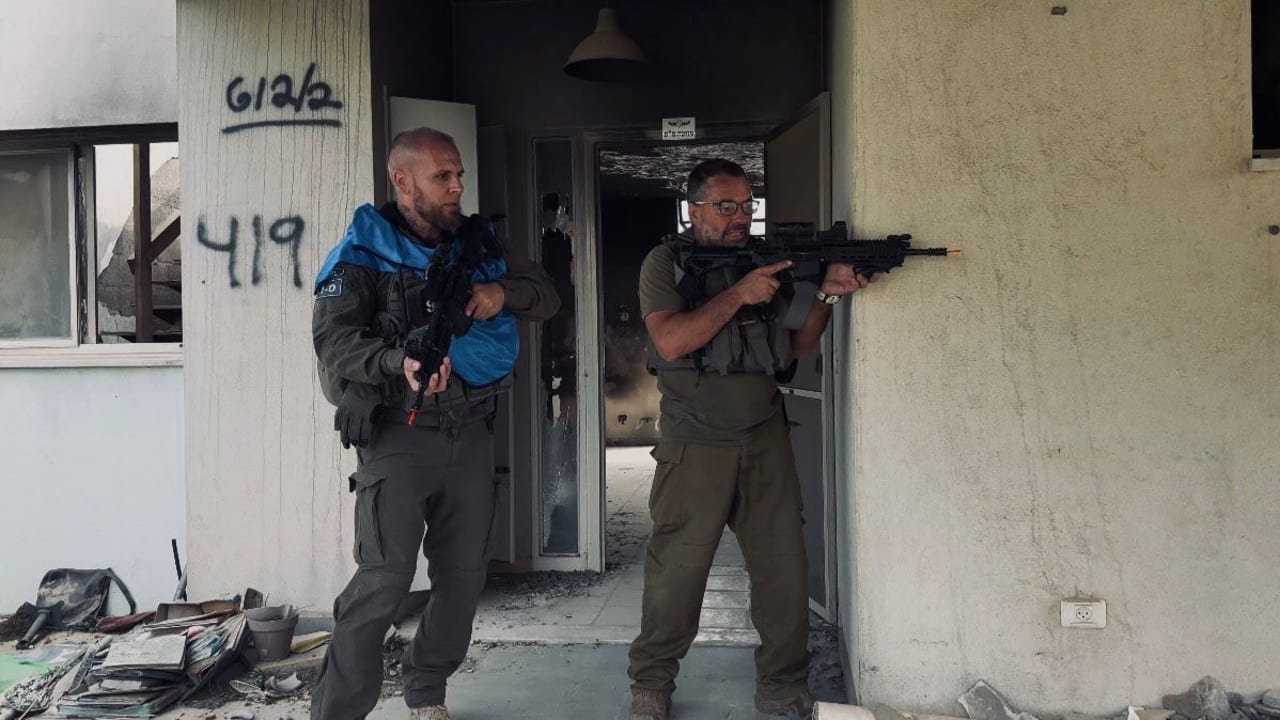
Magen 48 held an advanced training exercise for local civilian security teams in Kibbutz Be’eri days before Passover, using the still-burned homes of one of the communities hardest hit on October 7, 2023, as the setting for scenario-based drills meant to prepare responders for a future attack.
Public material from the organization identifies Magen 48 as a civilian first-response training initiative co-founded by Ehud Dribben and Ari Briggs.
The exercise brought together heads of local security teams from southern Israel, many of them survivors of the Hamas-led massacre who had fought to defend their communities during the attack.
According to Magen 48, this was the first time such training had been conducted inside the devastated neighborhoods of Be’eri itself, turning the remains of the kibbutz into a live training ground and a stark reminder of the failures and heroism of that day.
Among those leading the effort was Dribben, a counterterrorism trainer with decades of experience, who said he founded Magen 48 after concluding that trained civilian teams often made the difference between communities that held out and those that were overrun.
Magen 48 says its mission is to ensure that Israeli communities are ready to defend themselves until army forces arrive. That goal echoes the language the group has used publicly in describing its work since launching after the war.
'Communities must be able to hold the line until help arrives'
On October 7, Dribben said, he drove south with fellow fighters without waiting to be called up, then spent more than 100 days engaged in combat against Hamas and Palestinian Islamic Jihad terrorists. In the aftermath, he and his partners turned that experience into a structured training framework for local first responders.
“Communities must be able to hold the line until help arrives,” Briggs said in a statement released around the Be’eri training.
That idea has been central to Magen 48’s public messaging. The organization says it currently trains civilian first-response teams across 67 frontline communities in the Gaza border region and has trained more than 1,500 civilians in life-saving defense tactics. On its website, it also says it has carried out more than 400 training sessions and is working to establish a national training campus for civilian readiness.
Previous reporting on the initiative said Magen 48 was created after its founders concluded that Israel lacked a uniform, professional system for preparing civilian security squads in vulnerable communities.
A March 2025 report in The Times of Israel said the group worked in coordination with the IDF and local security officials, and that exercises included live-fire simulations, smoke, hostage scenarios, and tailored defense planning for specific communities.
The same report said the training model drew on lessons from Kibbutz Erez, whose local team had undergone extensive preparation before October 7 and later helped repel terrorists.
Magen 48 has argued that this kind of preparation does more than improve tactical response. It also helps restore enough confidence for evacuated families to return home.
That message carried special weight in Be’eri, where the physical scars of October 7 remain visible. Training inside the burned-out homes was intended to sharpen operational readiness, but also to make clear what is at stake for communities along Israel’s borders.