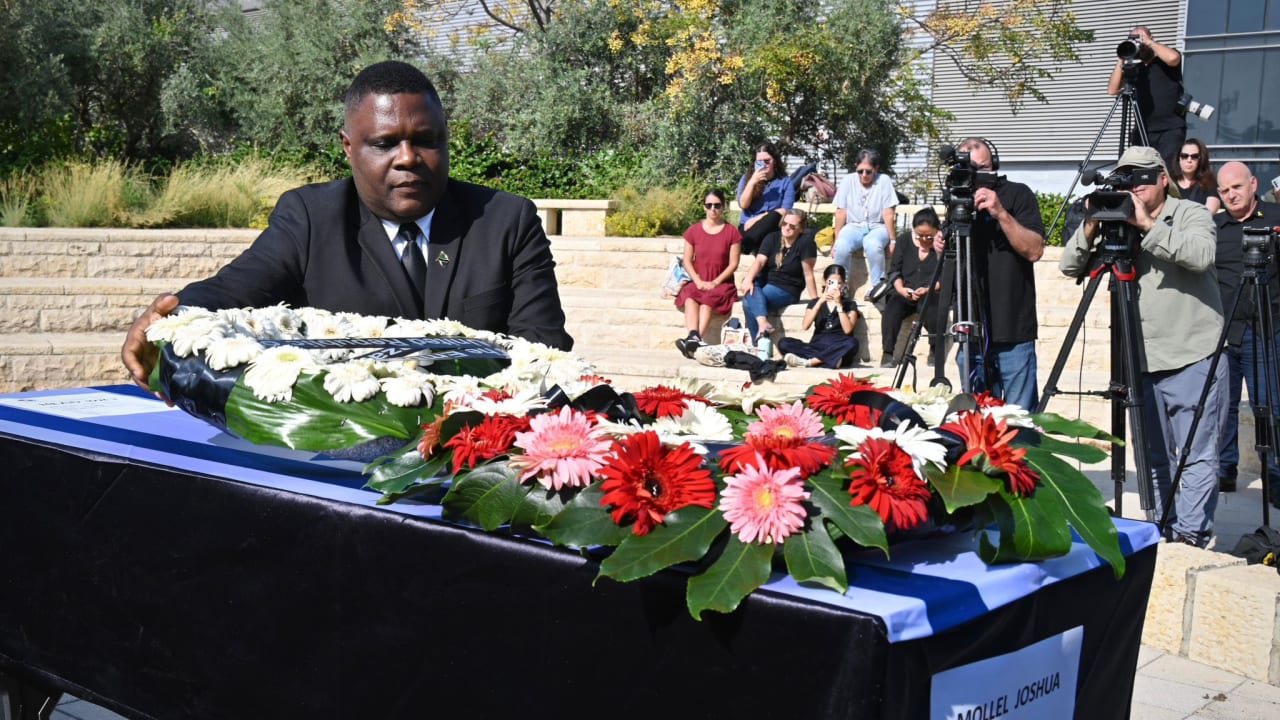
Tanzanian and Israeli officials and civilians bid farewell to slain Tanzanian agricultural student Joshua Loitu Mollel in a ceremony at Ben-Gurion Airport on Tuesday morning, marking the end of a two-year effort to recover his remains from Gaza, following the October 7 Hamas attacks.
The ceremony – live-streamed to his family and community in Tanzania – drew dozens of his fellow students from the Agrostudies agricultural internship program, as well as the senior officials who oversee the initiative.
Mollel, 21, arrived in Israel on September 19, 2023, as part of the long-running MASHAV program that brings students from developing countries to Israeli farms for hands-on training. He was murdered less than three weeks later at Kibbutz Nahal Oz, where he had been assigned to the dairy farm.
Deputy Foreign Minister Sharren Haskel, Tanzanian Ambassador Alex Gabriel Kalua, and Agrostudies founder Yaron Tamir all offered condolences and tributes. Then, Mollel’s coffin, draped in wreaths, was carried onto the plane that would take him home for burial.
Haskel spoke with visible emotion, emphasizing that Mollel’s murder underscored the brutality of the October 7 attacks.

“This man wasn’t Jewish. This man wasn’t Israeli. This man was a human being who happened to be working in Israel on October 7,” she said. “The jihadists murdered him anyway. That is the level of barbarity we are talking about.”
Haskel noted that Israel fought to recover his body, just as it would for an Israeli citizen. “We did not treat his tragedy as a Tanzanian tragedy, but as an Israeli one. We fought to bring him home; we paid the heavy price for his return.” She added that his loss now binds the two nations, “not only in grief, but in commitment – a commitment to remember him and to stand together against terror.”
Ambassador Kalua, speaking on behalf of the Tanzanian government, described the ceremony as the culmination of an agonizing wait. “After 761 days of long waiting, we are relieved that finally he has been returned… to be taken home for a dignified burial,” he told The Jerusalem Post before sharing remarks with attendees.
Kalua said he remembered Mollel as a young man “full of hope and ambition,” whose first trip abroad became, tragically, his last.
“His loss is devastating and deeply felt not only by his family, but also by the government and the people of Tanzania,” the ambassador said. He expressed Tanzania’s gratitude to Israel for its “relentless efforts… to secure the release and return of all hostages, including Joshua.”
Wreaths laid upon Mollel's coffin, and Israeli, Tanzanian anthems played
The ceremony included the playing of the Tanzanian and Israeli national anthems, followed by the laying of ceremonial wreaths atop the coffin.
MOLLEL’S FELLOW Tanzanian student, Kelvin Danstan, 26, from Dar es Salaam, arrived in Israel just a week before the October 7 massacre and was stationed in Sderot.
Danstan told the Post that the return of his friend’s body offered at least one measure of comfort. “In our country, we have a culture of burying a body – not a cloth, not anything else,” he explained. “This is a valuable thing we have gained: that his body was found and can return home.”
He emphasized that proper burial was important in his country and that there was cultural significance to it. Still, he described the moment as “deeply painful,” noting that both men arrived with dreams and ambitions that Mollel would never realize.
“When we came here, we had ambitions and dreams. It is painful that our friend never reached any of them,” he said. Danstan emphasized his gratitude to the Prime Minister’s Office and those involved in bringing Mollel’s body home, noting that most of the logistics of negotiating his friend’s return for burial had happened behind closed doors.
Josh Lawson, who represented families of foreign hostages at the Prime Minister’s Office, reflected on Israel’s moral obligation toward foreign nationals caught in the attacks.
Citing Rabbi Jonathan Sacks, Lawson said, “The commandment concerning the foreigner appears 36 times in the Bible – more than any other. It demands empathy toward someone who is not like us… someone utterly alone.”
Lawson recounted accompanying Mollel’s father during a visit to Nahal Oz in December 2023. “With tears in our eyes, we watched his father light a candle and gather soil from the scorched earth of Nahal Oz, where his son fell,” he said.
He added that the teams handling foreign national cases made a vow that day: “We promised never to stop searching for Joshua, never to stop speaking his name… and never, never give up hope for his return.”
Mollel was remembered by speakers and fellow students for his warmth, gentle nature, and the constant smile that made him beloved among his peers.
During the ceremony, Ambassador Eynat Shlein, director of MASHAV, announced that a new program would be established in Mollel’s honor at his home university in Tanzania, designed to expand opportunities for agricultural students like him. The initiative, she said, would ensure that his dream of contributing to his country’s agricultural development would continue through others.
As the plane prepared for departure, officials, students, and colleagues stood together in silence – Israelis and Tanzanians, united in grief – to send Joshua Loitu Mollel on his final journey home.