For most Israelis in their 60s and 70s, the words “Anu banu artza livnot u’lehibanot ba” elicit memories of the 1930s song, popularized decades later by the Gevatron kibbutz folk singers.
The words mean “We have come to this land to build it and to be built by it.” Written by Menashe Ravina, the single-stanza song expresses the pioneering Zionist spirit – that by working to build the Land of Israel, the builders themselves can be renewed and transformed.
In the past year, an organization has sprung up that is dedicated to the premise that retired Israelis have the know-how, desire, and ability to help improve cities and towns in Israel’s periphery and, in doing so, can renew themselves. Its name, not coincidentally, is Anubanu.
The brainchild of 72-year-old Izhak Eshchar, former head of the Education Department in Beit She’an, Anubanu is a volunteer program in which retired Israelis spend a year in development towns, lending their experience and expertise in education, psychology, social work, business, and other disciplines.
“The idea behind the initiative,” explains Eshchar, “is how to fully realize and properly utilize the potential of retirees in Israel so that they become an asset to society, not a burden.”

After he retired, Eshchar began to explore the full meaning of retirement. “One of the interesting things I discovered,” he says, “was the differences between retirement in Israel as opposed to many Western countries.
“In Israel, people who retire are immediately defined as retirees or pensioners, and they remain in that category until the end of their life. Society and the state view the pensioner as someone who, essentially, shouldn’t disturb ‘us.’ ‘If you need help, we’ll assist you – to deal with loneliness, finances, and healthcare.’ That’s the approach in Israel.”
By contrast, in Europe or the United States, he avers, there is a distinction drawn between the retirement age, sometimes called the “third age,” and extreme old age, known as the “fourth age.” “The third age is not chronological but functional – it can begin at different points,” says Eshchar.
“We had a request from a 49-year-old woman who wanted to join Anubanu, who said she had had enough of the working world; and we also had a request from a 106-year-old man, a watchmaker, who was still functioning independently. Both fall under the definition of the third age. The fourth age begins the moment you become dependent on others.”
Eshchar decided to try to bring about change among Israel’s retirees – not by changing state policy but by acting at the grassroots level. “I began to develop programs, the essence of which was to turn pensioners into contributors, not only for themselves but for society. That’s how it began.”
The idea behind the Anubanu initiative, he explains, is for retirees to live in and become part of communities in Israel’s geographic and social periphery for one to two years while giving of their talents.
In the winter of 2022, Eshchar and his compatriots – Efrat Noy (Lod), Alex Gliksberg (Yeroham), Reut Getz (Acre), Gila and Avi Robinson (Haifa), and Maoziah Segal (Tel Aviv) – founded Anubanu. The group planned to open the organization’s initial programs in Lod and Acre on October 8, 2023.
Needless to say, the outbreak of the war forced the group to pause its efforts. Some months later, Eshchar and the other members of the group decided to restart the initiative in the Negev town of Arad. Through the efforts of Yeroham resident Gliksberg, the municipality agreed to provide housing free of charge to the group’s members.
Participants in the Anubanu program receive free housing but are responsible for all other expenses. They are expected to work a minimum of 20 hours per week in the development towns where they live.
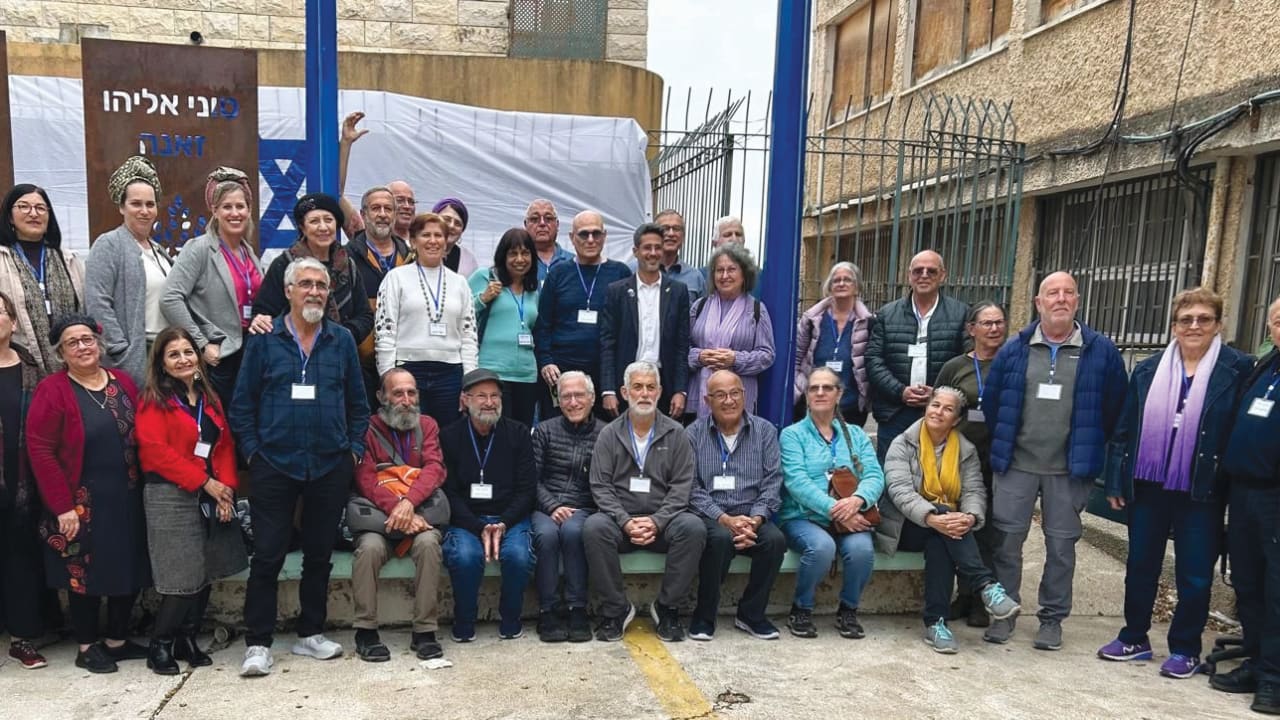
The initial core group of six families arrived in Arad on December 1, 2024. The volunteers are active in formal and informal education across all age groups, in social services, and in economic development. Today, the Anubanu group in Arad numbers 18 people, which include both religious and secular Jews.
Says Eshchar, “The volunteers in Arad are deeply involved in both formal and informal education. Those working in education volunteer within schools or through the community center (matnas) in the informal education framework.
“Some are engaged in various aspects of the social welfare field: There are volunteers at a factory that employs people with disabilities; they work at the early childhood center, at the day center for the elderly, and at a youth village located within the Arad Municipality.”
PROF. TAMAR BROSH was the head of the department of oral biology at the Goldschleger School of Dental Medicine at Tel Aviv University, and headed the school’s Dental Biomechanics Laboratory. She retired from the university in 2024 but felt that she could still contribute to the country’s betterment.
Over breakfast one morning in her Ramat Gan home, Brosh read a news item in Yediot Aharonot that described Anubanu. She interviewed for the program, was accepted, and arrived in Arad in December 2024.
Brosh volunteered at the ORT high school in Arad, tutored students in math, and helped them prepare for the matriculation exams (bagrut) in math. She worked alongside the teachers in the classroom, and tutored students one-on-one and in small groups, arriving in Arad from her Ramat Gan home on Mondays and returning to Ramat Gan on Thursdays.
“After I retired, I felt that I could still contribute more to the country, to those in need,” she says, adding that she loves the desert.
“They call me Tami,” says Brosh, who makes no mention of her extensive and successful career to the students. “They very much appreciate what we are doing there, and if I managed to help a few students pass their math matriculation exams, then I know I succeeded.”
Brosh tutored students usually between six and seven hours per day. In addition, she participated in a project that connects ORT schools with Russian-speaking Holocaust survivors in Arad, and performs with students in the school orchestra. The first year will end this December, and she will return for a six-month stint until the end of July.
“The city is wonderful – I love it: its quiet, its air, and the residents,” she says. “I’m very happy with our community of volunteers – we’re a mixed group, about 50% secular and 50% from the National-Religious sector. I felt I still had strength in me – not just to look for a lecture here or there or go out for coffee with friends. I thought I still had a few good years to give back to society and to my surroundings, and when I saw this opportunity it felt like a perfect fit.”
Adds Gliksberg, “The participants themselves believe that diversity is one of the most meaningful aspects of the initiative, reflecting a sense of unity that emerged in Israeli society as a result of the war. They’re very pleased with this dynamic.”
Meir Rosentzvaig and his wife, Ayala, also found the year that they spent with Anubanu in Arad to be a perfect fit. Hailing from Rehovot, Meir was a Torah educator and homeroom teacher in Yeshivat Hadarom for over 30 years, and taught Talmud, literature, and Hebrew language. Ayala was a veteran math teacher at Ulpanat Baharan, a religious girls’ high school in Gedera.
When the couple learned about Anubanu, they decided to offer their educational skills to the program. The Rosentzvaigs arrived in December 2024. “My idea was to go to something that was familiar to me – education,” says Meir.
Meir was assigned to the Tlalim religious state school in Arad and assisted the homeroom teacher for seventh- and eighth-grade students. He worked with students who needed additional assistance, not only bolstering students’ mastery of the subject matter but also helping to motivate them. Ayala worked at the girls’ high school in Arad and tutored students in math.
Beyond his formal classroom activities, Meir worked one day a week with immigrants from Ethiopia in the Falash Mura community who had made aliyah, helping them improve their Hebrew and preparing them for conversion. He reports that all three of the students successfully completed their requirements for conversion and are now fully recognized as Jewish by the state.
The Rosentzvaigs spent Mondays through Wednesdays in Arad before returning to their home in Rehovot for the weekends.
While Meir and his wife reveled in their contributions to the youth of Arad, another factor made the project successful – the weekly meetings held with Anubanu volunteers.
“The group spanned the entire social spectrum in Israel – religious, secular, right-wing, and left-wing,” says Rosentzvaig. “We all became friends. After three or four meetings, a beautiful openness developed among us,” he says. The group shared a common denominator: a desire to help people in the community. This shared interest bridged whatever gaps existed between them, he says.
Rosentzvaig wholeheartedly recommends the program for retirees. “In terms of giving, I really enjoyed it. I felt I was contributing, and the principal and the homeroom teacher agreed. If you come with a genuine desire to contribute and add your know-how, of course you can. Bless God, we saw results.”

ESHCHAR SAYS that a second Anubanu group was established in Kiryat Shmona, which opened in September. Like the group in Arad, the participants are composed of religious and secular Jews. There is a shortage of teachers, social workers, and educational psychologists in Kiryat Shmona, and Eshchar and his wife have joined that group.
Tamar Gidron, 65, from Givat Ela, a community settlement in the Jezreel Valley, worked in the Education Ministry and served as a principal in schools in the North for 15 years. She retired five years ago; but when she learned about Anubanu on social media, she applied to join the Anubanu program in Kiryat Shmona.
“Throughout the war we wanted to help, but we didn’t know what we could do to make an impact,” says Gidron.
She moved to Kiryat Shmona with her husband in August and provides pedagogical guidance to teaching aides, who include Sherut Leumi volunteers, IDF educational instructors, and others, helping them integrate within the schools in the city. In addition, she is active in developing the municipal cultural enrichment program.
Discussing her work in Kiryat Shmona, she says, “It’s fascinating – there are days when I come home happy, and there are days that are very frustrating. It’s about getting to know systems that operate differently. I come from the educational system – I’ve been in it for 30 years – and I thought I knew everything. It turns out it’s not the same in a regional council as it is in a city. Kiryat Shmona has its own unique character, which I’m still learning. So, on the one hand, it’s truly fascinating, and I meet wonderful people. On the other hand, it’s also frustrating sometimes. But that’s part of educational work – it is always full of ups and downs like that.”
Gidron says that programs such as Anubanu are important because they show that retirees who still have a great deal of energy and experience can make a valuable contribution to society.
The program adds meaning to her life, she points out, and she says that the volunteers in the program make up the fabric of Israeli society. They include religious, secular, kibbutzniks, and city dwellers, those aligned with Israel’s political Left, as well as those aligned with the Right. “We have a joint language,” she says.
New Anubanu volunteer groups opened in Metula, Beit She’an, and Sderot after Sukkot, and the program will also open branches in Acre and Mitzpe Ramon. All told, within a few months there will be seven Anubanu branches operating in Israel, with 130 to 150 volunteers.
Eshchar notes that while Anubanu is the first organization that has developed volunteer programs for retirees to assist in the periphery, others have followed, such as Elul’s Shnat Sherut 50 Plu
“We hope that there will be more organizations that will allow National Service for retirees to utilize their knowledge and free time for the benefit of society,” he says.
What are the skill sets of the retirees who apply to join Anubanu? Says Eshchar, “There is a significant group of educators of all kinds – college directors, school principals, teachers, anyone connected to education, even early childhood educators, like kindergarten teachers. There is also a group of caregivers – social workers, psychologists, and various therapists. Beyond that, there are people from every possible field – scientists, those who built careers in economics, finance, and so on.”
He adds that applicants are assessed not only by their profession but also by their entrepreneurial spirit, their potential for growth, and their ability to enter different niches beyond teaching, engineering, or medicine.
Eshchar points out that integrating within the community is paramount. “It’s important to emphasize that our people are not coming to replace anyone in the local authority. We are coming to be alongside them, to assist. As has been said, it’s very important to us that the volunteers integrate into the community and truly become part of it.”
He notes that while the majority of participants in Anubanu have been native Israelis, there is ample room and a clear need for those with expertise in English. There is a great shortage of English instruction, both formal and informal, in Israel’s periphery, and there is a shortage of social workers in these areas.
“Since native English speakers – that is, those who grew up with English at home – are almost nonexistent here,” he says, “the population we are considering, namely English speakers who live in Israel, is a potential pool not only to contribute their skills but also because, in my view, a large percentage of them are socially conscious, idealistic, and already volunteering in any case. What we are doing is calling on them to take part in something different.”
Eshchar adds that Anubanu is already beginning to think about groups from abroad that would come to Israel for several months or even a year and integrate into such a project.
“Our ultimate goal,” he concludes, “is that the State of Israel will adopt this initiative and turn it into something universal, run through government ministries. Because, at the end of the day, we are just a group of volunteers working with a nonprofit organization.
“Every year, 85,000 people leave the workforce in Israel. If we manage to reach even 1% of that population to take part, I believe we will create a revolution in the way society relates to the senior generation.”
To learn more: www.facebook.com/share/1BDt3mXyZe/?mibextid=wwXIfr
Questionnaire for those who want to sign up: https://docs.google.com/forms/d/1FwQc7zKLPTCWGj0c2KmGs6ci0ufZ1gNNBYyfl6LeNuM/edit?usp=drive_link
Volunteer opportunities for retired olim in Israel
There are myriad opportunities for retirees to volunteer in Israel. A Google search for the phrase “volunteering in Israel for seniors” displays a wide range of websites and volunteering possibilities, ranging from volunteering on IDF bases in logistical roles, to accompanying and assisting Holocaust survivors, to packing food parcels for the needy.
There is even a Zoom-based program for tutoring Israeli adults in English.
Below is a listing – which is far from comprehensive – of websites of organizations seeking senior volunteers in Israel, as well as general volunteer organizations: