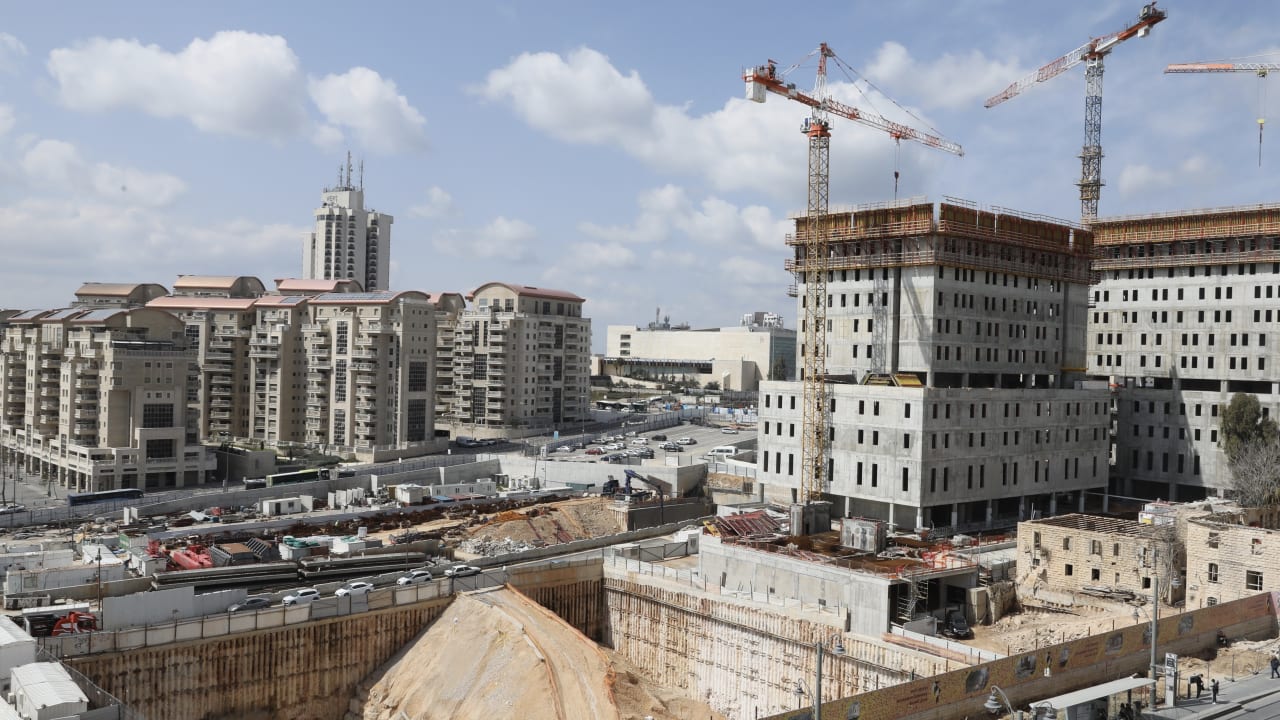

This Sunday, there was a major traffic change along Keren Hayesod as workmen dug up more road for light rail infrastructure and removed traffic lights from the corner of Ahad Ha’am Street. Construction work was still going on late at night; crossing the busy thoroughfare, with vehicles traveling in both directions without traffic lights, was terrifying.
Traffic lights had been previously removed from the King George Avenue extension of Keren Hayesod on two corners of Jaffa Road. Those crossing the road risk being hit by a light rail, bicycle, scooter, skateboard, or car. It is illegal for vehicles other than police cars and ambulances to ride on the light rail tracks, but that hasn’t stopped anyone.
Also on Sunday, light rail trains were very frequent – but so full that several would-be passengers remained on the platform. But that’s not really the worst of it.
Anyone suffering from claustrophobia should stay away from Keren Hayesod-King George for the foreseeable future. Areas with light rail work are fenced off, with construction sections completely boarded up on both sides, so pedestrians cannot see across the road. This leaves only a narrow strip of sidewalk, used not just by pedestrians but also by two- and four-wheeled vehicles.
The amount of rubble on the roads gives the impression that Jerusalem has been struck by a bomb. Imagine what this means to those evacuees still in the city. And what about tourists who have been sold a ton of spiritual and historic hype about the capital? Imagine their dismay.
It may all turn out to be beautiful and efficient in the long run, but in the short term it’s yet another example of a lack of preparedness and lack of consideration for the city’s residents.
World Zionist Congress
■ NONETHELESS, JERUSALEM’S tourism will be given a boost next week with an influx of delegates and observers from some 40 countries who will be attending the 39th World Zionist Congress organized by the World Zionist Organization, chaired by Yaakov Hagoel.
The Congress is composed of 525 delegates, of whom 38% are from Israel and the rest from Jewish Diaspora communities. The largest number of Diaspora delegates come from the US, which is represented by 152 delegates who collectively represent 20 organizations with diverse views.
Delegates from other countries will come from Canada, the UK, Australia, South Africa, France, Brazil, Italy, Hungary, Argentina, Mexico, and Chile.
Due to the war between Russia and Ukraine, elections for delegates from those countries could not be held, but presumably there will be Russian and Ukrainian observers in attendance.
Hebrew University on the Chords Bridge
■ IN CELEBRATION of its centenary year, the Hebrew University of Jerusalem (HUJI) illuminated the Chords Bridge at the entrance to the city with the university’s logo to herald the start of the new academic year, which opened on October 19.
Approximately 23,000 students began their studies at HUJI this year.
Since its founding, the Hebrew University has set the standard for excellence in the humanities, social sciences, natural sciences, and exact sciences. Its graduates include many of Israel’s leading doctors, lawyers, economists, and mathematicians.
The university’s research touches every aspect of modern life, from space exploration to deep-sea discovery, from the invention of the cherry tomato to breakthroughs in cultured meat.
HUJI scholars are global leaders in brain research, forensic science, psychology, and the health professions.
In recent years, the School of Engineering and Computer Science has, according to HUJI’s spokespeople, produced more graduates than any other research university in Israel, many of whom have gone on to shape the country’s hi-tech industry and contribute to global innovation.
This year, the university maintained its position among the world’s leading institutions, ranking 88th in the prestigious Shanghai Academic Ranking of World Universities.
Honoring Rabbi Sacks
■ RABBI LORD Jonathan Sacks, who died in November 2020, was chief rabbi of the United Hebrew Congregations of the Commonwealth, serving in that position from 1991 to September 2013, and was admired by Jews and non-Jews alike.
To honor his memory on the fifth anniversary of his passing, the Israel branch of the Jewish Historical Society of England will meet at the National Library on Monday, November 10, at 3:30 p.m. for a special program dedicated to the history of the Jews in Britain.
The program will include the library’s ongoing work with the Sacks archives and a display of historic artifacts that are in the library’s possession.
This week, as a prelude to what awaits them in November, members of the historical society were treated to a lecture by Leslie Wagner, CBE, former chancellor of the University of Derby and chairman of the Academy for Higher Education, whose talk was titled “Rabbi Lord Jonathan Sacks – The Making of a Rabbi.”
Wagner is well informed on this subject, having been commissioned to write the authorized biography of Rabbi Sacks, for which he has completed intensive research into the rabbi’s first two years as a member of the rabbinate.
In his own writings, Sacks wrote about how his career was influenced by two rabbinical giants – Rabbi Joseph B. Soloveitchik and Rabbi Menachem Mendel Schneerson, the Lubavitcher Rebbe.
He met both when he was a student at Cambridge University.
Registration for the library event is essential: Contact Sharon Levy at oldmotherlevy@gmail.com.
Daylight savings
■ SABBATH OBSERVERS should be aware that next week, they will be lighting candles an hour earlier. Daylight saving time ends on Sunday, October 26, and clocks will move back by one hour at 2 a.m. This means that candle lighting on the first Friday of November will be at 4:15 p.m.
greerfc@gmail.com