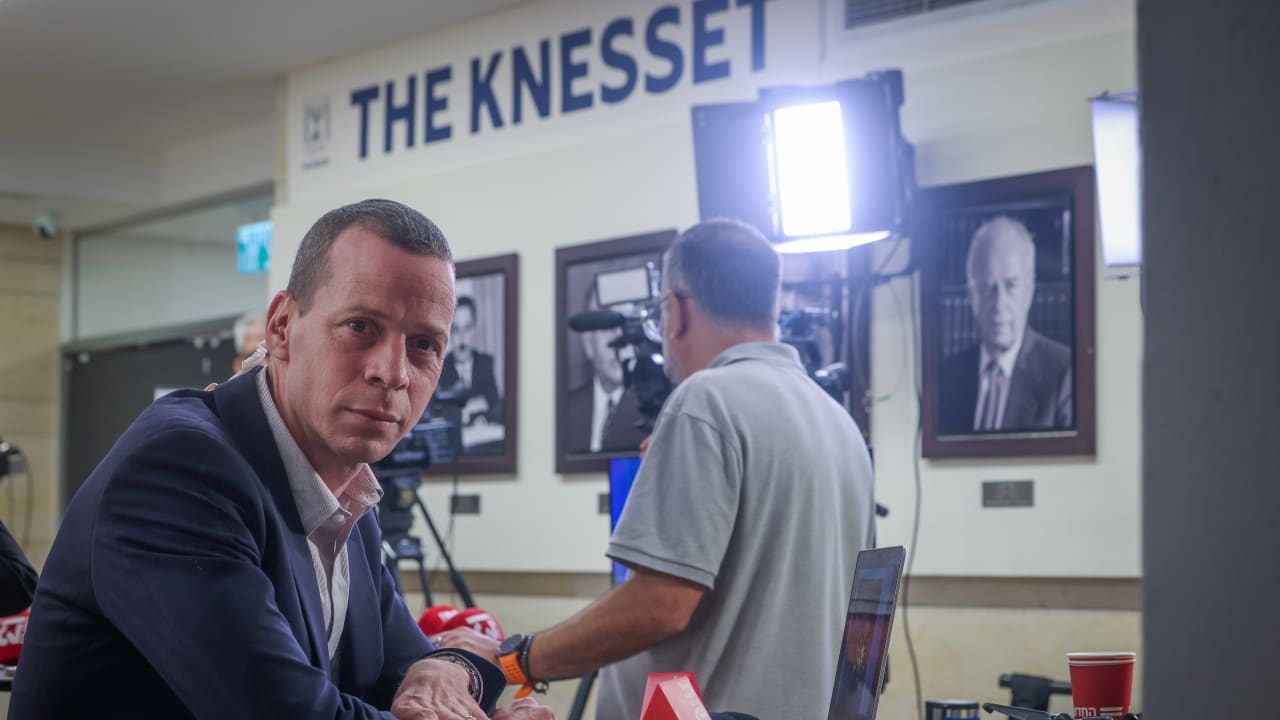
As the Israel-Hamas War reaches its end despite potential risks from bad actors, the new Knesset session is leading into an election season which may – or may not – culminate in the election of a new prime minister.
In his magnum opus A Call at 4 AM: Thirteen Prime Ministers and the Crucial Decisions That Shaped Israeli Politics, journalist and media personality Amit Segal offers a fisheye view of Israeli politics, beginning with David Ben-Gurion and ending with Benjamin Netanyahu.
But Bibi is not just the 10th chapter in the book. He is also the subject of its introduction, where he is described in March 2017 as sipping a “seltzer from a glass with the emblem of the State of Israel” while confronted by three members of the Israel Police, wearing uniforms bearing the same emblem, who have “come to question him under warning.”
Just as Netanyahu is being accused of lying, a knock on the door and the ensuing note he is handed result in the prime minister telling his interrogators, “The president of the United States is looking for me on urgent business.”
“Does this happen often?” the chief investigator asks, in a scene that could be taking place almost a decade later.
Once the interruption is over, the surreal questions resume. “What color was the champagne you received?”
“Pink.”
Segal admits to a “perverse fascination” with politics. As political commentator for Channel 12 News and the Yediot Aharonot daily, as well as co-anchor of Meet the Press, he confesses that he “can’t believe that my employers pay me for this pleasure.”

He exposes the underbelly of Israel’s “domestic politics and its bizarre alliances,” defining them as “skullduggery, friendship, corruption, tragedy – and the gulf between the exit polls and the real results.” It seems to all boil down to the fact that “an Israeli prime minister can be ousted at any moment by a no-confidence vote on a Monday afternoon at four o’clock.”
Masterfully translated by international Israel advocate Eylon Levy, Segal’s excellent factual oeuvre is a match for John le Carré’s deeply researched spy fiction.
– Marion Fischel
Extracts from Chapter 10: ‘Netanyahu’s Decision – Sticking to the Right at Any Cost’
From his father, Benjamin Netanyahu learned not only about the secret of cutting back on interviews but also about messaging. The differences between the two generations were more a matter of packaging than content. “Say something new,” he used to urge his aides, “or at least something old dressed up as new.” And what his father had written in academic English, he encapsulated in five-second TV soundbites: “The year is 1938 and [Mahmoud] Ahmadinejad is Hitler.” In the Netanyahus’ eyes, somewhere in the world, the year is always 1938.
The moment that he stepped into the Knesset, aged just 38, Benjamin Netanyahu shone brilliantly in the skies of Israeli politics: He sprinkled stardust and prophecies of doom, and somehow, they both worked together. Within five years, he had crushed all the Likud’s “princes” and taken control of the Right.
...
Netanyahu drew his inspiration from the same source as many of his imported ideas: America. This was around the time that the United States saw the launch of a new news network: Fox News. Its founder, Roger Ailes, proposed a revolution: Instead of appealing to all Americans, it would broadcast only to Republicans. Fox would offer them brash, provocative, right-wing, conservative news. America was big enough to make a lot of money from them.
Netanyahu knew Ailes very well. He was about to transform the Likud into the “Fox News Party”: a party that would appeal to the Right, not the Center. But it would take time even for him to act on this principle. Because in the world of the 1990s, the most important voter was someone called the “median voter.” Imagine Israel’s millions of voters sorting themselves into a very long row, from the northernmost tip all the way to Eilat in the south. Now imagine the voter located perfectly in the middle of the Israeli political spectrum. Let’s call him Shabtai.
...
... if Netanyahu could convince Shabtai that Peres was dangerous for Israel, every other voter to Shabtai’s Right would automatically fall in line.
...
In 1996, Netanyahu’s slogan included the obviously left-wing term “peace” (“Making a Secure Peace!”) while Peres used the right-wing buzzword “strong” (“Israel is Strong with Peres!”). Peres tried to convince voters that he was Netanyahu, and Netanyahu – that he was Peres. “Netanyahu’s coronation as the angel of peace has succeeded,” blared a Channel 2 headline a month before the elections when it became clear that using “peace” seven times in a single Likud broadcast had narrowed Peres’s lead to just three percentage points.
...
For ideologically right-wing voters, veterans of the protests against the Oslo Accords, the campaign caused an outbreak of hives. For three years, they had protested in the streets and been dragged by police officers at junctions, and when there was finally an opportunity at the ballot box to steer the country away from territorial withdrawals, they got white doves of peace on their TV screens and jingles that sounded like they came straight out of Aviv Geffen’s songbook.
But the campaign was not targeted at those who were already fired up and ready to go but at the swathe of voters in the middle who needed a kick. The ideological Right already had some of the highest voter turnout rates in Israeli history. Like always until then, Israel’s voter turnout rate was near 80%, and it was even higher in haredi and national-religious areas.
At 10:15 p.m., after the exit polls forecasted victory for Peres, the telephone rang at my parents’ home in Ofra. On the line was a haredi relative, who said that he had voted for Netanyahu but told the exit pollsters that he had voted for Peres. My parents hung up. On the screen, the celebrations at Labor HQ were in full swing.
One hour after sunrise the following morning, the president of the United States called the man who was still adjusting to the title of “prime minister-elect.” In his southern drawl, Clinton told Netanyahu something supremely undiplomatic: “We tried to f**k you, but you have beaten us.”
...
For the first time, the prime minister’s office was occupied by someone born after the establishment of the State of Israel, a young man of only 47 years, who dyed his hair white in order to look more authoritative. Since then, for nearly 30 years, he has always looked 60 years old.
In his first term, he maneuvered, quite clumsily, between his innately right-wing positions and the constraints of a world that still gave peace a chance. He flew to the United States for a summit with Yasser Arafat and gave him Hebron. One day, the Palestinian chairman sent him, through his adviser Ahmad Tibi, a large bouquet of flowers for his birthday. “It’s Bibi or Tibi!” roared the Likud’s billboards before the election, but afterward, it was both of them together. Two years later, at the Wye River plantation, Netanyahu signed another withdrawal agreement with Arafat.
When Netanyahu returned home, having committed to transfer 13% of Judea and Samaria to the Palestinian Authority, his coalition unraveled, and in the streets of Jerusalem, in a hallowed tradition, there appeared images of him wearing a keffiyeh.
...
Netanyahu learned a lesson: Never pick a fight with the National-Religious Right. A few years later, in 2006, he would also learn not to mess with the haredim and the Likud’s own voters. These two angry power bases took revenge on him at the ballot box for his economic policies, which had been essential to saving Israel’s economy but slashed the incomes of hundreds of thousands of his voters overnight.
Rabbi Ovadia Yosef refused to meet him for years. When he finally obliged, Netanyahu was smuggled into his home through the bicycle and stroller room in order to avoid igniting the rage of Shas voters who now had a hole in their bank accounts thanks to him. Netanyahu’s conclusion from this decade was unequivocal: Don’t mess with your base.
In the summer of 1999, after his defeat to Barak...
...
Everyone was convinced that Netanyahu, aged only 49, had seen the end of his political career, and that, like a meteor, he too had fizzled out. Everyone, that is, besides Netanyahu himself. Packing his belongings, he was already planning a comeback. The first stage was to found a newspaper. If he returned one day, he told associates, it would be with a media outlet that would give him a tailwind against the hostile, liberal, secular, left-wing media in Tel Aviv that he blamed for his downfall. Eight years later, when he was leader of the opposition, the first edition of Israel Hayom went to print, flush with cash and copies of his speeches, and owned by the Jewish billionaire Sheldon Adelson from Nevada.
...
As Israel’s ambassador to the United Nations, he had prided himself in 1985 on smashing the liberal media’s hegemony in shaping the agenda of decision-makers. “Thanks to newspapers, pamphlets, faxes, and broadcasts, thanks to lobbies and email, which I have recommended using before, I have managed to place our concerns and arguments in the global mindset,” he boasted. Nobody else knew what an email was, but Netanyahu could already spot an opportunity to reach influential people directly, without an editor’s meddling hand.
...
Israel’s ninth prime minister understood that the medium is the message ...
...
Gradually, the “Mr. Prime Minister” of the TV studios evolved into the “Bibi” of the social networks. Fending off social media outrage in early 2016, Netanyahu flip-flopped in just two days from condemning the soldier who shot a wounded terrorist in Hebron to phoning his father in solidarity. The same week, with impeccably symbolic timing, Donald Trump and his rage-filled Twitter account conquered the Republican Party. “Be like Trump,” the prime minister urged his aides. They followed his word. And then some.
...
It therefore became clear that the same resources that could be used to persuade one person from the other side to switch to voting for Netanyahu could be used instead to get four or five sleepy and disgruntled right-wingers to go out to vote. And thus, from openly supporting the two-state solution, Netanyahu embraced annexation; from speeches supporting the Supreme Court, he pivoted to fierce attacks on it; from statesmanlike announcements, he switched to clips with pickle jars as a jibe against his “sour” left-wing opponents. Netanyahu 1.0, the television celebrity who signed agreements with Arafat, gave way to Netanyahu 2.0, the social media wizard who favored annexing settlements.
...
When Netanyahu was first elected, in 1996, his party was only the second largest, after the Labor Party. This was seen as an outlier, but it happened to him again in 2009: Once again, the Likud finished second, with one seat fewer than Tzipi Livni.
There were parties at Kadima HQ all night long, but in the morning, Netanyahu received the mandate to form a government. In 2013, the Likud controlled fewer seats than Yesh Atid, but it was Yair Lapid who addressed Netanyahu as “Mr. Prime Minister,” not vice versa. In the first of the two rounds of elections in 2019, Netanyahu celebrated a “stunning victory” despite reaching a tie with Benny Gantz’s Blue and White party.
...
Netanyahu set about fortifying his bloc, not his party. This was a 20-year effort, at the end of which he became the undisputed leader not only of the Likud but also of the haredim, the religious Zionists, and voters in Israel’s periphery.
....
The religious Zionists, who had been used to sitting in the kosher food supervisors’ carriage in the train of Israeli politics, were suddenly upgraded to the driver’s compartment. “I only work with people who wear a kippah, or used to wear a kippah, or will wear a kippah,” Netanyahu has often joked at farewell events for retiring staff. For the first time, the first floor of the prime minister’s office started hosting afternoon prayer services.
...
One day, during the recording of our regular Friday night news show, the political analyst Amnon Abramovich spelled out the familiar list of Netanyahu’s left-wing credentials: implementing the deal to give Hebron to the Palestinians, signing the Wye River Memorandum, voting for the Gaza disengagement, and backing the two-state solution. After the recording ended, I told my left-wing colleague, “Sounds like you’ve got the dream candidate, with an impeccably left-wing record. Why don’t you vote for him?”
“Because I don’t believe him,” replied Amnon replied and then asked me: “But why don’t you denounce him, as someone on the Right?”
“Quite simple,” I replied. “Because I don’t believe him, either.”
...
He was sitting in a meeting with Donald Trump when his media adviser turned state’s witness. One year later, he announced Trump’s peace plan in Washington just as severe charges were filed against him in a Jerusalem court. Just a few weeks later, he led his party to its most powerful performance in a generation, bringing over one million voters to the ballot boxes. Did they not care about corruption? Of course they did. But they were convinced by his arguments that he was not being investigated and charged not because of the corruption of the accused, but because of the political biases of his accusers.
...
This American-style leader, who was initially seen as somewhat artificial, cold, and uninspiring, quickly became a focal point of love and hatred at levels that Israel had never seen since Begin and Ben-Gurion, if at all.
...
The hatred and love for Netanyahu, which paralyzed Israeli politics and propelled it into a nightmare sequence of elections, showed just how far cause and effect had been reversed: With all due respect to Netanyahu’s personality, his opponents wanted to get rid of him first and foremost because his government was steering the ship of state into what they saw as dangerous waters, giving immense influence to the haredim and the settlers and torpedoing a political solution to the conflict with the Palestinians based on a territorial division along the 1967 lines.
But at the moment of truth, when they had a chance, Netanyahu’s opponents offered the haredim everything and were ready to crown any other right-winger, no matter how radical, just to evict the Netanyahu family from the residence on Balfour Street.
...
... over the past few years, the Israeli Right has agreed to massive concessions over on its core beliefs just in order to strengthen Netanyahu’s rule. The Justice Ministry was given to an avid supporter of judicial activism, the Economy Ministry was handed to a socialist, the annexation plan was shredded, and the clear right-wing majority that had taken hold in the Knesset was wasted time and again.
...
How will politics remember Benjamin Netanyahu? As the man who resurrected the Israeli Right or the one who liquidated it? As the man who led Israel to new heights of international diplomacy or as someone whose trial changed the country forever? Will he be remembered for shaking hands on the White House lawn or for standing when the usher said, “Please rise”? As a historian’s son, the man who held office for longer than anyone else in Israel knows that only history will judge. ■
A Call at 4 AM is available at www.amazon.com/Call-AM-Thirteen-Ministers-Decisions/dp/B0F316MDXV