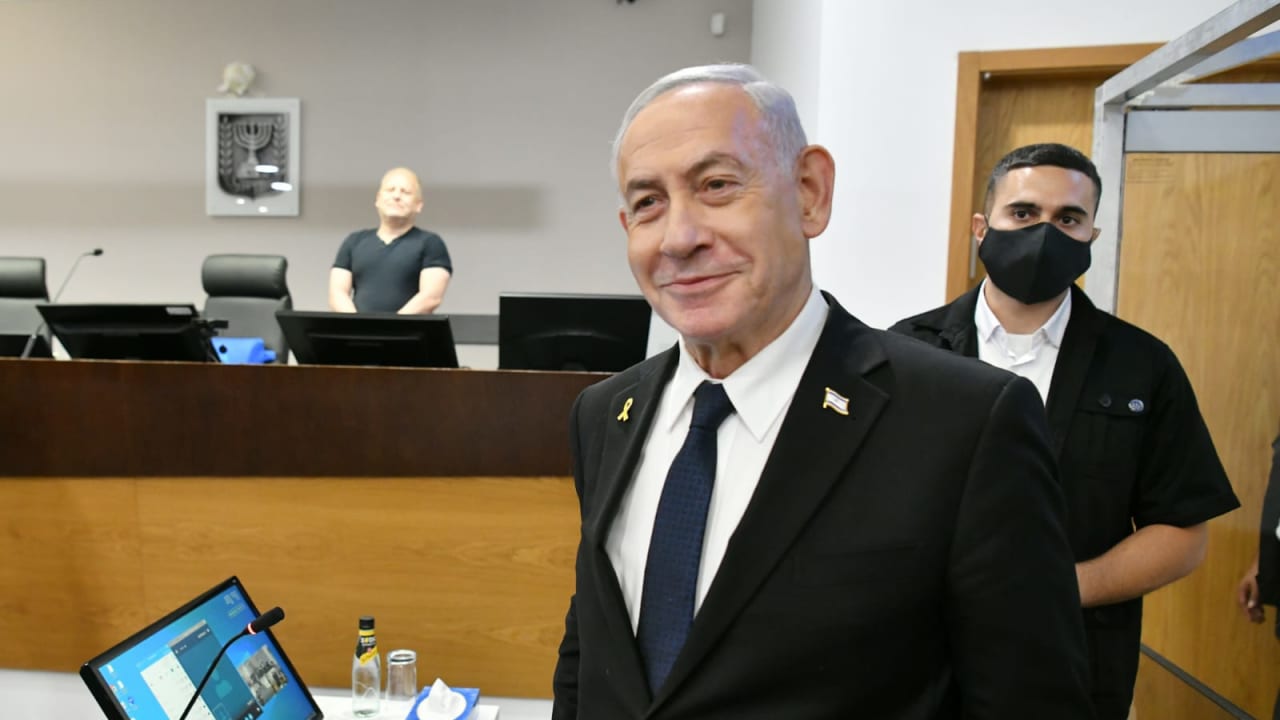
The testimony hearing in the criminal trial of Prime Minister Benjamin Netanyahu, which began behind closed doors on Tuesday until about 1 p.m., when the public testimony resumed for the eight day of testimonies in the cross-examination section of the trial.
The hearing focused on the prosecution’s attempts to isolate billionaire Hollywood producer and longtime friend of the prime minister, Arnon Milchan, as an outlier to Netanyahu’s intervention policies over the years, for a specific genre of people: Security or ex-security officials who were being denied visa applications and entries, and so filed requests through different methods and different ways to the prime minister.
What is Case 1000, in which Netanyahu was indicted in 2020?
The hearing began on Tuesday morning behind closed doors in questioning on Case 1000, one of the three cases the prime minister was indicted with in 2020, along with 2000 and 4000. He has pleaded not guilty to all three.
In Case 1000, Netanyahu is on trial for a conflict of interest relating to Milchan, who was his close friend and confidant while he served as communications minister from 2013 to 2015.
Allegedly, the prime minister received thousands of dollars worth of champagne and cigars from Milchan and from Australian billionaire James Packer, who was a friend to both.
Allegedly, the prime minister received thousands of dollars worth of champagne and cigars from Milchan and from Australian billionaire James Packer, who was a friend to both.
Netanyahu, allegedly, pushed for legislative and regulatory changes that would have been beneficial to Milchan during that time. The prime minister is charged with fraud and breach of trust.

In the last hearing before the recess, the subject matter of the questioning concerned Netanyahu’s efforts to secure a US visa for Milchan after his had been canceled.
Due to security concerns with information surrounding this issue going on the public record, a representative from the Defense Ministry asked that the hearing be switched to a closed-door setting.
Although it was never confirmed publicly by Israel, Milchan allegedly helped secure technology and materials for the Jewish state’s rumored nuclear program.
Prosecution Rep. Yehonatan Tadmor quoted former senior security officials, who said they were not familiar with the alleged pushes by the prime minister for the visa for Milchan.
“As you know from the closed-door sessions, Milchan helped Israel greatly... and he joins a long list of people, in uniform and out of it, who did the same,” said Netanyahu.
He added, “My concern at the time was to avoid a diplomatic disaster with the US.” The issue, he said, was the possible interrogation that would have been born out of the visa fiasco, not the visa itself.
“What concerned me was avoiding a 2.0 [Jonathan] Pollard scenario,” Netanyahu said.
Tadmor then asked about two other security figures who came up regarding visa issues to the US, but Netanyahu said he did not remember specifics. What this does for Tadmor is show that the treatment of Milchan was exceptional when compared to others.
Netanyahu stood on the difference between people turning to him as private citizens, as opposed to turning to him as professionals in a role, like security roles, where the appointments came from him.
Netanyahu's chief attorney heads up to assist aide Yonatan Urich
The prime minister’s chief defense attorney, Amit Hadad, left the courtroom at around 2 p.m. He headed out to assist another client of his, Yonatan Urich, an adviser to the prime minister and one of the chief suspects in the “Qatargate” investigations, whose hearing in the Rishon Lezion Magistrate’s Court was scheduled for the same time.
On Tuesday, the Israel Police requested that the restrictions imposed on Urich upon his release to house arrest – chiefly that he not make contact with Netanyahu, anyone at the Prime Minister’s Office, and at the company Perception – be extended for another 60 days.
At around 3 p.m., the prime minister received a sealed envelope, and the courtroom went on recess for about 20 minutes.
Allegedly, in 2013, Netanyahu actively pushed for an extension of tax exemptions for returning residents, which held significant financial advantages for Milchan.
Per the indictment, Netanyahu engaged in discussions with figures in the Finance Ministry on the matter. Those people at the ministry, however, opposed the initiative, according to the indictment, citing inconsistencies with national interests. Eventually, the initiative fell through.
Tadmor, on Wednesday, asked how Netanyahu was not aware that Milchan’s legal status was that of a returning resident, or that he would have benefited from this legislation.
The defense requested that the prime minister testify on Tuesday and Wednesday next week – instead of the regular Monday and Wednesday. It further asked that on the days that Netanyahu is slated to address the United Nations – the 29th and 30th – that other defense witnesses be presented to the court instead.