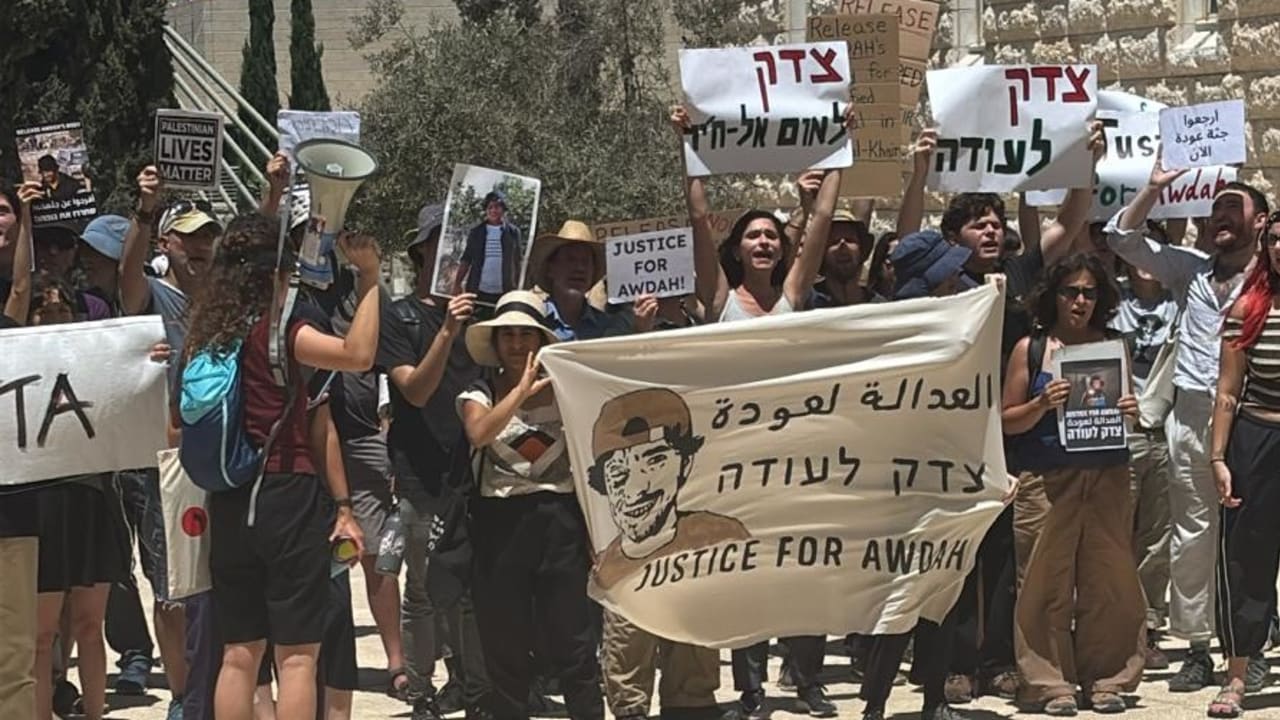
The death of Awdah Hathaleen, a Palestinian peace activist killed by an extremist Israeli settler in recent weeks, has sparked a wave of protests surrounding a hearing determining his family’s ability to receive his body. Hathaleen was known to the Israeli-Palestinian peacemaking community for his actions in nonviolent resistance and peaceful coexistence.
For a week and a half, Israeli authorities have held onto the deceased’s body, which was seized shortly after his death, hours before Yinon Levi, the settler who shot and killed the activist, was arrested. Witnesses said that Levi and other settlers entered the village of Umm al-Khair, attempting to excavate for further settlement expansion.
Residents said that on Tuesday, the excavators involved destroyed water pipes, cutting off half of the village’s water supply.
Videos from July 28 show Levi brandishing a gun as he advances toward a group of Palestinians before shooting indiscriminately in their general direction multiple times and killing Awdah Hathaleen. The incident occurred on Umm al-Khair’s territory, into which Levi and an Israeli minor had crossed, where they operated an excavator, damaged infrastructure and trees in the village, and tried to sever the main water pipe leading to it.

Hathaleen and other activists tried to stop the destruction, which was when the deadly shooting took place. Another video from the scene, filmed after the shooting, shows Levi speaking with Israeli soldiers and police officers and pointing at certain residents of the village, who were then arrested.
Israeli settler claims self-defense
Levi claimed that his actions were in self-defense and that he was attacked by a stampede of “dozens of rioters,” who were throwing stones. He received legal support from Honenu, a far-right organization, which called the incident an “attempted lynching.” A spokesperson for Carmel, the settlement Levi was believed to be excavating for, said that the event “could have ended in the murder of a Jew if he had not defended himself.”
Levi has been sanctioned by the EU, the UK, France, and Canada, according to Israeli media, with the Biden administration sanctioning him in 2024. However, US President Donald Trump rescinded all sanctions on Israeli settlers shortly after returning to office. Levi was released by the court, while Hathaleen’s family awaits his body.
Protest organizers have also staged a hunger strike in solidarity with the family, calling attention to their inability to bury Hathaleen according to tradition, as he remains in Israeli custody. The organizers say that both the military and police are placing several restrictions on the funeral, including the location of the burial, how many people can attend, and the establishment of a “mourning tent.”
“The prolonged holding of the body, the request for delays in the judicial proceedings, and the High Court’s granting of the extensions are an added level of cruelty inflicted on the family and the entire village of Umm al-Khair,” they said.
Hathaleen, 31, was a father of a young boy. His brother, Khalil, told The Jerusalem Post that his three-year-old nephew keeps asking when he can see his father again. Khalil recalled that Levi rode a bulldozer into the village, hitting his cousin, Ahmed, in the head with the vehicle. Upon hearing that someone was killed, he never thought it would be his brother.
“When I went to see the person who was killed, I saw a lot of blood, with my brother on the ground and beside him, his son. There was a lot of blood.”
The court postponed the hearing until Thursday afternoon, Khalil told the Post. Protests are expected to continue on Thursday in solidarity and support of the family.
Hannah Rozenblat contributed to this report.