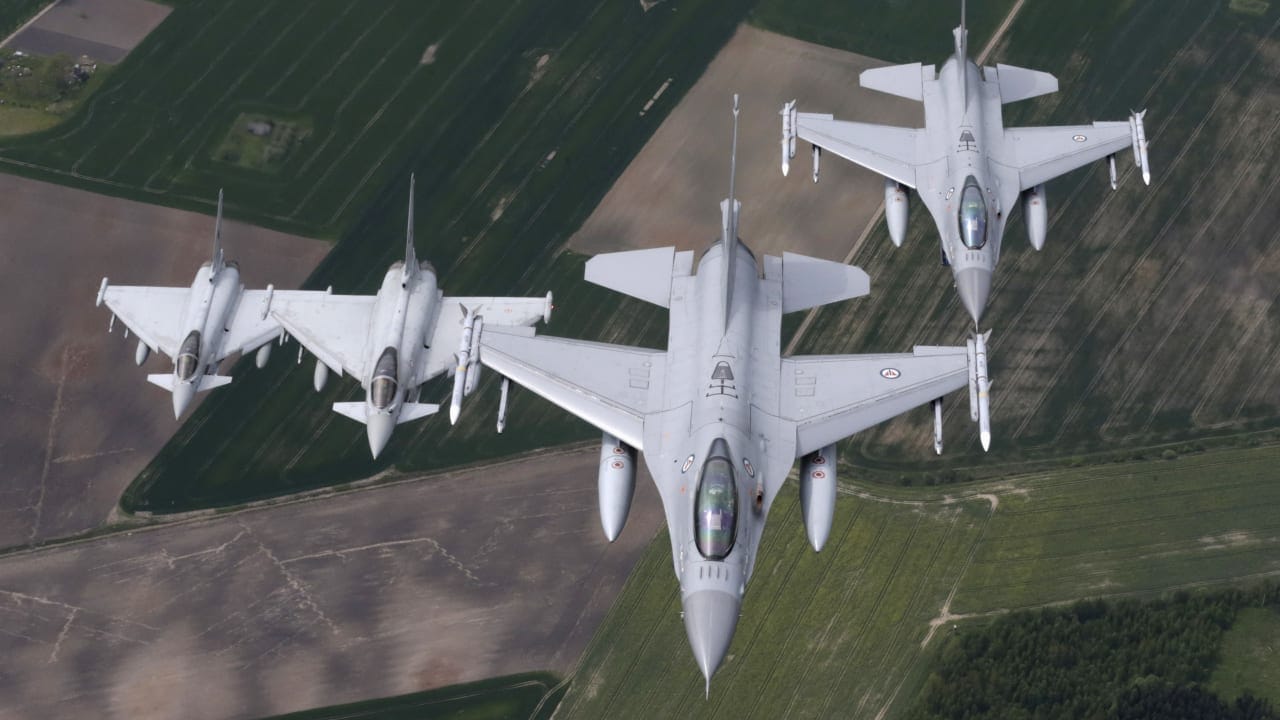
Poland and Romania said Russian drones crossed into their airspace, prompting allied scrambles and pushing NATO from routine air policing to a mobile air-and-missile-defense posture along the eastern frontier. The flights, on September 9–10 and later that week, aimed to probe warning time and intercept speed without triggering Article 5, the collective-defense clause that treats an attack on one ally as an attack on all.
For more stories from The Media Line go to themedialine.org
The Operational Command of the Polish Armed Forces reported about 19 drones crossing the border overnight on September 9–10 during a broader Russian strike on Ukraine, with allied jets assisting in intercepts. Days later, Romania’s Ministry of National Defense said a single drone loitered in Romanian airspace for roughly 50 minutes before turning back toward Ukraine. Two breaches in a week led allies to treat the pattern as something to deter before it hardens.
In response, NATO launched Operation Eastern Sentry, a flexible framework that allows commanders to move fighters, sensors, and ground-based air defenses to where the risk is highest.
That effort complements Baltic Sentry, which began in January to bolster Baltic defenses and protect seabed links after concerns about undersea sabotage.
“NATO deterrence today is more visible and credible,” political analyst Shary Mitidieri told The Media Line. She said Baltic Sentry and Eastern Sentry mark a shift “from air policing to an integrated air defense along the eastern flank,” with faster, more coordinated reactions to below-threshold actions.

Independent researcher and military expert Marco Cencio told The Media Line that deterrence on the eastern flank is now “reactive and visible,” pointing to Eastern Sentry, regional plans that include the Aegis Ashore site at Redzikowo, and a stronger multinational integrated air-and-missile-defense (IAMD) posture.
NATO commanders have already reported the first scrambles under Eastern Sentry, signaling day-to-day agility rather than one-off shows of force.
Tracks and debris in Poland point to testing rather than mass damage - decoys, auxiliary tanks for range, and routes designed to stretch coverage and decision time. As Cencio said, “The Russian drones … appear to be decoys, several with auxiliary tanks,” used to saturate and measure defenses.
Boundaries are key for NATO-Russian escalation
Mitidieri said governments will want a full evidentiary chain: “For a robust attribution, you need recovery of wreckage with serial numbers and chain of custody,” plus multilayer radar, electronic warfare/telemetry, and corroborating signals intelligence/open-source intelligence - or the result remains “high confidence,” not legal certainty.
Romania’s case fits that approach; defense officials said the drone lingered for 50 minutes - long enough to gather evidence without rushing a legal conclusion.
During the escalation, Warsaw reinforced its eastern frontier and tightened border security while Russia and Belarus ran the Zapad-2025 exercise next door. Poland also cleared the way for more allied forces to operate on its soil. Cencio said allied chains “were promptly activated,” citing Dutch F-35s, Italian Gulfstream G550 conformal airborne early warning aircraft, and German Patriot batteries “operating with synchronicity and coordination.”
Legal boundaries still matter. Article 4 of the North Atlantic Treaty, the 1949 pact creating NATO, allows consultations when a member perceives a threat, while Article 5 concerns an armed attack on allied soil or forces.
“Article 4 provides for consultative measures. Article 5, with Article 6, makes a clear reference to an armed attack,” Mitidieri said; red lines include casualties on NATO soil, strikes on critical infrastructure, or deliberate attacks on allied units. “In cyberspace, the threshold is case by case if severe, with a causal link and political will demonstrable.”