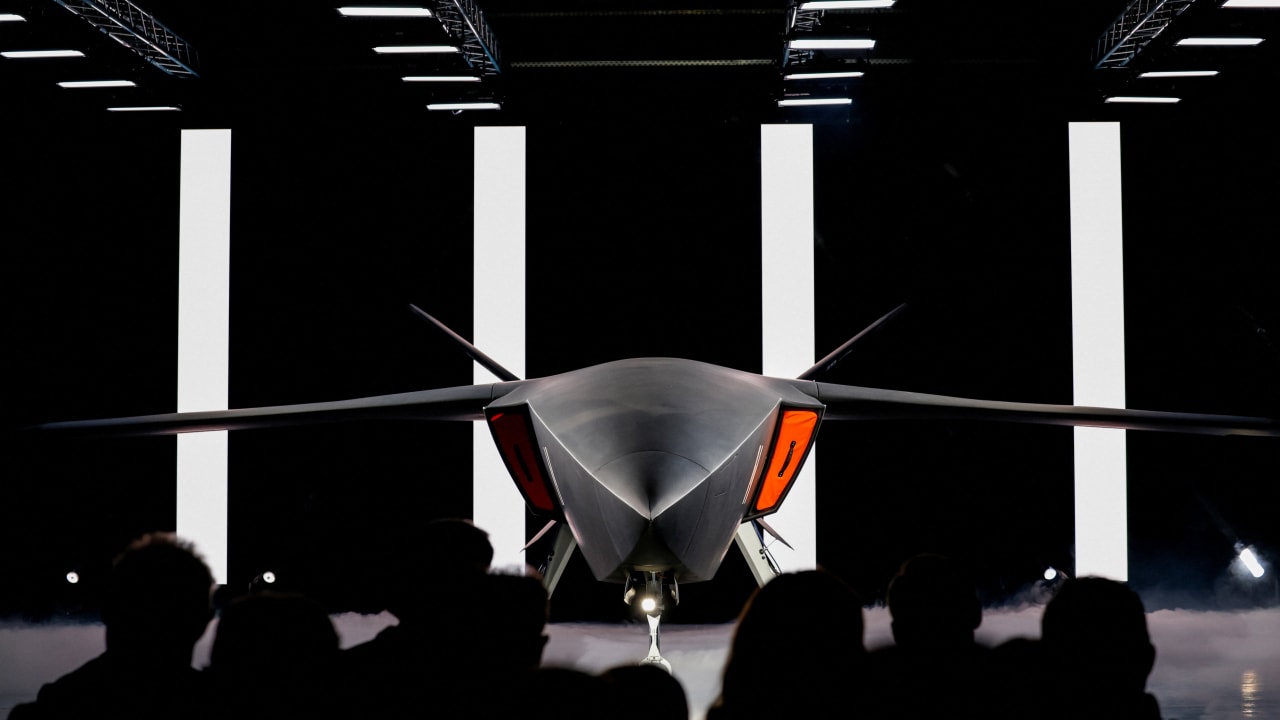
Denmark has reported an increase in drone incidents near its defense facilities, according to reports on Saturday.
CBS News reported that the Danish Defense Ministry said on Saturday that “drones have been observed at several of the Danish defense facilities.”
The latest incident occurred overnight between September 26 and September 27. It follows several incidents over the last week that also caused airport closures in Denmark.
These drone incidents in the Nordic country have been so far inexplicable – this is the biggest problem. Drones can pose a threat to commercial airline traffic and compromise military facilities. They can also be used to attack civilians, an experience that Israel underwent recently when a Houthi kamikaze drone strike on Eilat.
However, the problem in Denmark is the apparent inability of authorities to provide details about the drones or to stop the incidents.

Details about drone incidents in the Nordic state remain unclear. For instance, four airports have been affected by these drone threats. This occurred between Monday, September 22, and Thursday, September 25.
“Flights resumed early Tuesday at Copenhagen Airport after being suspended or diverted overnight because of drone sightings. Police reported two to three large, unidentified drones were seen on Monday night, forcing outgoing flights at Scandinavia’s largest airport to be grounded and others diverted to airports nearby,” CBS noted.
According to fresh details released on Saturday, NATO is reportedly upgrading its role in the Baltic Sea, sending an air defense frigate and other assets, per Reuters.
This is important. However, it is also concerning that NATO and its members do not already have sufficient air defense assets in the Baltic Sea. That area is crowded with ships and aircraft.
Further, it is a key strategic waterway. This is not the first time that incidents have happened in the Baltic since the Russian invasion of Ukraine. For instance, the Nord Stream gas pipeline was blown up in September 2022. Telecommunications cables were also damaged.
The drone incidents in Denmark also come in the wake of Russian drones penetrating Polish airspace and crashing in Poland.
All of this puts these European countries in a bind. Reports say that Germany may approve the shoot-down of drones in its airspace due to the threats in Denmark. Norway is also reporting incursion incidents in its no-fly zone.
More European states are therefore beginning to say they will shoot down drone threats. This move has taken far longer than it should have. Depending on their size and capabilities, drone threats are no different than foreign warplanes entering a sovereign country’s airspace.
IN THAT regard, the low-level drone war apparently being waged over a thousand miles from the Baltic Sea to Denmark, affecting various countries such as Poland, Estonia, Latvia, Lithuania, Germany, Denmark, Sweden, Norway, and Finland, illustrates that countries need to be prepared for complex threats.
Some reports described this kind of warfare as “hybrid,” meaning it combines traditional military means with cyber attacks or new technologies such as drones.
The diversity of drones
Drones come in a wide range of shapes and sizes. They can be commercial quadcopters or large drones the size of an aircraft. Military drones are often large and built to withstand the elements. Some of them can be used for long hours of surveillance, such as flying for 24 to 48 hours.
Smaller drones are also being militarized. These can be used at a tactical level and could have a flight time of a few hours. Another type of drone is the kamikaze one, embodied in the Iranian Shahed-136, which is a type of flying wing. This has been produced in Russia as well and used by the Kremlin in the thousands to attack Ukraine.
Another type of drone being used is a very cheap model that is being deployed to the front line in Ukraine.
These are typically less expensive than commercial DJI-type quadcopters. They can be deployed in the tens of thousands to conduct surveillance or carry out smaller attacks. Drones like these can drop grenades or fly into targets. Some are wire-guided and use fiber optics. This is to avoid jamming, which has become increasingly common on modern battlefields.
Israel is a pioneer in drones
Along with the various types of drones, there is also a range of systems designed to counter them. Israel is a pioneer both in drone warfare, dating back to the 1980s, and in countering drones.
Countering drones these days is typically referred to as “countering unmanned aerial systems” or C-UAS. This can refer to short-range systems developed by defense companies. Israel’s defense giant, Elbit Systems, manufactures ReDrone and Red Sky 2, among other systems designed to counter drones.
Israel Aerospace Industries makes a system called Drone Guard. Rafael Advanced Defense Systems, another Israeli defense icon, makes Drone Guard. All of these systems have various capabilities, including detection using optics and signals, as well as the ability to jam drones or provide information to a system to shoot them down.
When it comes to longer-range or significant drone threats, the Jewish state has also been a pioneer in inventing various means to take them down.
The Iron Dome system can down drones. Israel’s new laser air defenses, developed over the last decade, also possess counter-drone capabilities. In addition, drones can be downed by remote-controlled weapon systems such as Rafael’s Typhoon gun.
The challenge countries such as Denmark have is not the issue of being able to take down the drones. One can scramble aircraft and military helicopters to do so. The challenge lies in detection and classification. Drone sightings can lead to a kind of drone threat hysteria.
In 2024, for instance, numerous reports surfaced of drones flying in the skies over New Jersey. Many of these reports were actually sightings of commercial aircraft. What happened then was similar to the UFO hysteria witnessed in various countries over time.
REGARDLESS, THE fact that the public might not be able to distinguish between drone threats and aircraft is not an excuse for authorities at airports and defense sites to not know the difference themselves.
The incidents in Denmark, ergo, reveal a more complex problem. It is not clear that military and defense officials are prepared to shoot down drones in their own airspace.
They will need to modify their system of approvals to implement this line of defense.
Additionally, they will need to be able to detect, classify, and track the drones. In particular, if the drones are flown from an offshore vessel, authorities must be able to track and subsequently investigate them.
If the drones are being flown by people inside Denmark, perhaps hostile actors, or civilians, then these agents also need to be found.
The problem so far is a need to coordinate amongst European authorities and take the threat seriously. Is the threat one that the police should initially handle, or should it be coordinated with the military?
In the wake of the 9/11 terrorist attacks in the US, there was a significant overhaul of how America shares intelligence and deals with homeland security.
The Russian invasion of Ukraine should have already led to better drone defense mechanisms across countries in Europe. The recent incidents in Poland, Denmark, and other countries serve as a wake-up call.