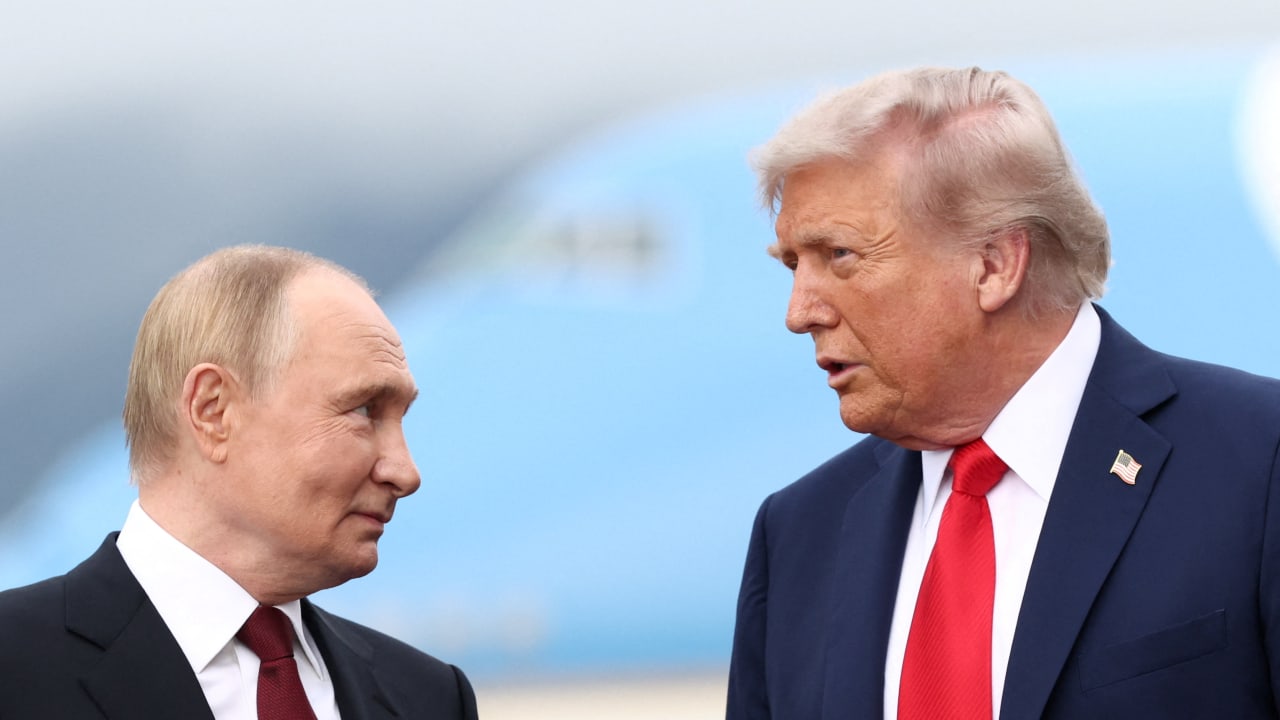
US President Donald Trump walked away from his meeting with Russian President Vladimir Putin in Anchorage, Alaska, on Friday without a ceasefire deal.
Trump said on Friday that he and Putin did not reach an agreement on "probably the most significant" aspect of their meeting, but there was a very good chance of getting there.
"Many points were agreed to. There are just a very few that are left. Some are not that significant. One is probably the most significant, but we have a very good chance of getting there. We didn't get there, but we have a very good chance of getting there," Trump told reporters.
This comes after Trump told reporters on his way to Alaska that he wanted to see some semblance of a ceasefire during Friday's meeting.
"I wouldn’t be thrilled if I didn’t get it," he said. "Everyone says, ‘You're not going to get a ceasefire. You – it'll take place on the second meeting,’ … but I'm not going to be happy with that."
However, both leaders portrayed the first face-to-face talks between Moscow and Washington in nearly four years as a win.

The talks went "remarkably" well, Russian special envoy Kirill Dmitriev said on Russian state television.
Putin said on Friday he hoped that agreements reached at his summit with Trump could be a launchpad for settling the Ukraine conflict and restoring ties between Russia and the US.
"I expect that today's agreements will become a reference point, not only for solving the Ukrainian problem, but will also launch the restoration of business-like, pragmatic relations between Russia and the United States," Putin said.
He said there was enormous potential for the two countries to build a business and investment partnership in areas such as energy, technology and space exploration, and in the Arctic.
"I have every reason to believe that by moving along this path, we can reach an end to the conflict in Ukraine as soon as possible," he said at a joint news conference at which the leaders did not take any questions.
"There were many, many points that we agreed on," Trump said at a joint press conference with Putin. "I would say a couple of big ones that we haven't quite got there, but we've made some headway. So there's no deal until there's a deal."
Putin, however, did not specify what the two sides had agreed on.
Trump and Putin each spoke for a few minutes to reporters and took no questions.
Kremlin spokesman Dimitry Peskov said that the talks between Putin and Trump allowed the countries to continue seeking ways for a settlement, Interfax news agency reported on Saturday.
"The conversation was indeed very positive, and the two presidents spoke about this. This is the very conversation that allows us to confidently move forward together along the path of searching for settlement options," Peskov said.
Putin-Zelensky meeting
Trump said that Ukrainian President Volodymyr Zelensky and Putin were going to set up a meeting to try to reach a ceasefire to end the in Ukraine.
"Now, it's really up to President Zelensky to get it done. And I would also say the European nations, they have to get involved a little bit. But it's up to President Zelensky... And if they'd like, I'll be at that next meeting," Trump told Fox News' Sean Hannity after the meeting.
"They're going to set up a meeting now between President Zelensky, President Putin, and myself, I guess."
Zelensky, who was not invited to the talks, and his European allies fear Trump might have sold out Ukraine by essentially freezing the conflict and recognizing, if only informally, Russian control over one-fifth of Ukraine.
Before the meeting, Zelensky noted in a video address that he was depending on Trump.
"It's time to end the war, and the necessary steps must be taken by Russia. We are counting on America," Zelensky wrote on the Telegram messaging app on Friday, adding that the Trump-Putin meeting should open the way for a "just peace" and three-way talks with him included.
Trump sought to assuage such concerns as he boarded Air Force One, saying he would let Ukraine decide on any possible territorial swaps. "I'm not here to negotiate for Ukraine, I'm here to get them at a table," he said.
Still, Putin appeared to send a threat to Kyiv and Europe regarding any future deal.
“We expect that Kyiv and European capitals will perceive all this in a constructive manner and will not create any obstacles, will not make attempts to disrupt the emerging progress through provocations and behind-the-scenes intrigues,” Putin said, as reported by CNN.
<strong>Trump presses for a truce in Ukraine-Russia War</strong>
Trump, who casts the war as a "bloodbath" fraught with escalatory risk, is pressing for a truce in the 3-1/2-year-old war that would bolster his credentials as a global peacemaker worthy of the Nobel Peace Prize.
Trump previously asserted he could end the conflict in one day, though he seems to have changed his tune.
"I thought the easiest one would be this one," he told reporters Thursday, referring to the array of diplomatic conflicts he aims to solve. "It's actually the most difficult.”
For Putin, the summit is already a big win as he can use it to say that years of Western attempts to isolate Russia have unraveled and that Moscow has retaken its rightful place at the top table of international diplomacy.
Trump emphasized that he believed Putin was a "smart guy" and that there is a "good respect level on both sides."
He also welcomed Putin's decision to bring a lot of businesspeople with him to Alaska, but said he would not start any deals until the war ended.
"But they're not doing business until we get the war settled," he said, repeating a threat of "economically severe" consequences for Russia if the summit goes badly.
One source acquainted with Kremlin thinking said there were signs that Moscow could be ready to strike a compromise on Ukraine, given that Putin understood Russia's economic vulnerability and the costs of continuing the war.
Reuters has previously reported that Putin might be willing to freeze the conflict along the front lines, provided there was a legally binding pledge not to enlarge NATO eastwards and to lift some Western sanctions.
Russia, whose war economy is showing signs of strain, is vulnerable to further US sanctions - and Trump has threatened tariffs on buyers of Russian crude, primarily China and India.
"For Putin, economic problems are secondary to goals, but he understands our vulnerability and costs," the Russian source said.
On the eve of the summit, Putin held out the prospect of something else he knows Trump wants - a new nuclear arms control agreement to replace the last surviving one, which is due to expire in February next year.
Will US, Russia be able to find common ground in Alaska?
The source familiar with Kremlin thinking said it looked as if the two sides had been able to find some common ground.
"Apparently, some terms will be agreed upon... because Trump cannot be refused, and we are not in a position to refuse (due to sanctions pressure)," said the source, who spoke on condition of anonymity because of the matter's sensitivity.
Putin has so far voiced stringent conditions for a full ceasefire, but one compromise could be a truce in the air war. He has claimed he is open to a ceasefire, but has repeatedly said the issues of verification need to be sorted out first.
Zelensky has accused Putin of playing for time to avoid US secondary sanctions and has ruled out formally handing Moscow any territory.
Beyond territory, Ukraine has been clear in talks with Western allies that it needs a security guarantee backed by Washington. It is unclear how that guarantee could work - and what part the US would play in it.
What could happen in Ukraine?
Last week, US Special Envoy to the Middle East Steve Witkoff met with Putin in Moscow. While both sides said that the talks went positively, reports emerged that European officials were frustrated and confused by Witkoff’s restating of the events.
The Wall Street Journal reported last week after Witkoff’s meeting, Trump administration officials told European officials that Russia would be willing to freeze the conflict along the front lines in Zaporizhzhia and Kherson. Russia and Ukraine would then negotiate land swaps; Moscow was aiming to gain control of the two regions, but officials who spoke to the WSJ stated they were unclear as to which regions Ukraine could gain.
However, in later calls, Witkoff later walked these statements back. Two European officials familiar with the calls told the WSJ that Russia wanted a two-phase ceasefire: In the first phase, troops would withdraw from Donetsk and freeze the frontlines; in the second, Putin and Trump would negotiate a ceasefire, and would later add Zelensky to the talks.
Reports emerged that the Kremlin chief had bested Witkoff, leaving him confused on both his demands for a ceasefire as well as the state of the conflict.
"Witkoff doesn't know what he's talking about," a Ukrainian government official told BILD.
Initial reports on the meeting noted that there would be a point where Putin and Trump would speak one-on-one without aides present, which would be a massive break from diplomatic form.
Leaders typically have professional note takers present, especially in a summit that was as hastily assembled as the one in Anchorage.
Now, Trump will have two aides - Rubio and Witkoff- along with interpreters. One of the two aides will be able to take notes during the meeting, which could be critical if the Kremlin reverses course.
Trump previously asserted he could end the conflict in one day, though he seems to have changed his tune. "I thought the easiest one would be this one," he told reporters Thursday, referring to the array of diplomatic conflicts he aims to solve. "It's actually the most difficult.”