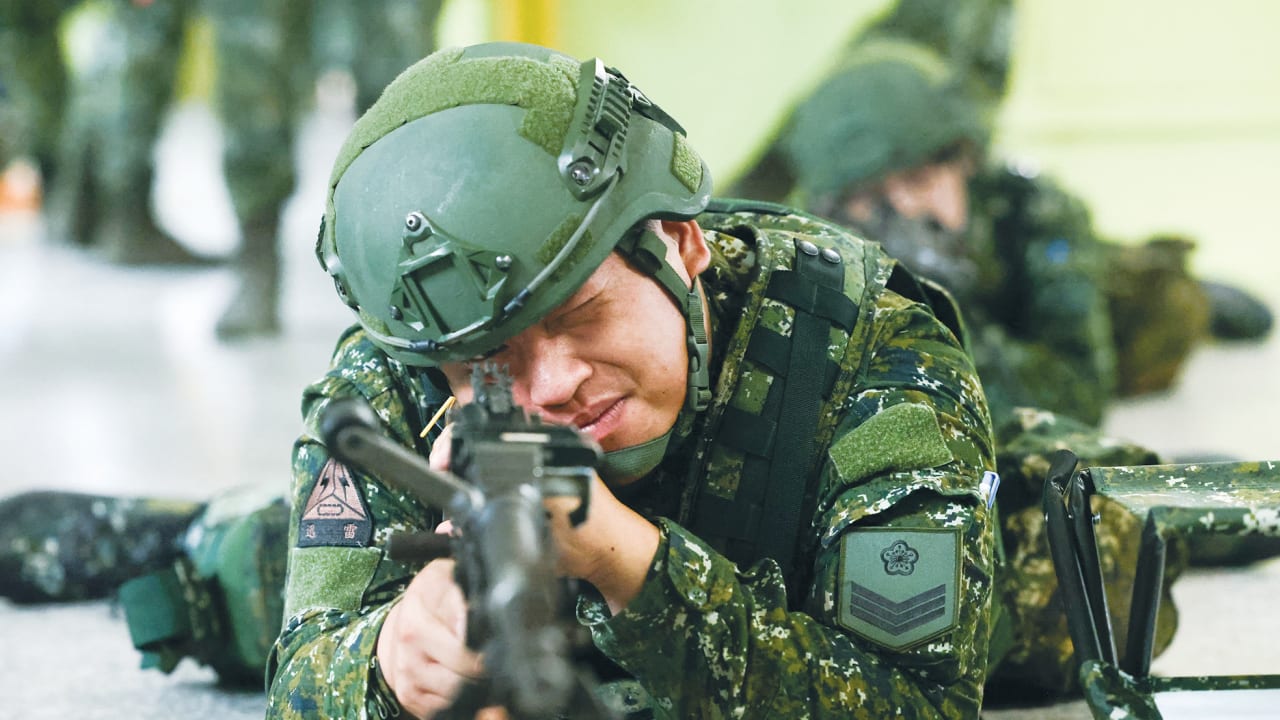
As Taiwan launched its largest-ever military exercises this week, mobilizing 22,000 reservists and testing responses to cyber and missile attacks, there was another war shaping the island’s strategic thinking: the recent 12-day confrontation between Israel and Iran.
For Taiwan, constantly under threat from a larger, more powerful China, the Israel-Iran conflict has become an unexpected case study in how to defend a democracy against a regional hegemon, with several important lessons to be learned.
“I have been sharing all the firsthand information on the ground here back to Taiwan. There are a lot of critical and valuable lessons for Taiwan to learn from the 12-day war,” Abby Ya-Ping Lee, Taiwan’s representative to Israel, told The Jerusalem Post.
“Taiwan has been living under hybrid threats from China for decades, and in recent years Beijing has stepped up the coercion and intimidation to incorporate Taiwan by force. So there is a sense of urgency for everyone in Taiwan to strengthen our defense capabilities and the whole of societal resilience.”

Similarities between Taiwan and Israel
The parallels between Taiwan’s predicament and Israel’s strategic environment are striking. Both are democratic, hi-tech societies surrounded by hostile neighbors. Both face threats that range from missile salvos and drone strikes to cyberattacks and information warfare. And both rely heavily on deterrence, early warning, and international alliances.
The Israel-Iran war in June, dubbed Operation Rising Lion, erupted on June 13, when Israel launched a surprise offensive targeting Iran’s nuclear and military infrastructure. The operation began with Israeli air and ground forces carrying out assassinations of high-ranking Iranian military officials, nuclear experts, and political figures. In the early phase, Israel succeeded in severely impairing Iran’s air defense systems and striking multiple strategic installations. Over the course of the 12-day war, Israel conducted hundreds of airstrikes.
In response, Iran unleashed a barrage of missile and drone attacks against Israeli cities and military bases, reportedly firing over 550 ballistic missiles and deploying more than 1,000 explosive-laden drones.
The United States, which provided defensive support to Israel throughout the conflict, escalated its involvement on the ninth day by launching direct strikes on three Iranian nuclear sites. Iran retaliated by targeting a US military base in Qatar with missile fire.
A ceasefire was reached on June 24.
That kind of preemptive capability has not gone unnoticed in Taipei.
“What did we learn from the Israel-Iran war? Firstly, the importance of intelligence,” Lee explained. “I know that Israel’s success in Operation Rising Lion was rooted in your advanced intelligence capability, which enabled Israel to degrade Iranian command and control and dismantle missile capabilities in advance. Taiwan will have to continue to fortify the intelligence networks, our cyber capability, and deepen our cooperation with allies and partners to detect and prevent hostile and surprise actions.”
Taiwan’s Defense Ministry said its current Han Kuang drills, which include decentralizing military command to withstand cyber strikes, are part of a broader effort to build that same kind of resilience. But it faces a serious imbalance. Taiwan’s military, while professional and capable, is dwarfed by China’s in every category.
“Compared to the Chinese military, Taiwan cannot match its assets,” Lee acknowledged. “We must focus on strengthening our air defense missile interception capabilities. This includes accelerating a symmetric defense transformation from acquired, smart, and efficient anti-drone and antimissile systems to modernize our economy to be more decentralized, nimble, and adaptive to different contingencies.”
It did not take long for the Chinese to focus on the Taiwanese defense drills. By 6 a.m. on Wednesday, Taiwan had detected 31 Chinese aircraft sorties and seven naval ships, the ministry said in a statement. Some 24 of the aircraft crossed the median line, the unofficial barrier between the two sides.
There is a deeper doctrine at work here – one also present in Israeli defense thinking: the understanding that help from allies comes only when a country demonstrates its own will and capability to fight.
“We understand that we must be committed to defending ourselves so that others can come to assist us,” Lee said. “But Taiwan alone is not enough. This is the fundamental defense doctrine of Taiwan, and I believe it is also reflected in Israel’s current situation.”
One key moment that resonated in Taipei was the speed of the US response during the Israel-Iran escalation. Washington deployed air and missile defense assets to the region, sent naval forces to intercept drones, and backed Israel diplomatically.
“We saw swift and decisive intervention by the US and Western allies, demonstrating the value of a credible alliance and joint operational plan,” Lee said. “The US’s rapid deployment also sent a reassuring signal to its allies and partners in the Indo-Pacific region. For Taiwan, we are very grateful that the US provides military aid in the form of foreign military financing.”
Beyond financing, Taiwan has long maintained its practical cooperation with the US.
“The US also sent soldiers to Taiwan to train our soldiers, and also took our soldiers to the US to train together with the National Guard,” Lee noted. “We will have to intensify the joint drills, defense strategy, intelligence sharing and defense technology cooperation with the United States and any countries that are willing to work together to preserve the peaceful and stable status quo.
This cooperation was further enforced this week, when the Taiwanese Army unveiled its first American-made M1A2T Abrams tanks on Thursday, showcasing their firepower in a live demonstration.
The demonstration took place at a muddy training ground in Hsinchu County. Four Abrams tanks maneuvered through the terrain, engaging both moving and stationary targets.
Taiwan’s President Lai Ching-te, observing the exercise in combat gear, emphasized the importance of these assets in bolstering national defense. “Every enhancement in our military’s capabilities adds another layer of security for our people,” he said.
Lai also praised the tanks’ performance, describing them as highly mobile and powerful – “without a doubt the most dominant force on the battlefield.”
Taiwan is also watching how US public opinion may influence future support.
“I read a very interesting poll from the Reagan Foundation in the United States,” Lee explained. “Approximately 78% of poll respondents supported the United States in helping to defend Taiwan and achieving peace through strength. It’s also relevant to how the US was involved and participated in the airstrikes with Israel.”
Another lesson Taiwan is drawing from Israel is on the home front. During the Iran attack, Israeli society proved highly organized – civilians knew where to go, how to seek shelter, and how to access accurate information.
“The resilience of Israeli society is inspirational to us,” Lee said. “The community supports clear civil defense protocols, as we see in the home front commands, timelines, and the population’s preparedness for missile attacks. The mamad (safe room) is part of your building code requirement.”
Taiwan is beginning to adapt those ideas to its own situation. With a population of around 24 million and a dense urban landscape, the island is beginning a phased process to integrate bomb-proof safe rooms into its infrastructure. Due to the scale of construction required, the initiative will start with new buildings, prioritizing public facilities and government structures. Authorities are also engaged in internal discussions on how to retrofit existing residential buildings with reinforced shelters to improve protection against missile strikes and explosive impacts.
The effort reflects an intensified sense of urgency to strengthen civilian defense capabilities across the island.
“Taiwan is already taking steps to enhance its overall resilience, and we have issued new air raid guidance and prepared air raid shelters across the country. Unlike Israel, even though our buildings are earthquake-resistant, we don’t have safe rooms in every residential building, but we are increasing them in public buildings, subways, and train stations.”
From July 15 to 18, Taiwan will conduct municipal resilience drills in Taipei, Taichung, and Kaohsiung – its three largest and most strategically important cities.
“We used to have a civilian defense drill for earthquakes or natural disasters,” Lee said. “But this time we expanded the scale.”
Taiwan’s digital preparedness is also evolving. While it has experience with emergency alerts for natural disasters, it lacks a cohesive public app like Israel’s Home Front Command system.
“We don’t have apps like Home Front Command yet, but we have been accumulating experience from earthquakes and typhoons,” Lee said. “We do have the SMS transmission system, but we want to integrate all the resources and to come out with a more updated app for our citizens.”
Civil society is also mobilizing. “We have been fortifying our civilian bodies, especially in the field of societal resilience,” Lee added. “Before the war, we had a medical resilience organization called Forward Alliance, which is the equivalent of United Hatzalah or Magen David Adom. The founder of Forward Alliance came to Israel to gain a better understanding of how civilian assets and resources can be fully utilized.”
Even psychological preparedness has become a priority.
“Although we live under a threat, many people in Taiwan haven’t really encountered kinetic warfare,” Lee told the Post. “The government believes that the people of Taiwan are actually quite resilient and strong. But we also need them to know how to strengthen your mentality in the face of those emergency situations.”
She pointed to recent cooperation with Kibbutz Palmahim, where Taiwan established a resilience center to study ocean-based trauma therapy and invited Israeli experts to share community-based recovery strategies.
“We know that keeping calm and also knowing how to adjust between emergency and routine is very important for society to keep operating under the threat.”
She also visited Soroka Medical Center in Beersheba on Thursday as a sign of solidarity with Israel after the hospital was hit by an Iranian missile. She told the Post she made the visit to “see how we can help and learn from your medical resilience.”
As China’s pressure continues, Taiwan is under no illusion about the stakes. But its leadership believes the lessons from Israel’s recent war could be vital in ensuring the island is prepared. From missile defense and urban resilience to psychological strength and alliance-building, Taiwan is taking notes and taking action.