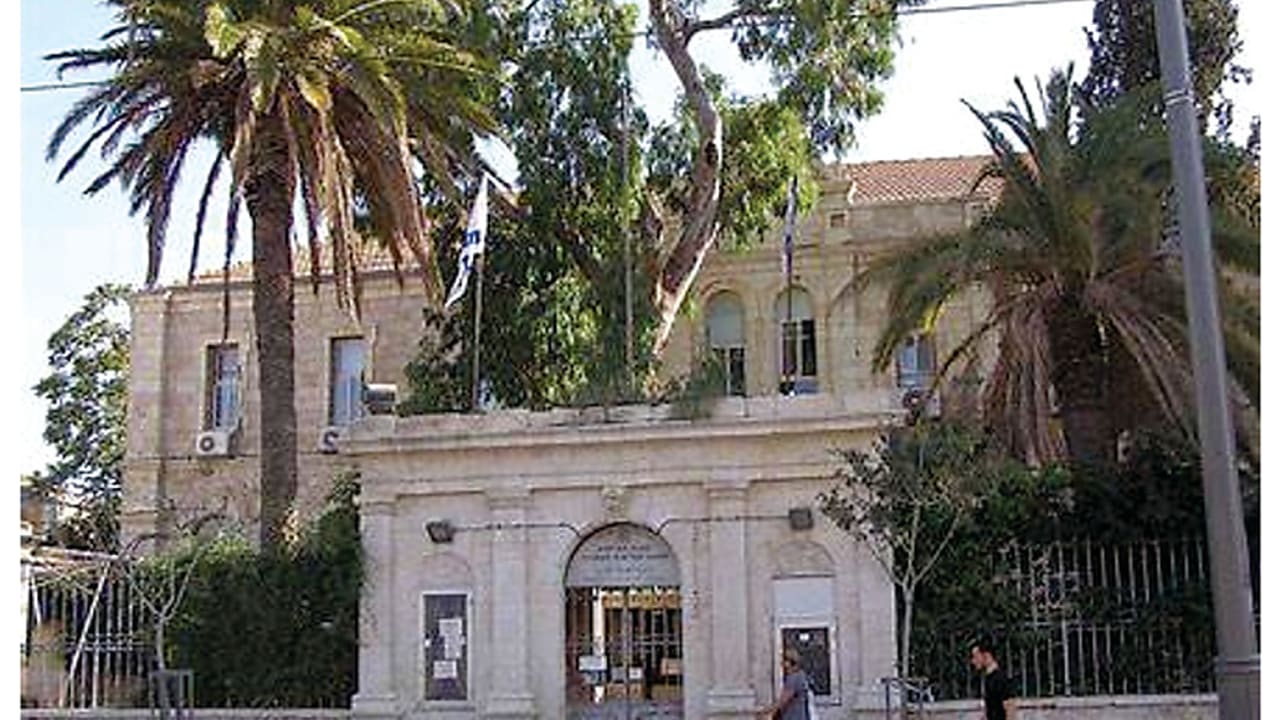

The Jerusalem District Health Office at 86 Jaffa Road provides a variety of public health services, such as the investigation of outbreaks of infectious diseases; operation of a vaccination clinic (rabies, vaccinations for travelers, and health-professional students); medical committees for civil servants to examine fitness for work and disability; the issue of burial licenses; and restoring vaccination records.
It’s rare that visitors who climb the steps and enter know about or even ask about the history of the 144-year-old building, even though the original floor made of large stones and the thick walls attest to its long history. The rooms haven’t been changed since it was built, except for Health Ministry symbols, electric wires and lights, computer screens, and Internet connections.
But even if visitors are curious, they won’t be able to scrutinize it for long because its Health Ministry staffers are moving in six months to a new building at the western entrance to the city. While the historical building cannot be destroyed, a boutique hotel will be constructed on the plot, Chief Jerusalem District Psychiatrist Dr. Koby Chernes, who has worked there for more than a decade, told In Jerusalem.
The building, whose history mirrors the transformation of medicine, government, and urban life in the city itself, is one of the oldest surviving public health structures in the modern (New City) part of Jerusalem.
Its history spans the late Ottoman Empire, in which the Turks ruled Jerusalem from 1516 until 1917, to the British Mandate, to the State of Israel, and reflects the evolution of public medicine in the city.
It began as a private residence in 1882, when the city was rapidly expanding outside the Old City walls along Jaffa Road, which had become the city’s modern commercial spine, linking Jerusalem to the port of Jaffa and opening the city to trade, diplomacy, and migration.
Architecturally, it reflects late-Ottoman civic style with its thick Jerusalem stone (limestone) walls, arched openings, symmetrical facade, and an Ottoman imperial emblem (tughra) still visible above the building.

Modern medical services
As Jerusalem’s population expanded dramatically in the late 19th century, modern medical services were urgently needed.
In 1891, the Ottoman Jerusalem Municipality established a public hospital in this building called the Baladiyeh [“municipal”] Hospital. There is a historical plaque on the wall near the entrance. The building was adapted from a home to medical use – one of the earliest organized public health institutions serving the growing “New City.”
Long before COVID made epidemiology a household word, public health officials in Jerusalem were already fighting epidemics from the stone building.
The hospital treated infectious diseases common at the time, such as scarlet fever, typhoid fever, and other epidemic illnesses affecting a crowded, rapidly urbanizing population. This marked a turning point – municipal responsibility for public health replaced earlier charitable or religious medical care.
During the British Mandate era, after Jerusalem was captured in 1917, the British authorities expanded the public health bureaucracy, and the municipal hospital was converted into the Jerusalem District Health Office. It was the administrative center for vaccination programs, disease control, sanitation regulation, and maternal and child health services.
After Israel’s independence in 1948, the new state’s Health Ministry simply continued using the building for district health services. Unlike many Mandate institutions that relocated, this building remained a working medical administration center, giving it one of the longest continuous public health uses in Jerusalem.
Since then, downtown Jerusalem has changed as infrastructure became outdated and government offices aged. The historic structure nevertheless remained in active use. Awareness grew of its architectural and historical importance as one of the last surviving Ottoman civic buildings on Jaffa Road. Over the years, municipal urban planners suggested relocating government functions and redeveloping the site.
The building is regarded as important because it represents three successive health systems in Jerusalem – the birth of civic medicine under the Ottomans, modern public health administration under the Mandate, and institutional continuity as part of Israel.
Few buildings in Jerusalem have served public health continuously for over a century. Its continued use reflects an unusual continuity in the city’s history – a place where the mission of public health has endured despite dramatic political and social change.
In an era shaped by pandemics and renewed awareness about public health, the building’s story feels newly relevant. For more than a century, decisions made inside its stone walls have shaped how Jerusalem confronts disease, protects families, and safeguards community wellbeing.