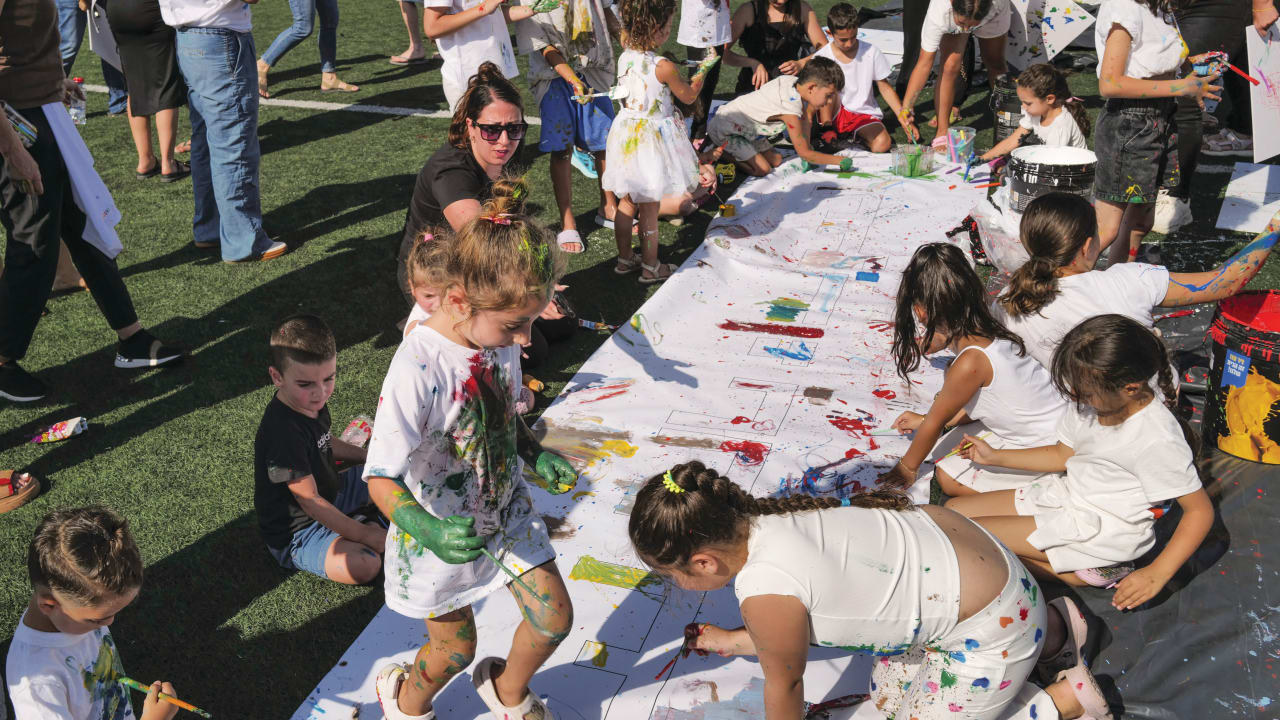
War wounds not only soldiers. The horrific events on October 7 – the invasion by Hamas terrorists of Israelis on the southern border, the war in Gaza, and the constant threat of missiles and drones – have caused significant emotional harm among children, especially the preschoolers.
Given the concern that harming young children will have serious long-term consequences, researchers at Jerusalem’s Taub Center for Social Policy Studies have investigated the problem, delineated the damage, and offered suggestions to ameliorate it. They stressed that it’s vital to strengthen the support system for both Jewish and Arab youngsters, who have also been affected.
Given the increase in the incidence of behavioral and emotional difficulties in children following the closure of educational institutions at the beginning of the war, especially in places where the frameworks were closed for a long time, it is necessary to ensure the continuation of educational activity even during periods of emergency, and if necessary, to implement alternative educational programs to minimize harm to children.
The research, which was printed in a Hebrew-language booklet for distribution among decision-makers, was led by Prof. Yossi Shavit, a principal researcher at the Taub Center, where he chairs the Education Policy Program and is an emeritus professor at the Sociology and Anthropology Department in Tel Aviv University’s Faculty of Social Sciences, along with sociologist Dr. Carmel Blank of Taub and the Ruppin Academic Center, and early childhood experts Dr. Dana Shay and Dr. Yael Navon.
The Taub Center is an independent, nonpartisan research institution that provides policymakers and the public with research and data on some of the most important issues facing Israel in the areas of education, health, welfare, the labor market, and economic policy.

Shay, who edited the booklet, said: “The survey findings reveal a complex picture: alongside impressive signs of recovery in the emotional state of children and parents, especially over the past year, there are still particularly vulnerable groups, such as families who were evacuated, families with parents in the reserves, and families with low incomes, who suffer from significant difficulties. With the right support, they can be rehabilitated, but no family must be left behind. We must continue to ensure the mental well-being of children and families to prevent long-term damage and strengthen community resilience.”
More than half of the families with young children sampled in the survey were directly physically or mentally affected by the war, they said. About 55% of the families sampled in the survey reported in the first wave that they suffered direct exposure to the war, in one or more of the following ways – physical injury or mental harm to the nuclear family or immediate social circle, evacuation from their homes, or the call-up of one of the parents for reserve service in the security forces.
The survey participants were asked whether their child needed daily care and support (such as speech therapy, tipat halav (early childhood health centers), and health fund follow-up), and whether they continued to receive it in the first three months of the war. Two-thirds of the children did not need routine care at all, but of the children who did, only 54% continued to receive most or all of the care they needed in the first three months of the war – more than half of the children in the survey who needed routine care did not receive it as usual during this period.
The prolonged closure of educational settings particularly affected children exposed to the war. The researchers found that preschool children whose educational settings were closed for more than two weeks at the beginning of the war and who experienced a high level of exposure to the events suffered from more severe emotional and behavioral difficulties compared to children who were exposed to the war to a lesser extent. The gaps were statistically significant in the first two waves of the survey, but a year later (in the third wave) they almost completely disappeared, regardless of the duration of the closure of the settings.
THE BOOKLET presents the average emotional and behavioral withdrawal of children according to the length of one parent’s reserve service, divided into boys and girls. They found that girls experienced greater emotional and behavioral withdrawal than boys following a parent’s prolonged absence due to reserve service. This may indicate girls’ increased sensitivity to a parent’s prolonged absence due to reserve service and emphasizes the need for tailored emotional support for them in such situations.
The survey’s third wave examined the level of school readiness of preschool children according to their parents’ reserve service after the outbreak of the war, as reported by the parents. It showed that children whose parents were drafted into the reserves during this period were rated at a lower level of readiness than children whose parents were not sent to reserve duty. This finding was obtained after controlling for a wide range of demographic, family, and emotional variables such as family status, family size, the emotional state of the parent who stayed home, and more.
It may reflect the consequences of a parent’s absence from home during a period of emergency, and the associated difficulties for young children precisely at the significant stage of preparing for the transition to formal educational frameworks, the team said.
Parents whose spouses served in the reserves for a long time also suffered from emotional difficulties – and this affected their children. Therefore, they urged, support systems adapted to these families should be established, with special attention to those with young children and those whose incomes are relatively low.
Arab parents experience depression, anxiety, stress at higher levels than Jewish parents
Not only Jewish families were affected. Blank told The Jerusalem Post that Arab parents experienced symptoms of depression, anxiety, and stress at higher levels than Jewish parents, and the economic damage they suffered was also more severe. “They have a lower status, are more likely to be fired, earn less, and often have large families. Their homes were also subjected to missiles and drones, and there is ongoing violence by Arabs against Arabs in Arab and mixed towns. Arabs were taken hostage and some were murdered by Hamas terrorists.”
In addition, there was the July 27, 2024, rocket attack on a football pitch in Majdal Shams in the Golan Heights, which killed 12 Druze children and wounded 42 – with most of the victims being between the ages of 10 and 16. Israel blamed Hezbollah terrorists in Lebanon for carrying out the attack with an Iranian-made Falaq-1 rocket equipped with a 53-kg. warhead.
To alleviate the unique difficulties of the Arab population, the researchers recommended that “dedicated programs for financial assistance and psychological support should be designed for them and equality in the responses provided to them should be ensured.”
Arab parents reported a significantly greater deterioration in their economic situation during the war than Jewish parents. The survey examined the reported changes in the income of families with young children following the war, and presents parents’ reports of the change in family income between January 2004 and January 2005, broken down by nationality. The findings show that the proportion of Arab parents who reported a decrease in their family income is higher than the proportion of Jewish parents who reported this: 61% of Arab parents reported a large decrease in income compared to only 7% of Jewish parents, and 13% of Arab parents reported a small decrease in income compared to only 71% of Jewish parents.
Since emotional harm to young children could have serious long-term consequences, the researchers emphasized that it’s important to strengthen the system of support provided to them. Blank added that although the research focused on small children, evacuated teens who had to leave destroyed homes and go to other schools elsewhere also suffered. “They have already suffered isolation due to the coronavirus pandemic. They have fallen between the cracks.”
Decision-makers have to understand the dangers facing parents of youngsters, Blank concluded. “There was a five-year plan in May 2023 to deal with this, but because of the war, the government cut NIS 200 million from this budget.”
When routine is disrupted, children need stability and routine, Blank said. “Parents think that if they don’t talk about the deaths of soldiers and the hostages, small children, two or three years old, won’t be affected. But they are still disturbed by these. They see signs, names, hear the siren, and have to run to protected rooms and shelters. Parents and educators have to speak about it in a way suited to their ages. And young children should be taught that not all Arabs are bad and all Jews are good; if they are raised thinking this, they may develop anxiety and hostility when encountering Arabs or could be victimized by ‘bad’ Jews. We have to live together.”