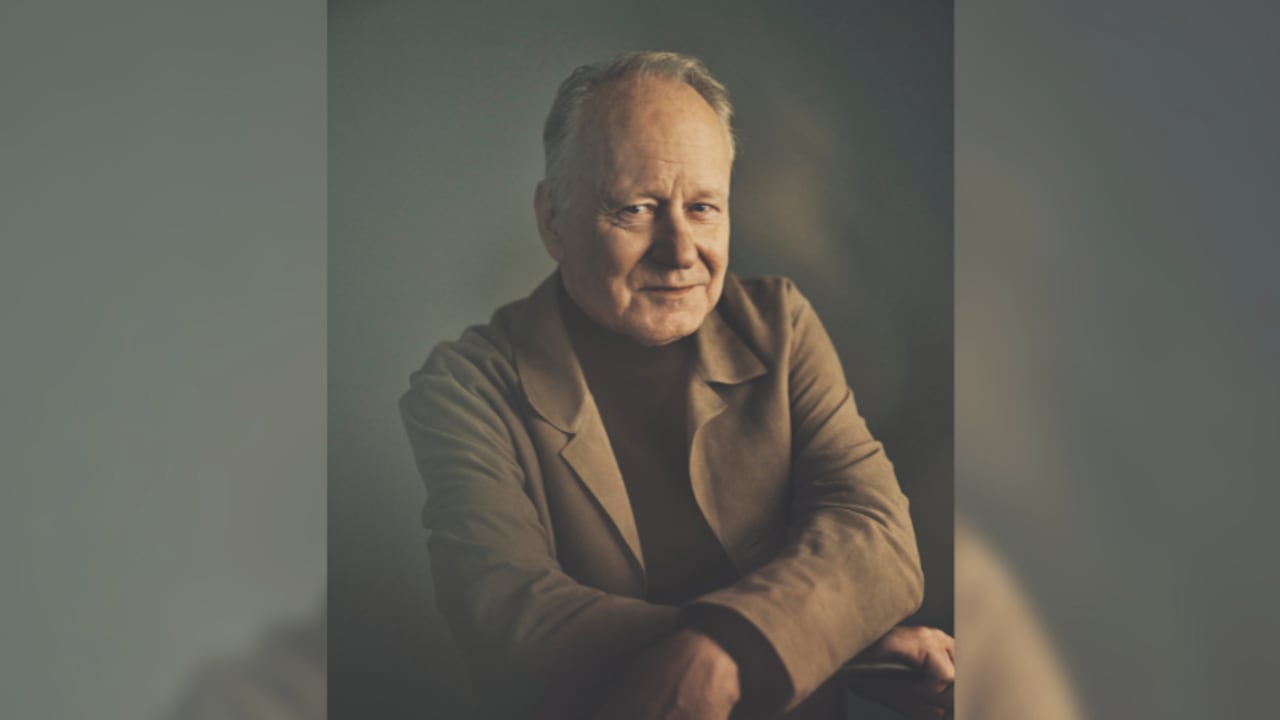
LOS ANGELES/TNS – Three years ago, Stellan Skarsgård suffered a stroke. It wasn’t catastrophic but it left him with damage to his short-term memory and focus. For a moment, he was certain his acting career was over.
“OK, so this is it,” he remembers thinking. “I’m finished.”
The Swedish actor, 74, was then in the middle of the most visible run of his half-century in film and TV, a towering presence in two major franchises, playing the monstrous Baron Harkonnen in Denis Villeneuve’s Dune and the rebel mastermind Luthen Rael in the Disney+ Star Wars series Andor. As soon as the shock subsided, Skarsgård began to look for a way forward.
“I said, I think I might be able to do it if I get somebody to read my lines,” Skarsgård says over Zoom from his home in Stockholm. “Because I can’t remember.”
At the time, he was between seasons of Andor and between the first and second Dune films – still in demand but unsure whether he’d ever work the same way again. He called Villeneuve and Tony Gilroy, the Andor creator and showrunner, to explain what had happened and what might need to change. Since then he’s used a small earpiece feeding him dialogue, a difficult adjustment, he admits, but one that’s allowed him to keep working.

The effects of the stroke linger, subtle but real. He speaks with the same measured warmth as ever – that deep, lilting rumble that can shift from conspiratorial murmur to amused growl in a heartbeat – but he sometimes loses a name mid-thought. As he recounts the story, he blanks on both Villeneuve and Gilroy.
“This is what happens,” he says, almost apologetically. “I cannot any longer have a political argument, which is sad,” he says. “I become a little more stupid and a little more brief, almost getting the point and missing it by an inch.”
There’s no self-pity in the observation, just a clear accounting of change. The stroke seems to have stripped away some of his old formality, leaving him more open, unguarded, even amused by his own lapses. That ease runs through his latest film, Joachim Trier’s Sentimental Value, a tender, sharply comic drama about a fractured family trying – and often failing – to heal.
Opening in US theaters last Friday after an acclaimed festival run (including opening the Jerusalem Film Festival), Sentimental Value stars Skarsgård as Gustav Borg, a renowned, narcissistic filmmaker who reappears in the lives of his estranged daughters after the death of his ex-wife, hoping to reconnect with them by turning their shared history into a movie.
Nora (Renate Reinsve), a celebrated stage actor, wants nothing to do with the project – or with her father. Her sister, the more measured Agnes (Inga Ibsdotter Lilleaas), tries to keep the peace as old grievances resurface and life and art begin to blur.
Trier’s prior film, the Oscar-nominated 2021 romantic dramedy The Worst Person in the World, made him an international name. Sentimental Value, which won the Grand Prix at Cannes, seems poised for a similarly warm reception and could bring Skarsgård his first Academy Award nomination.
'You can never tell how a film will hit'
A veteran of both Lars von Trier’s provocations and the Marvel universe, Skarsgård plays Borg with a mix of charm, vanity, and self-awareness. He seems genuinely surprised by the response.
“You can never tell how a film will hit,” he says, “but this one has reached everybody, every generation, every culture. It’s obviously touched something. And it’s remarkable, because in spite of its seriousness, it’s light. It’s like a soufflé with dark specks in it.”
WITH SENTIMENTAL Value, Trier hoped to bring Skarsgård back to the kind of intimate, emotionally exposed territory that first defined his work in films like his 1982 Swedish breakout The Simple-Minded Murderer and Von Trier’s searing 1996 drama Breaking the Waves, which brought him international acclaim.
“I wanted to offer him a chance at this age to go back to the roots of that dramatic, vulnerable openness that he does so well,” the Danish-born Norwegian director says by phone from his home in Oslo. “We spoke a lot about what kind of man Gustav was – the paradox of someone who can see people so clearly in his art yet be so clumsy and inept in his real life.”
That tension between sensitivity and limitation is one Skarsgård knows well. As a father of eight from two marriages, he has long seen parenthood as the most humbling role of all.
“I had to defend Gustav, in a way,” he says. “Being a father, which I am, is a very difficult thing to be. To be a perfect father, as we all strive to be, is impossible. So I felt very much for his failure. I told Joachim that I wanted to stress the humanity of it.”
He chuckles softly.
“Since 1989 when I left the Royal Dramatic Theatre, I’ve spent maybe four months a year in front of the camera and eight months changing diapers and wiping asses, being with my kids. So I haven’t lacked time. But is it enough? I don’t know. I have eight kids and they all have different needs. Whatever you do, you’ll fail. But you live with it.”
The film, he says, captures a helplessness he recognizes.
“All those scenes with the sisters, he’s trying so hard, and he really f***s up. He doesn’t have the tools for that. But it’s not that he lacks sensibility. He’s a filmmaker, he’s tactile and sensitive. I think a lot of filmmakers have that in common. It’s easier to be vulnerable and soft in your profession than it is in private life.”
For all of Gustav’s bluster and ego, the film leaves room for grace.
“Maybe there’s an opening, maybe there is forgiveness and maybe there’s understanding – or the beginning of understanding,” Skarsgård says. “I look at my parents. They were very flawed, but I forgive them. They were human.”
Learning to act with an earpiece – hearing his lines fed to him while still listening to his scene partners – became its own test of concentration and humility.
“I thought it would be easy,” Skarsgård says. “But you can’t have the rhythm of the scene affected by it. The reader has to say my lines in a very neutral way while my co-player is saying their lines at the same time, so you get both lines at once. It’s tough but it works most of the time, I think.”
In Sentimental Value, the long stretches of unspoken feeling in the script by Trier and the director’s longtime co-writer Eskil Vogt turned out to suit Skarsgård perfectly.
“As an actor, you really appreciate when a director is searching for the wordless expressions and the subtleties,” he says. “In a less and less subtle world, it’s necessary to find your way back to that.”
Jerusalem Post Staff contributed to this report.