An Israeli woman has become the sixth in the world to conceive and give birth to a healthy baby after undergoing uterine transposition surgery in which her uterus and ovaries were moved surgically to her upper abdomen – with the help of a da Vinci robot – so that her colon cancer could be treated with radiotherapy.
She gave birth a few weeks ago at Petah Tikva’s Rabin Medical Center-Beilinson Branch.
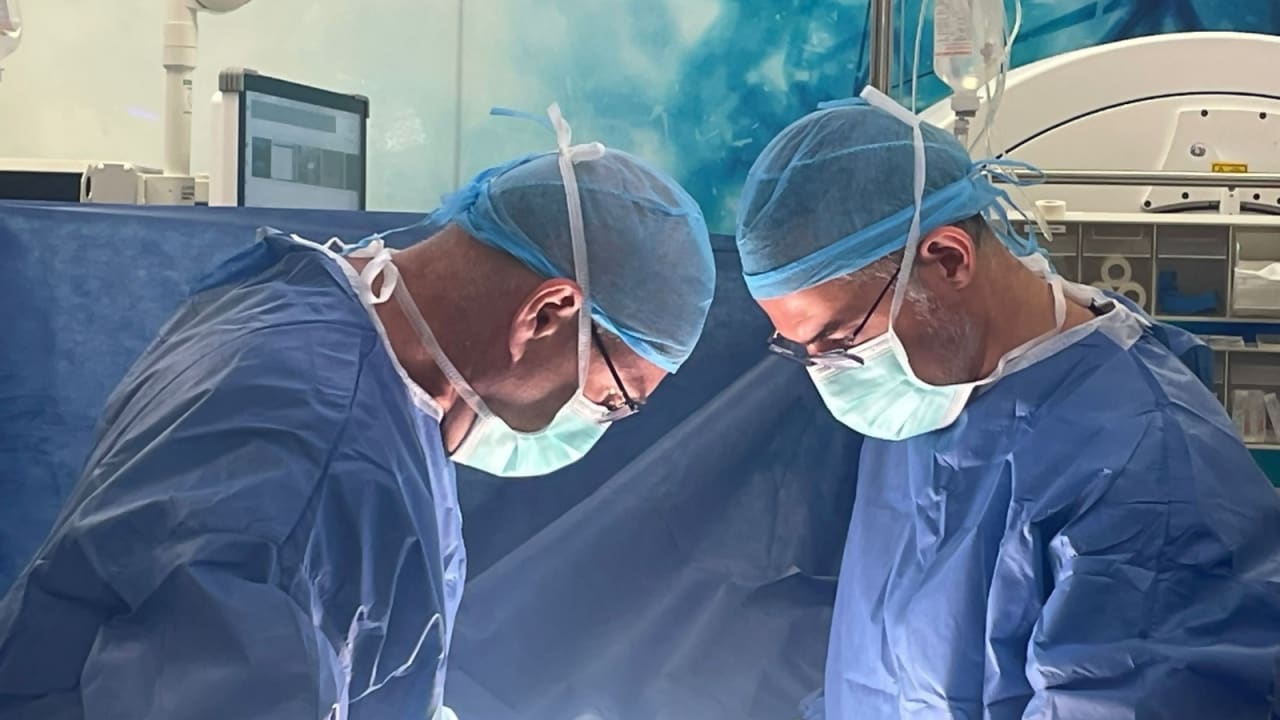
The procedure was led by Prof. Ram Eitan, a gynecological oncological surgeon who heads the hospital’s gynecological oncology unit.
A large team of surgeons, nurses, ultrasound experts, and anesthesiologists were present at the operation in which her organs were moved from her pelvis to her upper abdomen and then, months later, back to their natural placement.
Eitan told The Jerusalem Post that he consulted with doctors in Brazil and the US and didn’t get much sleep before the reposition procedures because of their complexity and the team’s wish for it to succeed.

Colon cancer is usually a problem of middle-aged and older patients, but the woman was in her early 30s when it was discovered, after she had bleeding and other symptoms.
Radiation irreversibly harms the uterine lining and muscle, and the only way to protect the uterus is to surgically detach it – along with the ovaries – from the pelvis (which is targeted by radiation) and suture them into the upper abdomen above the navel.
Until recently, there was no way to protect the uterus for young women who had to undergo pelvic radiation. Preserving fertility is a vital part of cancer care for young women, so adding uterine transposition to the tool chest of gynecological oncologists to help young female cancer patients remain fertile is an important development.

For uterine and ovarian transposition, surgeons carefully detach these organs and the cervix from the vagina, which is similar to a standard hysterectomy – but instead of removing them, they preserve the blood supply and attach them to the upper anterior abdominal wall.
Following radiation, the uterus is returned to its natural position in a second surgery. The robot, which today is used to help surgeons perform a wide range of surgeries in general and in specialties such as cardiac, urologic, and pediatric surgery, allows greater flexibility, more precise suturing, and highly accurate tissue handling.
The woman and her family allowed the announcement of the unconventional procedure but not personal details to protect her privacy.
A surgery that was only done 18 times in the world, operation at Rabin was the sixth where healthy baby born
Eitan also delivered the baby via cesarean section, adding that the new mother – who is now healthy – said she wants to have more children and that he would be glad to perform more cesareans for her.
The technique was first introduced by Dr. Reitin Ribeiro, a gynecological oncological surgeon from the Erasto Gaertner Hospital in Brazil who is known for innovative laparoscopic and robotic surgical techniques and has since moved to McGill University in Canada. He reported the first pregnancy and delivery after a transposition in July 2023.
To date, only about 18 women worldwide have undergone the procedure. Eitan heard a lecture by Ribeiro at a conference in Rio de Janeiro and said to himself: “I can do that too!” He told the head of his hospital’s fertility preservation unit that if he came across a woman who wanted such a procedure, to refer her to him. Eitan performed his – and Israel’s – first such surgery at Rabin Medical Center in 2021, but the woman did not have a baby, and he carried out the later procedure about a year later.
“It’s a rare operation, as this colon cancer typically occurs in older individuals and is seldom diagnosed in women of reproductive age, and some of the women have already had children or choose not to undergo the surgery,” Eitan said.
“Brazil has a large population and good doctors in many of its medical centers who make it possible for them to achieve advanced surgeries and other procedures, even though the country is not very rich. They are forced to think out of the box,” said Eitan. “Just in case our procedure wouldn’t work, we took other measures to freeze her embryos and eggs in advance.”
Since the uterus was in his patient’s upper abdomen, Rubeiro thought about what to do when she menstruated. He directed the monthly emission of blood via her navel so it could drip out. But Eitan solved that problem by giving injections to prevent his patient from menstruating. “After the uterus and ovaries were repositioned in her pelvis, she menstruated again, which made everybody very happy because it meant she was fertile again,” he said.
“It’s rare and deeply inspiring to see a woman who has faced cancer, radiation, and uterine transposition and still manages to conceive and bring life into the world,” her surgeon said. “The procedure is incredibly innovative. We didn’t know if the uterus could survive such a transposition and later sustain a pregnancy. So when we learned she was pregnant, it was an incredibly emotional moment. We realized we had pushed the boundaries of medicine to the maximum.”