
How much time do you spend thinking about food? I know I spend a decent portion of my waking life (and some of my sleeping time) thinking about food, reading about food, and, of course, eating food. A new book by food scholar Susan Weingarten offers a glimpse into what Jews ate almost 2,000 years ago and how the food was prepared.
For example – eggs. In a culinary irony, chefs are often judged by how well they make an omelet. Well, in the Talmud, there are 200 recipes for eggs, but for some reason chicken is not mentioned.
The book is “the first in-depth study of food in Talmudic literature in its geographical and cultural contexts,” the introduction reads. “It demonstrates the sharing of foods and foodways between Jews and their non-Jewish neighbors in the Near East in late Antiquity.”
Weingarten, who researched the book for decades, said she made some surprising discoveries.
Surprising discoveries about Talmudic food
“I was most surprised when I realized that not only did I have the single surviving Roman cookery book, attributed to the gourmet Apicius, to give me parallels to the food of the Jerusalem Talmud, written in the Roman province of Palaestina, but that almost the same held for the Babylonian Talmud, where the very first surviving Arab cookery book written by al-Warraq in Baghdad of the Caliphs was contemporary with the ge’onim of Babylonia, the successors of the rabbis of the Bavli, and could give me parallels to the food of the Babylonian Talmud,” she told The Jerusalem Report. “Not only did the cookbooks provide parallels, but they also gave extra details of how certain dishes were made.”
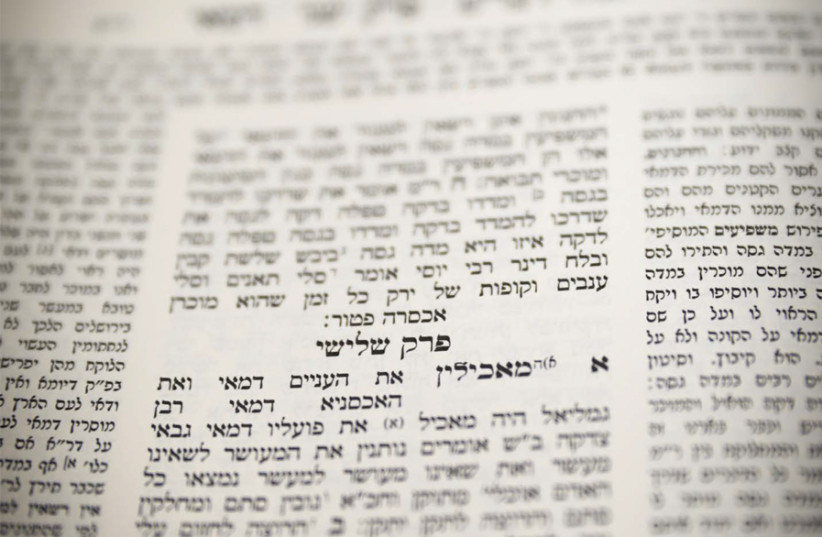
Many Jewish holidays, such as Shabbat, Passover, and Shavuot, revolve around food. The book is scholarly and interesting, divided into chapters like “Sausages and Methodology,” “Beginning with Basics: Bread,” and “How It Was Cooked: Two Hundred Ways of Preparing an Egg.”
In the latter, we read: “Whether eggs were actually eaten together with salt water as is traditional among many Jews today at the Passover Seder meal is unclear…They were certainly eaten sprinkled with salt, as there is a discussion in the Babylonian Talmud whether eggs or radishes may be salted on the Sabbath.”
A few paragraphs later, we learn something surprising.
“Eggs were also eaten sweet, with honey. A minimal quantity of honey is defined in the Palestinian Talmud as ‘enough to cook a light egg.’ Was this egg then beaten up and cooked in boiling honey?...Or were the eggs and honey cooked slowly together?”
In the chapter “Fermented Foods: the Raw, the Cooked and the Rotten,” Weingarten notes that fermentation was a good way of preserving food without refrigeration.
“It was not only bread and winemaking which made use of fermenting food,” she writes. “Fish, milk, and cereals were also fermented, and one side effect of controlled fermentation, with the added salt needed to combat microbial spoilage, were the resulting very strong-tasting products which ensued: a bonus for varying a diet where the main dietary staple, bread, tended towards the bland and boring…Modern research has also pointed out that these fermented foods would have been a source of the umami taste which acts as a flavor enhancer, due to the presence of monosodium glutamate produced in the fermenting process.”
Weingarten said that most Roman and Greek literature at the time was written by aristocrats for aristocrats about the food eaten by aristocrats, as most ordinary people couldn’t read.
“They were not very interested in the everyday food of ordinary people,” she said. “The same holds true of the cookbooks written for the caliphs. It is almost only fancy food. On the other hand, the rabbis were interested in everyday food and how it was made, in order to bring it under halachic control. Cooking was forbidden on Shabbat: But was drying food in the sun cooking? Was rolling an egg in hot sand cooking? What about soaking salt fish in water to get rid of the salt on Shabbat? So, information about food from Talmudic sources can fill in the gaps about ordinary food in our picture of food in late Antiquity.”■
- Ancient Jewish Food in Its Geographical and Cultural Contexts Studies in the History of the Ancient Near East
- By Susan Weingarten
- Routledge, 2025
- 322 pages; $133 (hardcover)