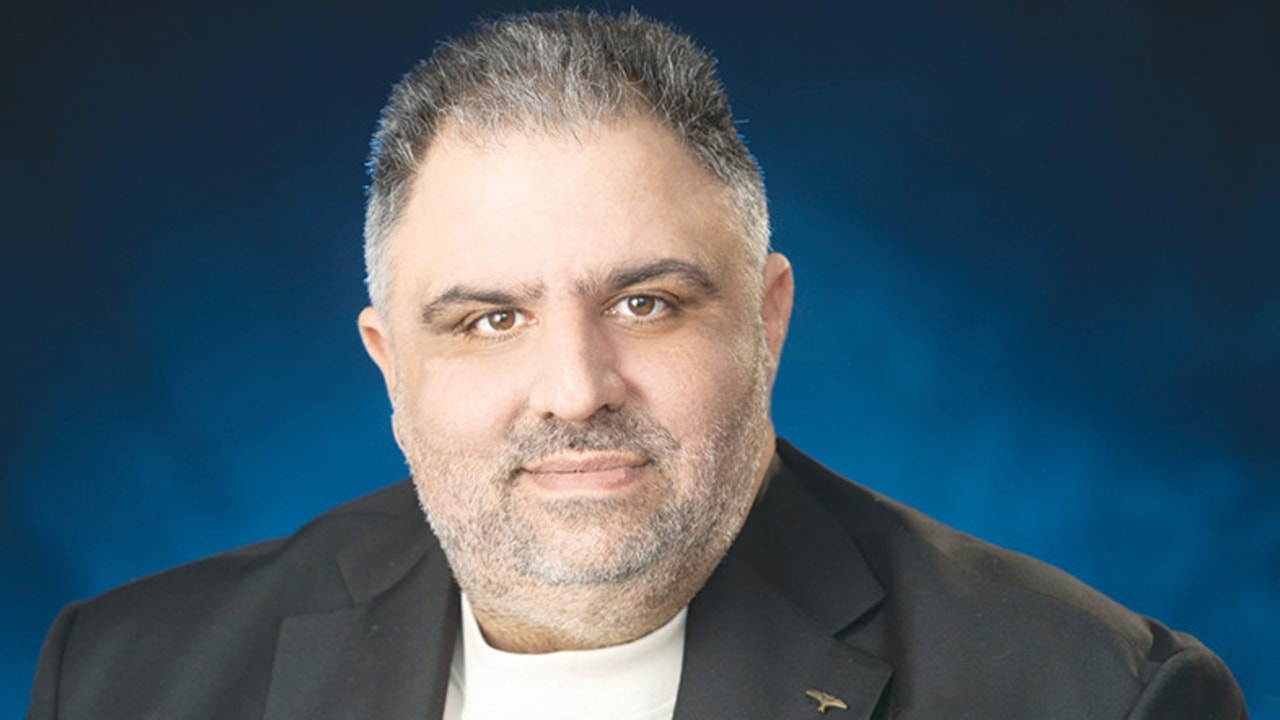
KKL-JNF Chairman Eyal Ostrinsky is on the phone when I walk into his office in Jerusalem. I have been in this building many times over the years. What is different this time is the register of the conversation. Ostrinsky is instructing his staff, in very specific terms, on an emergency deployment of portable shelters to municipalities in the North. Where. How many. Which towns get them first?
He wraps up, apologizes, and sits down. We meet after the ceasefire that ended Operation Roaring Lion, but nothing in the room feels settled.
“We cannot rebuild after every round,” he says. “We have to solve this now.”
Ostrinsky, 41, is the youngest chairman KKL-JNF has had in decades, elected by the board in late December as part of a coalition deal between the center-left liberal bloc and the Likud at the World Zionist Congress. He took office on January 1, succeeding Ifat Ovadia-Luski, the first woman to hold the post.
The election came sharpened by the scandal over Culture and Sport Minister Miki Zohar’s attempt last October to appoint Yair Netanyahu to a department head role at a minister-level salary, a move that collapsed under public pressure and pushed the rival blocs toward a compromise. In that sense, Ostrinsky is the candidate nobody fully planned for, which may be why the job suits him.

His pace is unbelievable. He has held 10 executive committee meetings and nine board meetings in his first three-and-a-half months, a rhythm he contrasts with recent terms, when the board sometimes convened five or six times a year.
“I want fast decisions, fast meetings, fast execution,” he says. “Where bureaucracy is excessive, I want it cut, and cut sharply.”
He speaks the way he runs meetings – fast, each sentence packed with numbers and dates and line items. Every figure in his enormous budget seems to be available to him from memory. He does not reach for a briefing book once, in the course of our conversation.
His first personal test came quickly. Three weeks into his term, his wife went into premature labor at 28 weeks. Their daughter spent two months in the neonatal intensive care unit. Ostrinsky ran the organization from a hospital lobby, moving between the incubator and a rotating cast of officials who needed decisions.
“My wife was extraordinary,” he says. “We try to split parenting evenly. This time, that was not possible. I was going baby, meeting, baby, meeting.”
The daughter is home now. He is, by his own account, very tired.
The reform agenda he came in with was not subtle. He wanted what he calls a “public rehabilitation” of KKL-JNF: fewer flights, fewer conference sponsorships, fewer expenses of the kind that have made the organization a recurring target of Israeli investigative journalism. Channel 13’s Raviv Drucker’s older reporting on emissary spending still trails the institution, as do more recent complaints about jobs handed to political insiders.
“Some of those criticisms are real,” Ostrinsky says. “From the first day, I said I wanted not only an efficiency program but a public rehabilitation. You cut waste, you narrow the gap between resources and purpose, and you refocus on what the organization was built to do.”
That refocus thesis got stress-tested on February 28, when Iranian missiles reached Israeli cities. In the first week of the war, Beit Shemesh and Beersheba were hit. Two days later, Ostrinsky was in Beit Shemesh. Not, he says, on an “anthropological tour” but to ask a single practical question: What do you need right now?
The answer was money. Within days, the executive committee approved NIS 2.5 million each for Beit Shemesh and Beersheba – NIS 1m. for immediate emergency use, and NIS 1.5m. for protection.
Dimona and Arad, hit two weeks later, got the same treatment on a tighter clock.
“The incident happened on Saturday night,” Ostrinsky says. “By Monday we were touring the sites, holding the executive committee in Arad, and approving the assistance that same day.”
People needed somewhere to breathe
In Arad, the city used part of the money to harden the municipal country club, which had been closed because it lacked adequate protection. People needed somewhere to breathe.
The North was another category of problem. Residents were running to shelters 20, 30, sometimes 50 times a day. Ostrinsky spent a full day calling heads of local authorities along the confrontation line, Kiryat Shmona, Shlomi, Metula, Nahariya, and Ma’alot among them, asking what they needed. The answer, he says, was not full-scale evacuation, which neither the government nor the municipalities wanted. It was respite. Short, organized breaks of three or four days, with transport, lodging, education, and cultural programming handled end-to-end.
He began with NIS 7m. When the situation continued, local authority heads asked for more. The program grew to NIS 32m. In one week alone, more than 8,000 residents from the northern line were moved to hotels for five days, with thousands more scheduled the week after. The total exceeded 13,000 residents.
Farmers raised a parallel problem: they could not work the fields, because there were no protected spaces nearby. Regional councils submitted mapped requests for roughly 200 agricultural shelter units. Ostrinsky committed to 120-130.
He spent Passover Seder night in a shelter in Kiryat Shmona, with the mayor and thousands of residents distributed across roughly 70 public shelters.
“Some of the shelters had been refurbished and were decent,” he says. “Others were not.”
By the next morning, renovation of public shelters in Nahariya, Shlomi, Kiryat Shmona, and Ma’alot was a line item in the budget.
Ostrinsky came to this job from politics. He joined the Labor Party in 2005, after army service in a unit that tracked down deserters. (He was rejected for combat because of a childhood cancer, he mentions in passing.) He helped run Danny Atar’s 2015 campaign for the KKL-JNF chairmanship and entered the institution as a senior adviser.
Avraham Duvdevani, the veteran chairman of the World Zionist Organization, used to joke that Ostrinsky learned in three months what others had not learned in 30 years.
He returned to politics as an adviser to MK Eitan Cabel, served as senior adviser to Amir Peretz when Peretz was Labor Party chairman and economy minister, and in 2020 was pulled back into the national institutions by Yizhar Hess, now WZO vice chairman. He was Hess’s chief of staff until this term.
He is widely considered one of the strongest political operators in the national institutions, a figure who worked his way into a seat many others in this world could only dream of. He describes himself as a “consensus person” with liberal and progressive values, and a pragmatic political style he traces to the old Mapai instinct.
“Politics should aim at action and realization,” he says, “not only shouting from the opposition benches.”
He supported the Netanyahu-Gantz unity government in 2020. When it collapsed, he concluded politics had become too unstable, and began thinking about returning to the institutions.
The reform thesis, once you strip away the rhetoric, is simple: spend less on the machine, spend more on the mission, and narrow the list of missions.
He names three core fields. Forestry is first. The climate context has shifted, and Ostrinsky wants to greatly expand forested areas, push tree planting as a measurable target, and confront the tree die-off that climate change is accelerating. He wants the public in the forests, too: more accessibility, more trails, more picnic areas, more lookout points.
Water is second. KKL-JNF plans to invest roughly NIS 100m. a year in new reservoirs with the Water Authority, and to widen its model beyond reclaimed-water reservoirs to freshwater reservoirs in the Galilee and the area around Gaza. Stream rehabilitation, an area the organization had quietly abandoned, is back on the agenda.
Land development is third. Ostrinsky speaks in geographic clusters: the Golan, the northern confrontation line, the Galilee, the Gaza border area, the central Negev, the Arava, the Jordan Valley, and the Dead Sea region.
He does not like slogans about “a million new residents.” Real demographic growth, he says, happens one thousand people at a time, and only sticks when schools, culture, and quality of life arrive with them. KKL-JNF is buying apartments in Kiryat Shmona, Arad, Beit She’an, and Nahariya to bring in mission-driven young families. In Kiryat Shmona the target is 300 such families.
On informal Zionist education, he is emphatic. Young Israelis in a year of service before the army, pre-military academies, service-year programs, and youth movements are, in his view, the strongest engines of Zionist leadership. He wants support for informal educational initiatives to rise from NIS 40m. to NIS 60m. a year within two years, and support for field schools from NIS 10m. to NIS 15m.
The list of things he wants KKL-JNF to stop doing is shorter but pointed. Supporting the establishment of medical centers and certain innovation and treatment projects, he says, is not the organization’s job. “We drifted into too many projects that may matter to people but are not in our core mission. I am not saying they are bad. I am saying they are not ours.”
For a KKL-JNF chairman, Ostrinsky talks about the Diaspora more than any of his predecessors I have interviewed in this building. He has a reason. Over the last five years, the organization’s budget for Diaspora work grew from roughly NIS 12m. to roughly NIS 70m. This year it is close to NIS 90m. He wants it higher.
The case he makes is built in two parts. The first is institutional. “KKL-JNF is one of the national institutions. It was built by Diaspora Jewry for the State of Israel and also for the Jewish people. It belongs to the Jewish people, not only to Israel. If the Jewish people now need support abroad, we cannot say our responsibility ends at the state’s borders.” The second is situational. Antisemitism, he says, is a security emergency.
KKL-JNF has doubled its regular budget for antisemitism and campus work from NIS 3m. to NIS 6m., and added a two-year special allocation of close to NIS 20m., above the base budget, for the same areas.
The second Diaspora challenge is Jews distancing themselves from the State of Israel
The second Diaspora challenge, he says, is distancing, particularly among Reform, Conservative, and liberal Jews. Some of that is driven by Israeli government policy. Some is driven by the politics of religion. Here, Ostrinsky does not soften.
“What has been happening around the Western Wall is, in my view, madness,” he tells me. “I say that as KKL-JNF chairman and as someone deeply engaged with the Jewish world. It damages the relationship with Diaspora Jewry. You cannot ignore the fact that millions of Jews around the world are Reform and Conservative, and many more are secular-cultural Jews. Some do not follow every Israeli debate. But leaders do. When they see exclusion and contempt, they move away.”
Covering the American Jewish beat for years, I have heard Israeli officials of every party use the word “painful” about this subject. I have rarely heard use of the word “madness.” That a KKL-JNF chairman, whose seat exists because Diaspora Jews built and funded it for more than a century, has chosen that word on the record is the news.
He reaches for a specific example. Rabbi Elliot Cosgrove of Park Avenue Synagogue in New York took out his phone during services on October 7, 2023, and instructed congregants to donate to the emergency effort through the federations immediately.
“That tells you something about commitment,” Ostrinsky says. “We have to invest in Zionist leadership development across the streams, including Reform and Conservative communities. The Israeli government may be doing everything possible to push them away. We have to do everything possible to keep them close, even when the relationship is conflicted.”
When I press him on whether this is really the job of a land-and-water institution, he does not hesitate. “KKL-JNF’s identity is national. The Jewish people is the broader frame. If the frame is in crisis, the institution has to show up.”
He is quietly dismantling an old piece of KKL-JNF infrastructure, too. The “central educational emissary” positions, one senior emissary dispatched to a country and then absorbed into a round of ceremonial events, have been canceled this year.
“I do not believe in that model,” he says.
What he wants instead he calls “edge-level shlihut”: youth in pre-army community service, youth movement emissaries, campus emissaries, teacher emissaries, deployed where the Jewish demographic engine actually lives.
Strong communities, he says, can bring in emissaries themselves. Midsize ones, in Rome or a secondary American city, need a financial push. KKL-JNF, in his telling, is there to close that gap. Support for global youth movements is now roughly NIS 15m. a year. He expects it to climb toward NIS 20m.
He rejects the old metric of measuring Jewish connection only by aliyah. Today, he says, a young Jew who remained in the Diaspora but is running a Jewish communal institution and is engaged with Israel is a success story, not a failure. That framing matters more than it looks. It is the difference between an institution that treats the Diaspora as a recruiting pool and one that treats it as a constituency.
Before we finish, I ask him what he wants KKL-JNF to be measured by. He answers in one word: impact.
“If we support youth doing a year of pre-army community service, I want to know whether the number went from 30 to 50,” he says. “If Birthright asks about a volunteer track, I want to know whether it grew from 4,000 to 6,000. If we planted trees, I want to know how many trees actually live. We put in NIS 10m., and this is the change it produced. And if it did not produce change, we say that, too.”
He takes a view some would find unfashionable about the right-wing and haredi partners around the board table. “Zionism won,” he says. “The Reform movement joined after not being there at the beginning. The haredim came in later, too. It is messy. It is also a sign that these institutions still matter.”
Toward the end of the conversation, Ostrinsky seems genuinely surprised that I have not pressed him harder on internal political disputes in the national institutions. Some of them I already know about, I tell him. Others I do not want to know about. He laughs, and we move on.
As I leave, his staff is back at the door with a map of northern localities and a list of shelter sites awaiting sign-off. The ceasefire is holding. The North is not.
Ostrinsky has roughly two-and-a-half years before the chairmanship passes to a Likud successor under the coalition deal that brought him in. He is running the clock as though he knows it.