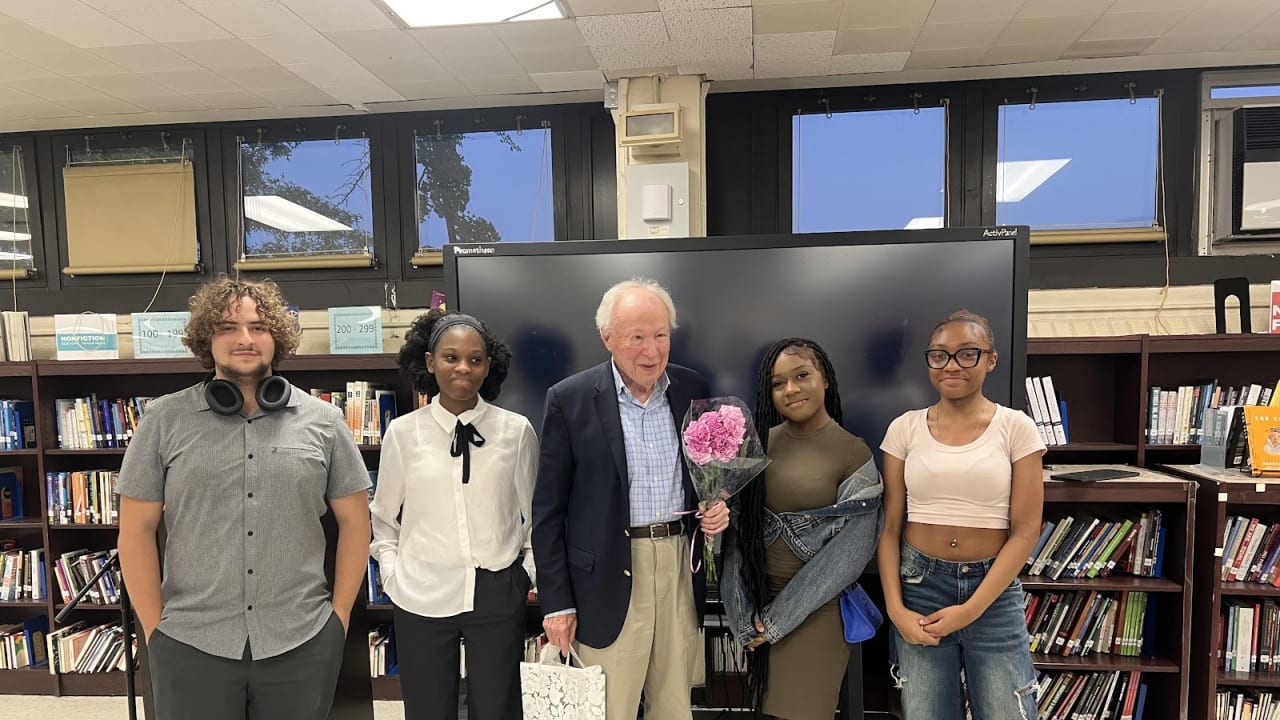
The Edward R. Murrow High School in Brooklyn has made history as the first New York City public high school to partner with Names, Not Numbers. This Holocaust education program trains students to conduct interviews with survivors and document their stories on film.
This past Wednesday night, students, parents, administrators, elected officials, and survivors gathered to watch the premiere of Names, Not Numbers: A Movie in the Making, which chronicles the resilience of five Holocaust survivors.
At the heart of the initiative is Karen Wagner, a teacher at Murrow who created a course called Holocaust and Human Behavior. Driven by a sense of urgency to bring Holocaust education into secular classrooms, Wagner pushed to launch the program.
“When you listen to a witness, you become a witness,” she told her students, quoting writer Elie Wiesel.
“These words have a special meaning tonight. We have just heard from the voices of Holocaust survivors, witnesses to one of the darkest chapters in human history. By hearing them, we have all become witnesses,” Wagner said.
Principal Allen Barge praised Wagner’s vision and the dedication of her students. “What started as an idea became something much bigger and more powerful than we expected,” he said. “This program is about learning from the past to make the world better.”

Superintendent Michael Prayor applauded the students directly, calling them “the leaders we need to make a difference.” He expressed hope that the program would expand to more schools in Brooklyn. “We need this in our classrooms – urgently,” he said.
Mariya Markh, the chief of staff for Assemblyman Kalman Yeger and a Murrow alumna, said, “My grandfather survived the camps, but he never spoke about it.”
“When I finally saw a taped interview with him, it was like having him back in the room.” She emphasized that this project helps ensure these stories are not lost. “This isn’t ancient history,” she said. “Survivors are still here.”
Tova Rosenberg, the project’s creator and director, placed it in historical context. Quoting Gideon Hausner, the lead prosecutor at the 1961 Eichmann trial, she told the audience that the voices of survivors continue to carry the weight of history.
“I am not standing alone. With me are six million accusers, but they cannot rise to their feet and point an accusing finger... Therefore, I will be their spokesperson,” Rosenberg said.
21 years later the program has involved 5,000 survivors and 8,000 students
She continued, “In 2025, it is the survivors and the students in this project who are continuing to unfold the indictment by telling their stories. Now in its 21st year, Names, Not Numbers has involved over 5,000 survivors and nearly 8,000 students worldwide.”
The Names, Not Numbers program receives support from a major national foundation, assistance from the Conference on Jewish Material Claims Against Germany, and backing from Germany’s Finance Ministry and the Foundation for the Record of Responsibility and the Future.
The survivors’ stories left a profound impact. Dorothy Berman, a Krakow ghetto survivor, noted, “I’ve only done this in Jewish private schools, and it means even more here, where students may not have this background.”
She added, “It’s insane that I’m going to a survivors’ event and I’m worried about my grandson wearing a kippah on the subway to get here.”
Another survivor, Ernie Brod, echoed her concerns: “My life began with antisemitism – and now I’m ending it surrounded by it again.”
Students discussed the lessons they had taken away. One said, “At the time, they [some Jews in the Holocaust] were my age. They should’ve been in high school, worrying about graduation or what college to go to, but instead, they had to worry about surviving.”
Another asked the question at the heart of the issue: “How can you hate someone you don’t even know?”
A third student said that the experience transformed his understanding of history. He explained that speaking to survivors made history feel real and not just something out of a textbook.
The students’ interviews with Holocaust survivors Dorothy Berman, Ernie Brod, Dori Katz, Manfred Korman, and Sally Muschel are expected to serve as a living archive, ensuring that these stories reach future generations.
Wagner said, “The stories we heard tonight weren’t just reflections; they were invitations. I implore you to be upstanders. Go out and do something extraordinary – each in your own way.”