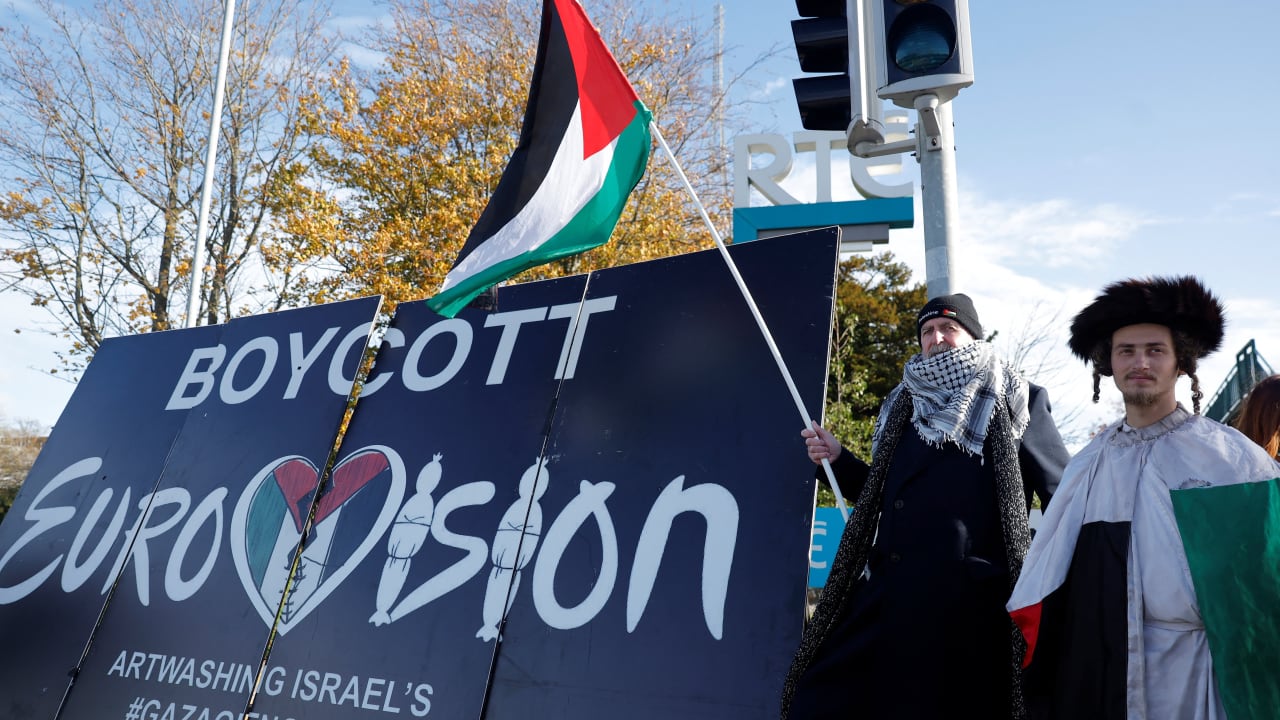
The host broadcaster of the next Eurovision Song Contest, Austria's ORF, will not ban the Palestinian flag from the audience or drown out booing during Israel's performance as has happened at previous shows, organizers said on Tuesday.
The 70th edition of the contest in May will have just 35 entries, the fewest since 2003, after five national broadcasters, including those of Spain, Ireland, and the Netherlands, said they would boycott the show in protest against Israel's participation.
What is usually a celebration of national diversity, pop music, and high camp has become embroiled in diplomatic strife, with those boycotting saying it would be unconscionable to take part given the number of civilians killed in Gaza as part of Israel's retaliation to the October 7 attack by Hamas in 2023.
"We will allow all official flags that exist in the world, if they comply with the law and are in a certain form, size, security risks, etc," the show's executive producer, Michael Kroen, told a news conference organized by ORF.
"We will not sugarcoat anything or avoid showing what is happening, because our task is to show things as they are," Kroen said.
The broadcaster will also not drown out the crowd's booing, as happened this year during Israel's performance, according to ORF's Programming Director Stefanie Groiss-Horowitz.
"We won't play artificial applause over it at any point," she said.

Austria supports Israel participating in 2026 Eurovision
Israel's 2025 entrant, Yuval Raphael, was at the Nova music festival that was a target of the Hamas-led attack. The CEO of Israeli public broadcaster KAN News had likened the efforts to exclude Israel in 2026 to a form of "cultural boycott."
ORF and the Austrian government were among the biggest supporters of Israel participating over the objections of countries including Iceland and Slovenia, which will also boycott the next contest in protest. ORF Director General Roland Weissmann visited Israel in November to show his support.
This year's show drew around 166 million viewers, according to the European Broadcasting Union, more than the roughly 128 million who Nielsen estimates watched the Super Bowl.