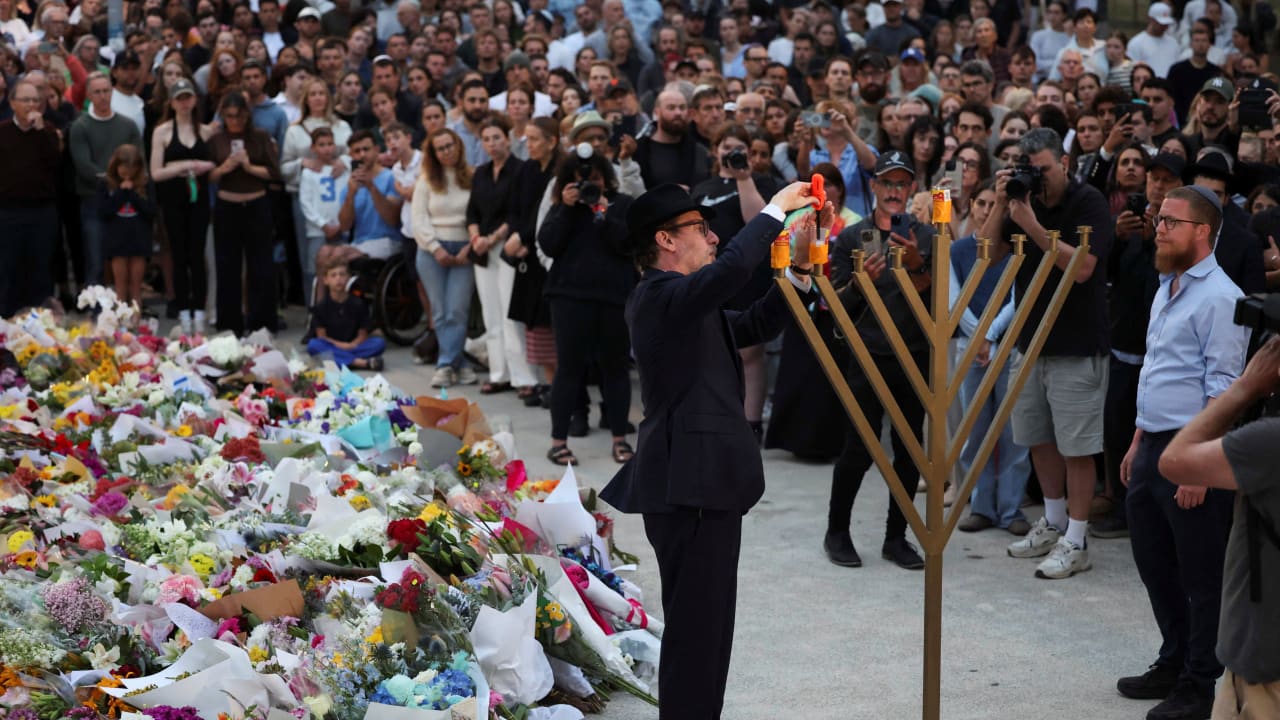
In the hours after the terror attack at a Hanukkah celebration on Bondi Beach, the newsroom of Sydney’s The Daily Telegraph shifted into crisis mode, with editors and reporters working late into the night, tracking hospital updates, verifying shaky social media footage, and trying to confirm victims’ identities before publishing names that families might not yet know.
Ben English, editor-in-chief of The Daily Telegraph, described a city and a staff running on adrenaline, confronting a type of violence many Australians never expected to see on their own shoreline.
“It’s obviously a pretty huge day,” he said at the start of our conversation. “But we’re all good here.”
The Daily Telegraph, known locally as “The Tele,” is a Sydney tabloid owned by News Corp Australia, with a combative, direct style and a center-right editorial bent that often leans into law, order, and national cohesion debates.

On Israel and antisemitism, its tone is typically blunt rather than academic. English himself has written from Israel in the past, and the paper has regularly covered pro-Israel community mobilization and warned about antisemitic rhetoric and its consequences.
The words “We’re all good” sounded like a professional reflex, the kind editors use when they are trying to steady everyone else. In truth, English said, Sydney was “really hurting,” and the attack had punctured whatever sense of insulation Australians may have still carried.
Terrorism takes Australia by surprise, despite early warning signs
People in Sydney had already reached for a comparison Israelis understand instinctively.
“People have described it as our October 7,” English said. He recounted a conversation with a close, Jewish friend, someone he had known since primary school, who lived near Bondi and was traveling to Israel to teach for a month. “He was at the airport, and he said, ‘The irony, who would have thought that I’d be safer in Israel than I would be here.’”
Bondi Beach, normally a symbol of Australian ease and sunlit normalcy, became the scene of a massacre at a public Jewish gathering. In the first hours after the shooting, details were still moving, and the list of dead and wounded was still being clarified publicly by officials and media outlets, with early reports differing as identifications and notifications continued.
English said the shock was compounded by uncertainty. “We still don’t know the identities of all the victims,” he said, adding that dozens remained hospitalized.
For English, the attack was not simply another major breaking story. He contrasted it with the mass stabbing at Bondi Junction last year, an incident authorities tied to severe mental illness. “Which was horrific, absolutely, in itself,” he said. “But this is a new level of horror because it’s the culmination of what so many people have warned was coming.”
He framed the moment as a national reckoning. “There’s a whole heap of reflection and examination going on about the past two years,” English said, “and the way that, in many people’s minds, the cancer of antisemitism has not been dealt with adequately, not even nearly dealt with adequately.” He added that there was “no satisfaction” in feeling warnings had been ignored. “We all feel like we’re in something of a nightmare right now.”
I asked whether he saw the violence as directed only at Jews or as a broader threat to Australia.
“Oh, unquestionably, this is an attack on all Australians,” English said. But he also emphasized the symbolism of the target and the location. “It couldn’t have been more pointed at Bondi. We’re not immune.”
Then he delivered the phrase that has been echoing in Australian commentary since: “The global intifada reached our shores.”
English argued that the atmosphere did not change overnight. In his view, Bondi Beach was not an isolated eruption but the most catastrophic point on a rising curve.
He pointed to what he described as the escalation in extremist rhetoric and street-level intimidation since October 2023, including the demonstrations in Sydney immediately after the October 7, atrocities as evidence that something had shifted in public life well before any shots were fired on the sand.
“This didn’t come out of the blue,” he said. “There were already warning signs that antisemitism was massively on the rise. It’s never really been absent.” He suggested that the post-October 7 environment accelerated a process already underway and that Australia had not confronted it with the seriousness it demanded.
As an Israeli editor-in-chief, I am used to being asked by others about sirens, emergency broadcasts, and the feel of a country in crisis. In this conversation, the roles were reversed. I was calling Sydney to ask how a peaceful beach became a crime scene and how a newsroom functions when the unimaginable lands at its doorstep.
I asked English a question that in Israel is tragically routine and elsewhere still feels intrusive.
“Did you sleep at night?” I asked.
“I got home very late, and I didn’t sleep,” he said. “I’ve probably got a couple hours, and I actually woke up having a nightmare about it.” He spoke quietly about the difference between living with the threat of terror as a persistent reality and encountering it as a rupture. “Unlike you, we’re not used to this,” he said. “You probably delude yourself that it won’t happen here. So when it does happen, even though you’re not surprised, you are utterly shocked.”
He said the trauma was already reaching into his home. “I’m still processing it, as are my children and all my friends and family,” he said.
Bondi was personal for him. He grew up in Sydney’s eastern suburbs and had surfed there since childhood. “It’s such a happy place,” he said. He described the contrast between the normal rhythm of the weekend and the sudden violence as “evocative in a horrible way.”
I asked what his readers were seeking on the first day and how he saw the story evolving.
“This goes through a cycle,” English said. First, the raw hunger for facts, footage, and clarity. Then, the second phase, which he said had already begun. “How was this allowed to happen?” he asked. “Is this a significant intelligence failure of our intelligence agencies that a crazed father-son fanaticist duo could orchestrate this?” He said it was “starting to emerge” that there had been planning, though he stressed that unknowns remained, including whether others were involved.
He also described a political storm gathering around the tragedy. “There’s an enormous political element to this,” he said. “There’s a lot of anger.” He spoke about a growing fear that Australia may be changing into “a different Australia to the one that we thought it was” and that many Jews felt their identity was being pulled into political arguments about Israel in ways that made daily life less safe.
The question of media framing also surfaced. I told English that I had watched Australian television coverage and was struck by how long it took to plainly state that the attack took place at a Jewish community celebration, even as that context was widely circulating online.
English did not hide his frustration. “Unfortunately, the ABC [Australian Broadcasting Corporation], a little bit like the BBC, [is] so terrified of offending minority groups or being seen to be profiling any particular group that they actually depart from reporting the truth,” he said.
He contrasted that approach with what he said his paper tried to do in moments like this. “We try to keep things simple at The Daily Telegraph,” he said. “Just be factual.”
Then he defined the facts as he saw them. “This was an attack by Islamist extremists on primarily Jewish people,” he said, adding that non-Jewish victims were also killed. He described it as a “pointed, orchestrated, planned attack” carried out on a public Hanukkah gathering, one of the most visible moments of Jewish communal life.
As our interview ended, English described what his newsroom was preparing for the next day’s front page: the victims, the faces, the human cost. The image he singled out was of a child, a 10-year-old girl named Matilda, who he said would symbolize the innocence destroyed on Bondi Beach.