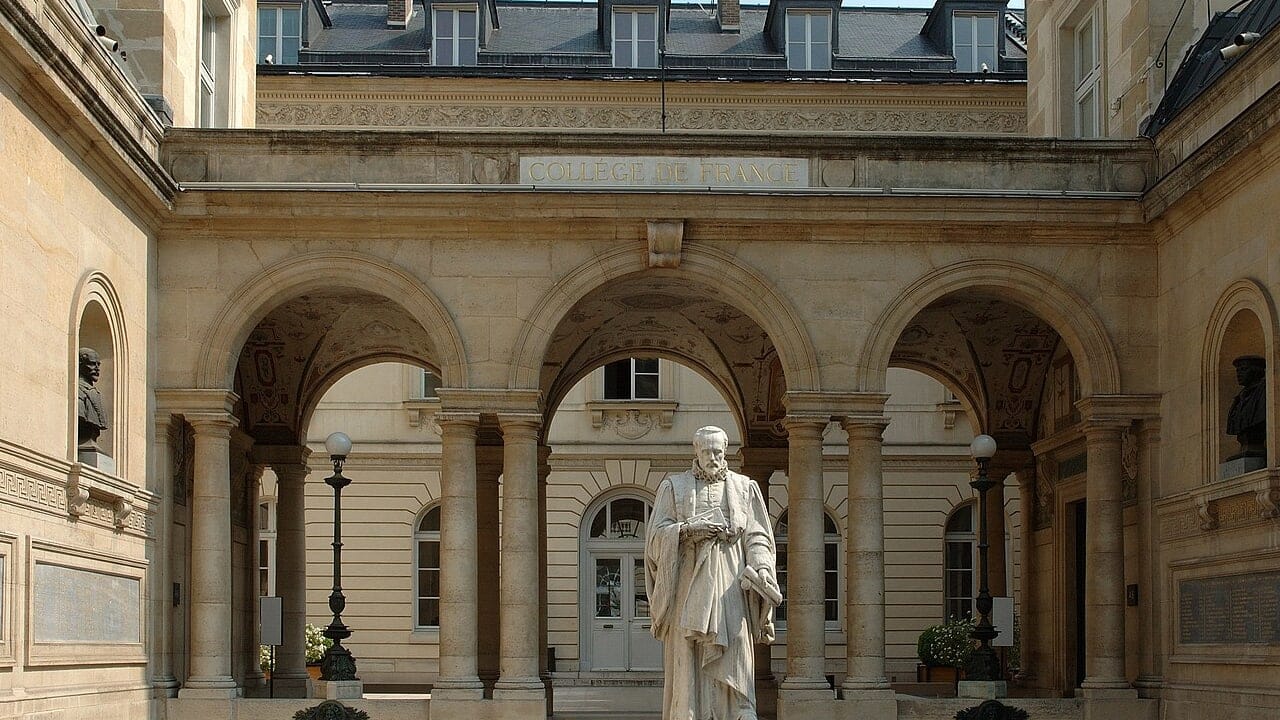
After several days of heated debate, the Collège de France has canceled an upcoming symposium on the subject of Palestine.
The panel “Palestine and Europe: the weight of the past and contemporary dynamics” that was scheduled for November 13 and November 14 was co-organized by Prof. Henry Laurens, the chair of Contemporary History of the Arab World at Collège de France, and the Arab Center for Research and Political Studies in Paris (CAREP).
It was set to platform speakers from the University of Amsterdam, SOAS University of London, the Université libre de Bruxelles, the Complutense University of Madrid, and others. The first two sessions were to be devoted to the history of the Zionist movement and Palestine under the British Mandate.
It first attracted attention (and controversy) on November 7, when Le Point published an article about CAREP being funded by the Doha Institute (and its treasurer, who lives in Qatar).
Le Figaro has also described CAREP as “the intellectual spearhead of the Muslim Brotherhood.”

The former president of CAREP, François Burgat, said in 2024, “I have infinitely, I mean infinitely more respect and consideration for the leaders of Hamas than for those of the State of Israel.”
He was prosecuted for the remarks but later acquitted. Notably, CAREP stood by him in “full solidarity.”
Moreover, Le Point exposed some of the expected speakers and moderators, including anthropologist Véronique Bontemps, who was recently the subject of a disciplinary procedure for “glorifying terrorism”; CAREP development head Muzna Shihabi, who celebrated Hamas’s October 7 massacre; history researcher Thomas Vescovi, who said classifying Hamas as a terrorist movement poses “a democratic problem”; and historian Jihane Sfeir, who spoke in a blog post published at the end of October 2024 of “Israeli necropolitics toward the Palestinian people.”
The International League Against Racism and Antisemitism (LICRA) expressed deep concern over the panel, writing on X/Twitter: “Hamas supporters, BDS militants, Al Jazeera editorialists... the ‘symposium’ organized by the Collège de France on November 13 and 14 looks more like an anti-Zionist fair than a moment for debate and the confrontation of ideas.”
“La Licra [LICRA] is astonished by this perversion of a prestigious institution founded in 1530,” it added.
Following a few days of debate in France, the research establishment released a statement on Sunday announcing the colloquium’s cancellation.
“In light of the controversy and the security risks surrounding this symposium, the scientific committee was first advised to hold the event behind closed doors, a solution that ultimately proved unfeasible,” the statement read.
“However, it is also the duty of the administrator of the Collège de France to ensure the safety of the institution’s staff and audience, and to prevent any risk to public order, and therefore we are obliged to cancel.”
THE COLLEGE said that it maintains “strict neutrality regarding political or ideological issues” and does “not advocate, encourage, or support any form of activism.”
'Defending academic freedom means a free, respectful, and plural debate'
France’s Higher Education Minister, Philippe Baptiste, welcomed the cancellation, saying that this was “responsible.”
“Defending academic freedom means defending free, respectful, and plural debate. The symposium was very likely not to meet those conditions,” he said,
“This cancellation is a relief,” Yonathan Arfi, the president of the Representative Council of Jewish Institutions in France, said on X. “Nothing was going well in this conference... neither the biased and militant approach, nor the questionable speakers, nor the indecent date of November 13 [the anniversary of the Bataclan attacks].”
French journalist Céline Pina said the college had been “caught with its hand in the Muslim Brotherhood’s jam jar,” leading it to cancel the “shameful symposium where the worst supporters of Hamas had been given free rein.”
“The problem is that the institution is not backing down because it holds a high idea of the demands of its mission; it is not backing down because academic excellence depends on the pursuit of truth and the preference for facts over ideology,” she said.
“It is canceling the symposium because it got caught, and because the choice of speakers was particularly indefensible. The risk that the whole thing would end up as an apology for terrorism was real,” Pina continued.
The legal organization Actions Avocats, which had alerted the Higher Education Ministry to the event in advance, praised the decision to cancel, saying the event would have been “devoid of any critical analysis.”
“At a time when France is experiencing an alarming resurgence of antisemitic acts, it is essential that our institutions remain spaces of knowledge, not political platforms.”
CAREP and Laurens, however, released a strongly worded statement condemning the decision to cancel.
“Under the guise of ‘guaranteeing scientific rigor,’ the ministry is directly and politically intervening to silence scholarly research – in direct contravention of its fundamental mission to protect academic freedom,” it said.
The statement claimed the symposium had been designed in strict accordance with established scientific and scholarly procedures. It dismissed all accusations of antisemitism as “baselessly disqualifying the work of the researchers.”
“This deliberate confusion between scholarly evaluation and ideological control directly jeopardizes the independence of knowledge,” it added.