For too long, the international community has operated under the assumption that the Islamic Republic of Iran can be contained through limited measures – a round of sanctions here, a targeted airstrike there, and yet another round of diplomatic overtures that yield nothing but time for the regime to regroup, rebuild, and press forward with its destabilizing agenda.
That assumption died on February 28, 2026 with a bold decision by US President Donald Trump and Israeli Prime Minister Benjamin Netanyahu.
When Israel’s Operation Roaring Lion and the US’s Operation Epic Fury launched in the early hours of that Saturday morning, the two attacking countries did what decades of cautious policy-making had failed to do. They struck at the heart of the Islamic regime, eliminating supreme leader Ali Khamenei, dismantling key Islamic Revolutionary Guard Corps (IRGC) command nodes, and crippling the military infrastructure that has for years projected Iranian aggression across the Middle East.
Trump did what no previous US president had the nerve to do; not Obama with his nuclear deal; not Bush, who toppled Saddam but looked the other way on Tehran; not Biden, who dithered while Iran enriched uranium to near-weapons grade. Trump acted.
But striking Tehran is one thing. Winning the peace is another.
As this article is being written, the war is only days old. Three American service members have already been killed in a suspected drone strike in Kuwait, and Trump himself has acknowledged that casualties are projected to climb. Iran has retaliated across the Gulf, hitting targets in the UAE, Bahrain, Qatar, Kuwait, Saudi Arabia, and even Oman. Hezbollah has joined the fight from Lebanon. Missiles have been fired at Israel. The Strait of Hormuz is effectively disrupted.

The immediate military picture is fluid and dangerous. But the strategic question that will determine whether this moment becomes a turning point is not about Tehran. It is about what happens on Iran's periphery.
The periphery is the center of gravity
The regime's weakest points are not in the capital. They never have been. They are in Kermanshah, Sanandaj, Ilam, Sistan-Baluchestan, and Khuzestan - the provinces dominated by ethnic minorities who have borne the brunt of the Islamic Republic's repression for over four decades.
In January 2026, when nationwide protests erupted across Iran in the largest demonstrations since 1979, it was the Kurdish-majority provinces in the west that saw the fiercest resistance and the most brutal crackdown.
The cities of Abdanan and Malekshahi were effectively abandoned by security forces, with protesters taking de facto control. In Sanandaj, Kermanshah, and across the Kurdish heartland, demonstrators faced live ammunition, mass arrests, and the deployment of IRGC Ground Forces in what the regime described as "clearing operations."
According to human rights organizations, the most intense clashes and highest casualty figures were recorded in Iran's western provinces of Kurdistan and surrounding areas, where the country's Kurdish population is overwhelmingly concentrated. Eyewitness reports indicated that security forces operating in Kurdish areas during the January massacres spoke Arabic, suggesting the deployment of Iraqi Shia mercenaries brought in specifically to suppress Kurdish resistance. Families were forced to pay compensation for the bullets used to kill their own relatives.
And yet, despite all of this, the Kurds kept fighting. They always have.
This is not new. The Kurdish resistance in Iran predates the Islamic Republic itself. From the Republic of Kurdistan in Mahabad in 1946 to the post-revolution insurgency of the early 1980s to the Jina Amini protests of 2022, the Kurds of Rojhelat in eastern Kurdistan have consistently been at the forefront of every major challenge to central authority in Iran. What is new is the level of political organization and coordination that has emerged in recent months.
The Kurdish coalition: ready, organized, waiting
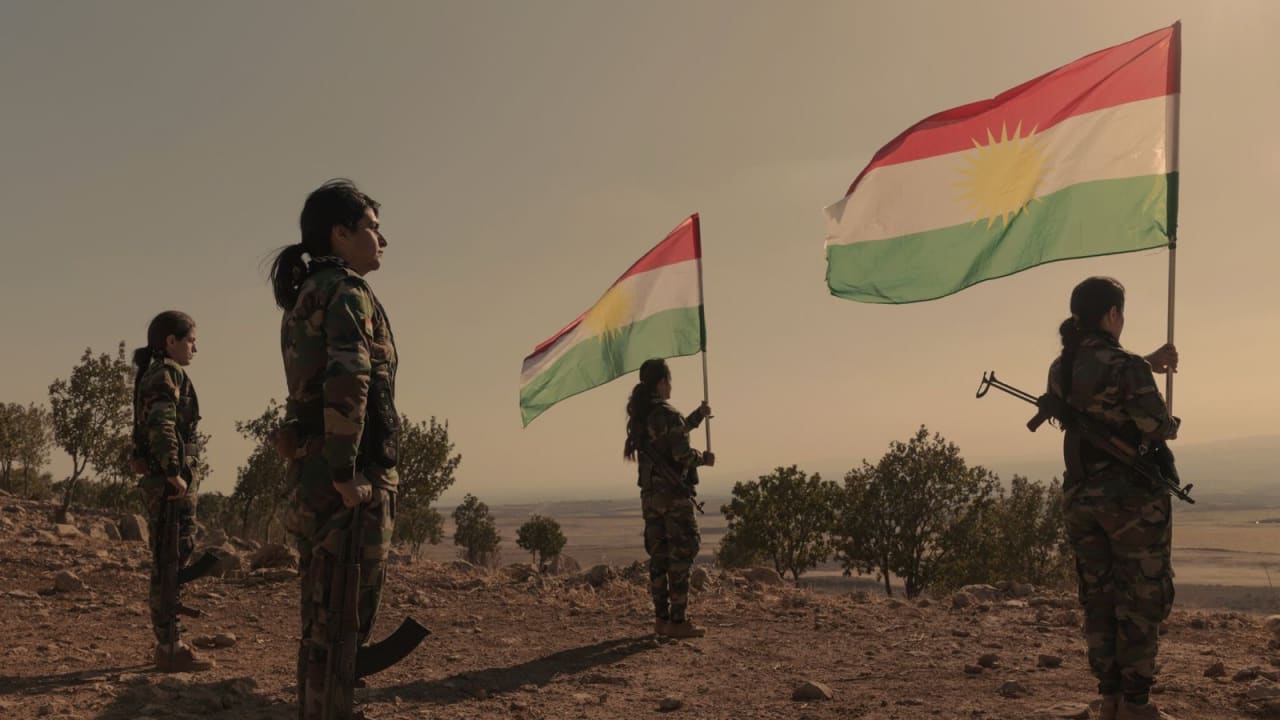
On February 22, 2026, just six days before the US-Israeli strikes began, five major Iranian armed Kurdish parties formalized the Coalition of Political Forces of Iranian Kurdistan (CPFIK). The coalition includes the Democratic Party of Iranian Kurdistan (PDKI), the Kurdistan Freedom Party (PAK), the Kurdistan Free Life Party (PJAK), the Khabat Organization, and a branch of the Komala Party. Their leaders, Mostafa Hijri, Hussein Yazdanpanah, Viyan Peyman, Baba Sheikh Hosseini, and Reza Kaabi, gathered at a joint press conference to announce a unified political and military platform.
This is significant. These are not fragmented rebel groups issuing symbolic statements from exile. This is a coalition with a joint command center for peshmerga and guerrilla forces, a joint diplomatic committee for external relations, and a detailed plan for administering Kurdish-majority areas during a transition period. PDKI leader Mostafa Hijri stated publicly that the coalition has created a "joint plan for administering" Kurdish-majority areas in the event of regime collapse.
Following the February 28 strikes, representatives of the coalition stated that their local forces were "deep inside Iran" and along border regions, ready to respond as the situation developed.
The Kurds are not the only minority preparing.
In December 2025, Baloch militant groups merged into the People's Fighters Front (Jebhe-ye Mobaarezin-e Mardomi), explicitly rejecting Shia-led clerical rule. In Khuzestan, the Ahwazi Arab population has long resisted Tehran's exploitation of the province's vast oil wealth while the local population lives in poverty.
But it is the Kurds who have the most developed political infrastructure, the most experienced fighting forces, and the deepest track record of governance and alignment with the West’s values, thanks in part to decades of institutional development in the Kurdistan Region of Iraq next door.
If any group is positioned to fill a power vacuum on Iran's periphery, it is the Kurds. It is a strategic reality that planners in Washington, Jerusalem, and allied capitals must recognize and act on.
The No-Fly Zone: from theory to urgent necessity
In July 2025, I suggested that a coalition-backed no-fly zone over Iran's eastern and western airspace, specifically over Kurdish and Baloch regions, was a strategic option that must be seriously studied. At the time, the argument was forward-looking. Today, it is urgent.
The air superiority achieved during the opening hours of the combined US-Israel strikes on Iran was decisive. They dismantled Iranian air defences, command nodes, radar installations, and weapons infrastructure across the country. The IDF confirmed the destruction of the general staff of internal security forces and the Thar-Allah Headquarters. The regime's ability to project airpower over its own territory was severely degraded.
But this advantage must not be squandered. If history teaches us anything, it is that temporary air dominance means nothing if it is not sustained and converted into lasting strategic leverage. This is exactly what a no-fly zone achieves.
Consider the situation on the ground. Kurdish peshmerga and guerrilla forces are signalling readiness to act. Baloch fighters in the southeast are mobilized. But these communities will not commit fully, nor should they, without assurance that they will not be massacred from the air the moment international attention shifts or the news cycle moves on.
A sustained no-fly zone over western and eastern Iran provides that assurance. It tells the Kurdish peshmerga in Kermanshah that their skies are protected. It tells the Baloch fighters in Zahedan that they will not face helicopter gunships when they move to secure their towns. It tells the Ahwazi population in Khuzestan that the regime cannot simply fly in reinforcements to crush dissent.
And critically, it denies the IRGC the use of domestic air corridors to resupply, reinforce, and repress. Without air mobility, the regime's ability to project force from Tehran into its restive periphery is fundamentally compromised.
Larijani's warning tells you everything
If there were any doubt about the regime's intentions toward these communities, Ali Larijani, now heading a "temporary leadership council" in the wake of Khamenei's assassination, removed it. In his first public statement, he explicitly warned "secessionist groups" of severe consequences if they took action. This was not subtle. This was the regime telegraphing its playbook: Stabilize central control first, then crush the periphery.
We have seen this before. After every major crisis in Iran, the Kurdish, Baloch, and Ahwazi populations have been the first to suffer retaliatory crackdowns. After the Jina Amini protests, it was the Kurds who were disproportionately targeted for alleged “espionage and collaboration” with Israel. After the 12 Day War in 2025, it was again the Kurds of Iran who bore the heaviest reprisals.
The no-fly zone must be implemented now, before the regime reconsolidates. Every day that passes without it is a day the IRGC uses to reposition, to identify opposition leaders, and to prepare the kind of targeted repression it has perfected over four decades.
The regional landscape has never been more favourable
One of the most remarkable developments of the past 72 hours is the regional reaction - or more accurately, the lack of opposition to the US-Israeli operation.
Iran's retaliatory strikes have hit virtually every Arab state in the Gulf. The UAE, Bahrain, Qatar, Kuwait, Saudi Arabia, Jordan, and Oman have all been targeted. And the response from these capitals has been telling. The UAE, Jordan, and Egypt condemned Iran by name. Saudi Arabia confirmed interceptions of Iranian missiles over Riyadh. Syria, newly liberated from decades of Iranian influence, condemned Tehran and expressed solidarity with the affected Arab states.
In southern Iran, a monument to Ruhollah Khomeini was toppled by civilians. In Damascus and Homs, celebrations were reported.
The so-called "axis of resistance" has so far proven hollow. Tehran achieved something remarkable, though not in the way it intended. It united the Gulf Arab states, the United States, and Israel in a common cause; not through diplomacy but with its own missiles.
This alignment creates an unprecedented opportunity. The Arab states, long wary of Iranian hegemony, would tolerate, and in many cases quietly welcome, a weakened, decentralized Iran. A federal model that empowers Kurdish, Baloch, and Ahwazi self-governance is not a threat to regional stability. It is the answer to it.
A decentralized and partitioned Islamic Iran where ethnic minorities administer their own affairs within a democratic framework is an Iran that can no longer export “revolution,” fund proxies, or threaten its neighbours.
The day after: what must be done
The strategic objectives of the IDF and American forces are clear: Neutralize Iran's nuclear capability, eliminate the regime's command and control architecture, and degrade the IRGC's ability to project force. These objectives are being achieved at significant scale and pace.
But as the Chatham House analysts correctly noted within hours of the strikes, collapsing a regime is far easier than shaping what follows. The parallel with the 2003 Iraq war is difficult to ignore and must be avoided at all costs.
The difference, however, is that in Iran in 2026, unlike Iraq in 2003, there are ready-made partners on the ground.
The CPFIK is not a diaspora fantasy. It is a coalition with armed forces, administrative plans, and territorial presence. The Kurdish peshmerga have decades of experience defending and governing territory. The Baloch People's Fighters Front, while newer, has demonstrated the ability to coordinate and act. These are the building blocks of a post-regime order that does not require American boots on the ground to sustain.
What they require is logistics and support. Communications equipment, humanitarian corridors, diplomatic recognition of their administrative legitimacy, and above all, a no-fly zone that ensures they can operate without being annihilated from the air.
The United States has the largest military buildup in the Middle East since 2003 already in place. The aircraft, the ISR platforms, the radar coverage, the carrier strike groups — they are all there. Sustaining a no-fly zone over western and eastern Iran is not a hypothetical. It is operationally feasible right now.
The window Is open, but not for long
Trump has done what needed to be done. He has broken the cycle of appeasement, half-measures, and wishful diplomacy that allowed the Islamic Republic to terrorize its own people and destabilize an entire region for over four decades. The military operation is bold, decisive, and achieving its immediate objectives.
But military success alone is not enough. The regime may be decapitated, but it is not dead. The IRGC remains embedded in every province. The clock is ticking.
The periphery holds the key. The Kurds, the Baloch, and the Ahwazi Arabs are ready. They are organized. They are willing to fight and to govern. What they need is the assurance that they will not be left behind.
A no-fly zone over western and eastern Iran is not a provocation. It is a commitment. It is the bridge between military victory and a political outcome that serves everyone: the people of Iran, the security of the region, and the long-term interests of the West.
The window is open. It will not stay open forever.
AJ Jaff is a security professional and defense analyst. He writes on Middle Eastern security affairs, geopolitical developments, and Western defense strategy. The views expressed in this article are those of the author.