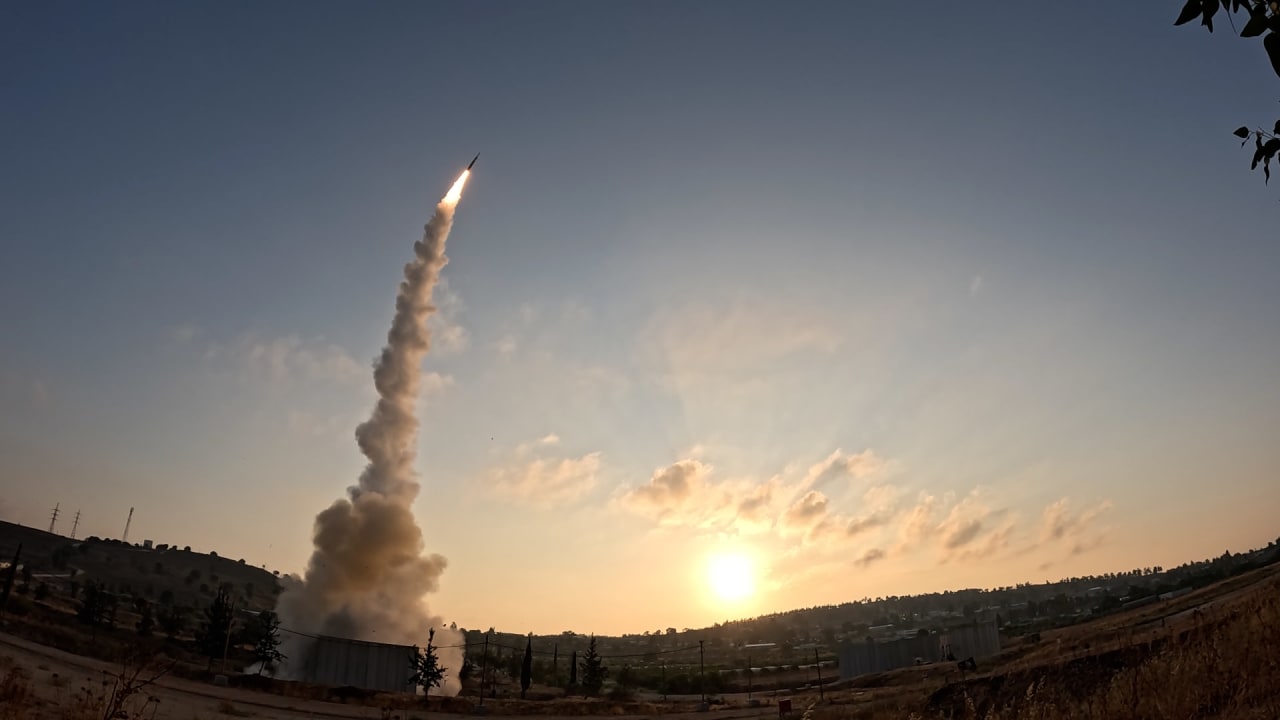
Another war involving the US, Israel, and Iran would be defined by a contest of advanced technologies, not by massed armies or territorial advances.
The balance of power would hinge on long‑range precision weapons, integrated air and missile defense, cyber capabilities, and the ability to fuse intelligence from satellites, drones, and stealth aircraft into a single, coherent picture of the battlefield.
In such a conflict, the side that could see first, decide faster, and strike most precisely would hold the advantage.
The world had a preview of this dynamic in June, when Israel and Iran briefly crossed a threshold that had held for decades, during Operation Rising Lion.
The Jewish State launched a preemptive attack against the Islamic Republic early on the morning of June 12, with its fleet of unmanned aerial systems (UAS) and F‑35I Adir fighters against targets deep inside Iranian territory. Within moments, Israel had aerial superiority after successfully destroying dozens of Iranian missile launchers and air defense batteries.

Over the subsequent days, Iran launched waves of drones and missiles at Israel, many of which were intercepted. Others struck civilian areas in Tel Aviv, Ramat Gan, Beersheba, and Bat Yam.
It was the first openly acknowledged direct exchange of fire between the two sworn enemies, and it demonstrated both Iran’s ability to coordinate large salvos and Israel’s capacity to penetrate Iranian airspace and control it for the length of the war.
The episode underscored both how quickly a confrontation can escalate and how relatively speedily it can end when technologies that compress decision‑making into minutes are involved. That lesson is central to understanding the current tensions.
For Israel and the United States, the strategic priorities for any future conflict are clear: Degrade Iran’s ability to launch missiles and drones, degrade its nuclear and military infrastructure, and protect their own territory and bases.
Highest concentration of assets in over 20 years
Washington has deployed what is being described as the most substantial concentration of naval and air assets in the region since before the 2003 war in Iraq – even larger than prior to the June war with Iran.
The military force buildup is centered on two carrier strike groups equipped with Aegis‑capable destroyers, in addition to over 150 aircraft, including F‑35s, F‑18s, and EA-18 Growlers, which have been moved to bases in Europe and the Middle East.
For the first time, a dozen F-22 Raptors have also been deployed to southern Israel. Additional aircraft are aboard the USS Gerald R.Ford, which docked in Haifa on Friday.
Some of the aircraft are equipped with electronic‑warfare systems that experts have told Defense & Tech by The Jerusalem Post are “essential” to winning any war. Additionally, cargo and refueling planes are continually seen flying between the United States, Europe, and the Middle East on flight tracking platforms.
These forces are not merely symbolic. They form a mobile, networked strike complex able to suppress Iranian air defenses, target missile infrastructure, and provide missile‑defense coverage for Israel and Gulf partners.

Fighter jets, drones and long-range precision munitions
Airpower would remain the decisive tool for Israel and America. Israel’s F‑35I fleet, which played a central role in the 12 Day War, gives it the ability to hit hardened or distant targets with minimal warning. The US, meanwhile, has rotated F‑22s into Israel and F‑35s through other regional bases, supported by Airborne Warning and Control System (AWACS) aircraft that provide wide‑area radar coverage. Tilt-rotor Bell Boeing V-22 Ospreys have also been tracked in the area.
Unmanned systems would play an equally prominent role. Israel is a global leader in military drones, fielding platforms including the Hermes 900, the Heron, and the Harop loitering munition, among others. These systems provide persistent surveillance and can strike mobile targets with little warning and at long distances. The US adds its own fleet of MQ‑9 Reapers, US Navy Northrop Grumman MQ-4C Triton drones, and other high‑altitude surveillance assets.
Iran, meanwhile, has invested heavily in drones, such as the Shahed series, which it has exported to Russia and used across the region. A future conflict would likely feature drone‑on‑drone engagements and large‑scale attempts to saturate air defenses with swarms.
These platforms would be essential in any campaign to degrade Iran’s integrated air‑defense network, command‑and‑control hubs, and nuclear‑related facilities.
The June confrontation demonstrated that Iran’s defenses can be penetrated. However, a sustained campaign would be far more complex, especially if Iran dispersed its assets or relied on underground facilities.
Israel’s upgraded F‑15 and F‑16 fleets, armed with domestically produced stand‑off weapons, such as the Spice guided bomb family and the Rampage missile, add range and precision without requiring pilots to fly directly over defended targets.
The United States brings a broader arsenal of stealth aircraft, long‑range bombers, and cruise missiles. Weapons like the JASSM‑ER and Tomahawk allow US forces to strike from hundreds of miles away, targeting air defenses, command centers, and critical infrastructure. Together, the two militaries can conduct a campaign built around precision and disruption rather than large‑scale continuous bombardment.
Iran’s strategy, as the 12 Day War also illustrated, relies on asymmetric pressure. Its arsenal includes ballistic missiles, land‑attack cruise missiles, and a wide range of drones, many of which have been tested and used by proxy forces in Lebanon, Iraq, Syria, and Yemen. The June attack on Israel involved a mix of these systems, including one‑way attack drones similar to the Shahed models Iran has exported abroad.
In a broader war, Iran would likely attempt to saturate Israeli and US defenses with simultaneous salvos launched from multiple theaters, including through allied militias. It could also target American platforms, including warships currently in the Red Sea, the Mediterranean, and the Indian Ocean.
Air defense is critical
The challenge for defenders is not the sophistication of each individual weapon but the volume and timing of attacks.
Israel’s layered air‑defense network, formed by the Iron Dome, David’s Sling, Arrow system, and now Iron Beam laser defense system, has proved its value over the last two years, intercepting the majority of incoming threats. But a prolonged conflict would test these systems at a scale far beyond what has been seen before.
The United States has reinforced the region with Patriot and, where necessary, THAAD batteries, while Aegis‑equipped destroyers provide additional coverage from the sea.
The June exchanges showed that coordinated defense among Israel, the US, and regional partners can blunt large‑scale attacks, but sustaining that level of interception over weeks or months would strain command and control systems and already limited interceptor stockpiles.
The June war, as well as during the April 2024 attack on Israel by Iran, saw support from US, British, French, and Jordanian forces in intercepting Iranian threats. But this time around, many allies have said that they would not allow Americans to use their bases for their platforms, or have denied use of their airspace to carry out attacks.
But what is said in public is rarely what is agreed to behind closed doors, and when missiles are flying through the air.
Yet, the economic imbalance remains incredibly stark, with interceptors costing up to millions of dollars each, while many Iranian drones and missiles are far cheaper to produce.
War on the water
The maritime domain would be equally contested. Iran’s naval forces rely on fast attack craft, mines, anti‑ship missiles, and drones to threaten shipping in the Strait of Hormuz.
US carrier groups are built to counter these threats, but the June confrontation highlighted how quickly Iran can activate proxy forces across the region, including in the Red Sea and Gulf of Oman, to target commercial vessels. Protecting shipping lanes would require constant surveillance, rapid‑response strike aircraft, and electronic‑warfare capabilities to disrupt Iranian targeting.
Last month, the US Navy’s Nimitz-class nuclear-powered supercarrier USS Abraham Lincoln (CVN-72) and its escorts, from Carrier Strike Group 3 (CSG-3), were deployed to the Middle East after previously conducting operations in the South China Sea. The USS Gerald R. Ford (CVN-78) has also made its way to the region, after taking part in the US military buildup for the mission to capture former Venezuelan president Maduro in January.
Iran’s supreme leader, Ali Khamenei, has also threatened to sink American aircraft carriers, something that hasn’t happened since the end of World War II.
“The Americans constantly say that they’ve sent a warship toward Iran. Of course, a warship is a dangerous piece of military hardware. However, more dangerous than that warship is the weapon that can send that warship to the bottom of the sea,” Khamenei wrote on X/Twitter.
Cyber and space
Cyber and space technologies would shape the conflict in ways less visible but no less consequential. All three actors possess offensive cyber capabilities, and both Israel and the United States have reportedly used them against Iranian infrastructure in the past.
In a future war, cyber operations would likely target air‑defense networks, communications systems, and critical infrastructure. Electronic warfare, such as jamming, spoofing, and radar deception, would further complicate the battlespace.
Space‑based assets, such as satellites for reconnaissance, missile warning, and communications, would underpin nearly every aspect of US and Israeli operations, providing high‑resolution imagery, signals intelligence, and missile-launch detection. Their data feeds into a networked command system that links aircraft, drones, ships, and ground units. The F‑35, in particular, serves as a flying sensor node, sharing information across platforms and accelerating the targeting cycle. Artificial intelligence (AI) is increasingly used to sift through vast amounts of sensor data, identify threats, and recommend responses in real time.
The war in June demonstrated that even a brief exchange can involve hundreds of drones, missiles, and stealth aircraft operating across thousands of kilometers. A full‑scale war would dramatically magnify that complexity, despite the technological edge of the United States or Israel.
The June events also illustrated how narrow the margin for miscalculation has become. In a battlespace shaped by real‑time intelligence, rapid‑fire salvos, and stealth platforms, escalation can unfold faster than diplomacy can contain it.
Technology does not make conflict clean or predictable. And in a region where miscalculation is always possible, the sophistication of the tools involved may raise the stakes even as it promises greater precision.