
Taken in combination with their recent stoppage of CB exports and China's taking their own Gold off the SHFE market, there is likely something very big coming in 2026. Putin knows how to squeeze metals markets. Russia did exactly this in Palladium for years. We report the news and give what it might mean given the flurry of Gold related news items out of BRICS nations
TL;DR
Russia plans to ban gold bar exports in 2026 to curb capital flight and retain strategic resources, per senior government statements.
Current law already bans export of precious-metal scrap through May 2026.
No formal decree yet exists for a bullion ban; the measure remains a policy proposal.
If enacted, global bullion supply will tighten as Russian gold is redirected to domestic reserves.
GFN -MOSCOW: Russia is preparing a major shift in its gold policy that would effectively halt the export of refined gold bars beginning in 2026, according to reporting by the Russian business daily Vedomosti. The plan, attributed to statements by Deputy Prime Minister Alexander Novak and Finance Ministry officials, is framed as part of a broader campaign to curb capital flight, illicit cross-border cash flows, and grey-market movements of precious metals. Though not yet enacted into law, the proposal builds upon existing restrictions on precious-metal scrap exports and growing controls on private bullion movement, signaling a coordinated push to retain domestically produced gold inside Russia.
Don't miss out on the opportunity to invest in Gold & Silver. Check out our featured companies today: (Ad)

Augusta Precious Metals — Named “Best Overall” by Money Magazine and trusted by high-net-worth investors. Augusta specializes in premium IRA and 401(k) rollovers, offering direct access to educational 1:1 web conferences and U.S. Mint-approved gold and silver.
- Minimum Investment: $50,000
- Fees: $0 storage up to 10 years
- Rating: ★★★★★ (A+ BBB, AAA BCA)

Goldco — With over $2 billion in precious metals placed for customers, Goldco is a leading name in Gold & Silver IRAs and direct bullion purchases. Known for its strong buyback program and industry awards, Goldco offers both IRA and non-IRA investments.
- Minimum Investment: $25,000
- Buyback Guarantee: Yes
- Rating: ★★★★☆ (A+ BBB, AAA BCA)

American Hartford Gold — Ranked #1 Gold Company on Inc. 5000, endorsed by Bill O’Reilly and Rick Harrison. AHG offers flexible IRA rollovers and direct gold & silver purchases, serving over $2B in precious metals to clients nationwide.
- Minimum Investment: $10,000
- Endorsements: Bill O’Reilly, Rick Harrison
- Rating: ★★★★☆ (A+ BBB)
Vedomosti reported that officials said "from 2026 Russia will restrict the export of cash rubles of uncertain origin and gold bars," describing the effort as a nationwide initiative to "whiten" financial flows and improve state oversight of strategic resources. No details were provided on implementation mechanisms or whether exemptions would apply to state-directed exporters, leaving the ultimate scope unresolved pending publication of a formal decree. This comes after GoldFix reported Russia had recently ceased selling its Gold to former soviet states to raise cash.
What is confirmed is the continuation of Moscow's ban on exporting precious-metal waste and scrap through May 31, 2026. Under Decree No. 1947, Russia has prohibited outbound shipments of recyclable materials containing gold, silver, platinum, or palladium, aiming to protect domestic refining feedstock and reduce capital leakage through undervalued exports. Russian industry publications report the measure is designed to expand the local precious-metals processing chain by keeping input materials inside the country rather than exporting semi-processed supply.
The proposed bullion export ban would represent a much broader escalation. Russia remains one of the world's largest gold producers, with bullion exports historically serving as a critical foreign-currency earnings channel. Since Western sanctions reduced access to dollar and euro settlement systems, gold has assumed an increasingly strategic role. Reuters reported in November that the Russian central bank has expanded domestic operations in the gold market as part of reserve management and fiscal support programs under sanctions pressure, reducing Moscow's reliance on foreign bullion markets and expanding physical circulation within its domestic financial infrastructure.
Earlier proposals focused on limiting individual bullion exports to small allowances of roughly 100 grams per traveler, but the measure referenced by Vedomosti would replace those thresholds with what amounts to a wholesale ban on exporting gold bars. Such an approach would consolidate gold flows within internal state frameworks, likely channeling production toward reserve accumulation, domestic collateral use, or sanctioned settlement systems rather than export sales.
Officials present the initiative as an anti-smuggling and anti-capital-flight measure rather than a restriction on domestic ownership or trade. Gold's portability makes bullion particularly attractive for covert wealth transfers, and authorities have cited illicit cross-border bullion movement as a recurring problem since 2023. Blocking exports would remove a key pathway for such flows while tightening state oversight of financial assets.
Uncertainty remains around the final structure of any ban. It is unclear whether restrictions would apply equally to private miners, refineries, jewelry exporters, and state institutions, or whether certain government trading channels would receive exemptions. No formal regulatory text has yet been released, and market participants note that guidance remains preliminary.
If enacted fully, the policy could marginally tighten global bullion supply by removing Russian bars from international markets. Russia's output historically accounted for a noteworthy share of global mine supply, and the withdrawal of that metal from export channels could contribute to localized availability constraints and elevated physical premiums. Analysts also suggest domestically produced gold would be increasingly absorbed by government reserves, Russian banking collateral systems, or internal payment networks rather than reaching global trading hubs.

The scrap ban already in force provides a preview of Moscow's wider strategy: prioritizing internal processing capacity, domestic liquidity, and capital controls over immediate foreign-currency export revenue. Extending this approach to finished bullion marks a deeper shift from export monetization toward sovereign resource retention.
WHAT IT COULD MEAN
Over the past month, a rapid sequence of coordinated developments has begun to emerge across Asia and Eurasia that reframes Russia's proposed gold export ban as part of a wider monetary realignment.
Cambodia has confirmed storage of sovereign gold reserves inside China. South Korea has sourced bullion directly from the Shanghai Gold Exchange. China has formally announced restrictions on silver exports while simultaneously expanding gold warrant issuance on the Shanghai Futures Exchange, accelerating domestic vault construction, and sustaining the largest net physical gold purchases in the world. Indonesia has moved to impose an export tariff on gold to retain domestic supply, echoing Russia's tightening posture.
Against this backdrop, Russia's decision to halt gold bar exports marks not an isolated sanctions maneuver, but the escalation of a developing trend among producing states to internalize precious-metal flows. Gold, increasingly treated as strategic collateral rather than a commodity export, is shifting toward functional treatment as high-quality liquid asset (HQLA) within domestic and regional settlement frameworks. The near-parallel tightening of silver trade, alongside India's ongoing liberalization of silver's monetary role, adds to the pattern.
Taken together, these developments constitute an unusually compressed timeline of sovereign monetary repositioning. Such clustering of reserve retention and trade restriction policies is historically rare. For market observers, the convergence suggests a deliberate shift toward physical metal scarcity management at exactly the moment global financial systems are increasingly strained.
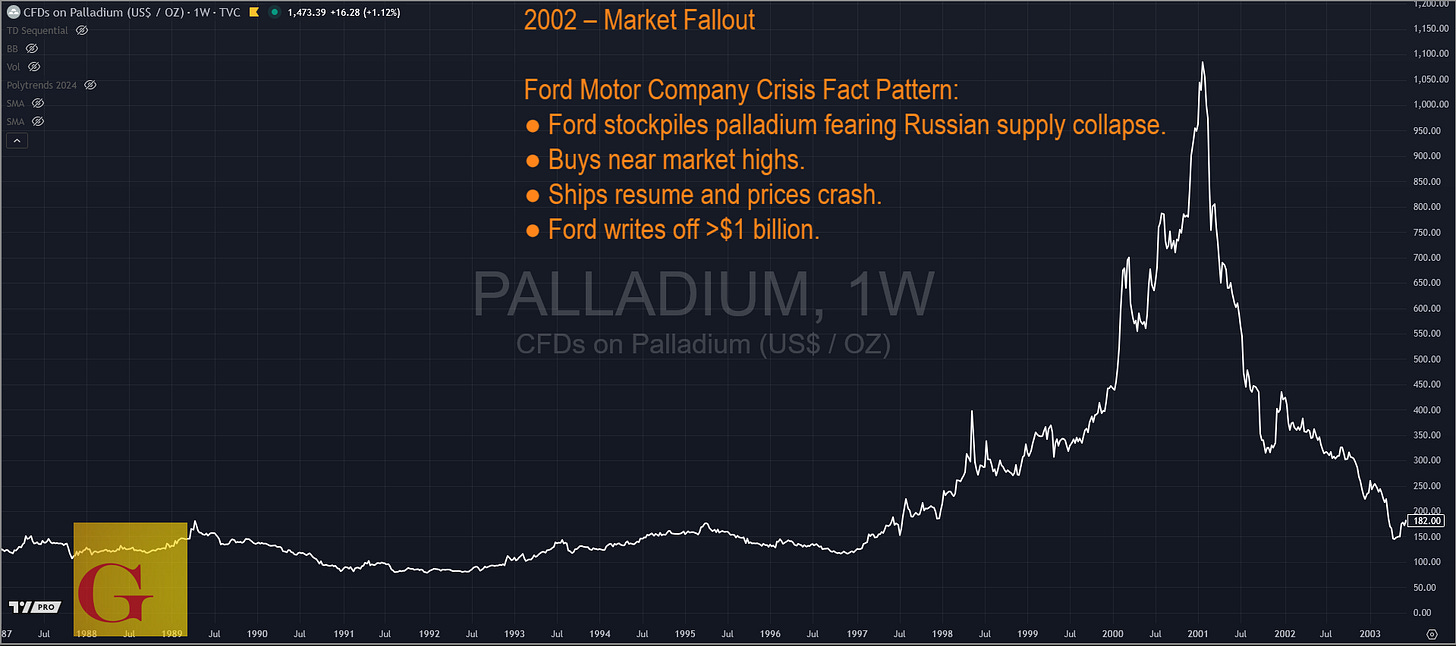
Bigger Picture: Gold on a Similar Path to Palladium
● 1999-2002 constitutes an explicit supply manipulation episode, with Russia leveraging state export quotas to force artificial shortages.
● Post-2002 represents structural influence through opacity and strategic stockpiling, maintaining pricing power without overt embargo.
● Post-2014 pricing behavior confirms that market memory alone prices in Russian leverage risk, meaning Russia's influence continues even without active intervention.
Russia's palladium control has evolved from overt quota manipulation into a durable geopolitical supply weapon whose presence alone can destabilize price when geopolitical stress rises. Gold is on a similar path.
--
Vincent Lanci is a commodity trader, Professor of MBA Finance (adj.) , and publisher of the GoldFix newsletter.
Content quality approved by JPost. JPost oversees the native, paid, and sponsored content on this website and guarantees quality, relevance, and value for the audience. However, articles attributed to this byline are provided by paying advertisers and the opinions expressed in the content do not necessarily express the opinions of JPost.The sponsor retains the responsibility of this content and has the copyright of the material. For all health concerns, it is best to seek the advice of your doctor or a legal practitioner.