
The age and sex of an ancient Egyptian child mummy has been figured out by researchers in Poland, according to a recent study published in Digital Applications in Archaeology and Cultural Heritage.
Using CT scans of the mummy’s tissues and dental development, researchers determined that the mummy belonged to a boy around 8 years old.
The child’s brain had been removed through his nasal cavity, researchers found. Additionally, the absence of a mummification incision on the abdomen indicated that most of the internal organs, including the heart, were either not preserved or removed per rectum.
His eyes, though, are still preserved, and researchers were able to spot his optic nerves in the scans. The torso had been padded with loosely rolled fabric rather than the traditional resin, and the skull was left unfilled.
The front of the child’s head and neck were partially unwrapped, and covered in a noticeable layer of dark embalming residue, though the study added that “the head is still covered in at least four layers of bandages at the back.”
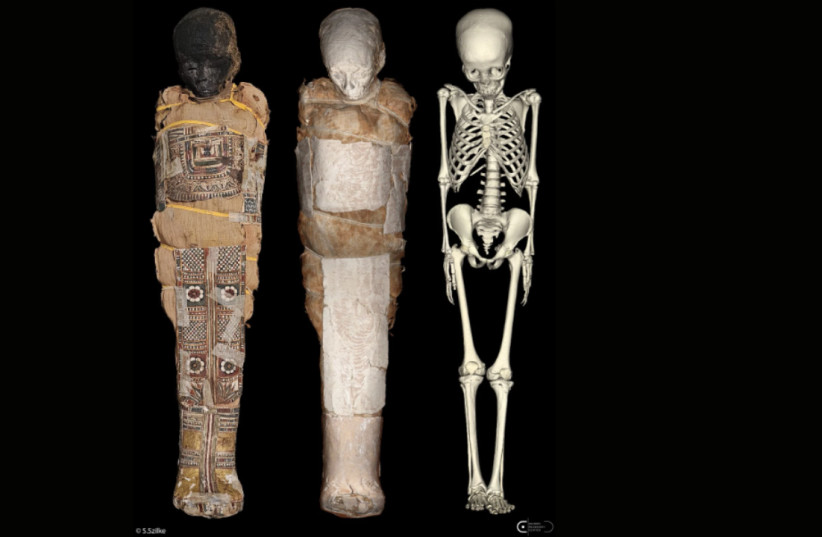
The child's face may have also been originally covered in a mummy mask.
Several missing toes and damage to two of the mummy’s vertebrae and the surrounding tissue from “likely due to historical display practices,” researchers noted in the study.
“This is not the end of the research,” said Professor Agata Kubala in a statement from the University of Wrocław. “We are still working on the mummy," as an "X-ray revealed the presence of an object on the chest, which may be a papyrus containing the boy’s name.”
Origins of the mummy are unknown
Studies of the mummy began in 2023 at the request of the Metropolitan Archbishop of Wroclaw, Józef Kupny. Before that, no in-depth examinations of the mummy had been completed using paleoradiology.
The mummy was first brought to Wrocław in 1914 by Cardinal Adolf Bertram upon being appointed the city's bishop. Later, Bertram donated it and the rest of his collection to the local Museum of the Diocese.
Bertram was a collector of antiquities and a close friend of Wilhelm Pelizaeus, a wealthy German businessman who sponsored archaeological excavations in southern Egypt in the early 1900s.
As such, it is believed Bertram may have acquired the mummy through his connection to Pelizaeus, though the exact circumstances and its site of origin are unknown. Further, any museum records that would’ve aided in pinpointing exactly where they came from were destroyed during World War II in 1945.
However, analysis of the mummy's cartonnage (the decorated casing of painted plaster and linen that encloses it) points strongly to the Kom Ombo or Aswan regions of Upper Egypt, dating to the Ptolemaic period. The cartonnage's distinctive chequered patterns, lotus flowers, and rosettes match those found on other mummies excavated at Kom Ombo.
Further, the precise fit of the catonnage around the child's body confirmed to researchers that the mummy is most likely real and not a forgery, such as those that flooded the European market during the 19th century.