
A temple dedicated to the local god Pelusius has been unearthed after six years of excavations at Tell el-Farma in the city of Pelusium in the northern Sinai, the Egyptian Tourism and Antiquities Ministry said in a statement last week.
Within the temple, archaeologists uncovered a circular basin with a diameter of 35 meters, which connects to the Pelusiac branch of the Nile River, Professor Mohamed Abdel Badie, head of the Egyptian Antiquities Sector at the Supreme Council of Antiquities, pointed out.
There, the basin was filled with “water loaded with Nile silt,” symbolically indicating the temple’s connection to Pelusius, whose name was derived from the Greek word plus meaning “mud.”
Further, the basin is surrounded by a system of drainage channels, and a square base at its center, believed to have held a statue of the deity. The building also had multiple entrances on the eastern, southern, and western sides, while the northern side has suffered significant damage.
Analysis of the site also shows that the structure had been continuously used from the 2nd century BCE to the 6th century CE, with only minor architectural modifications happening during that time.
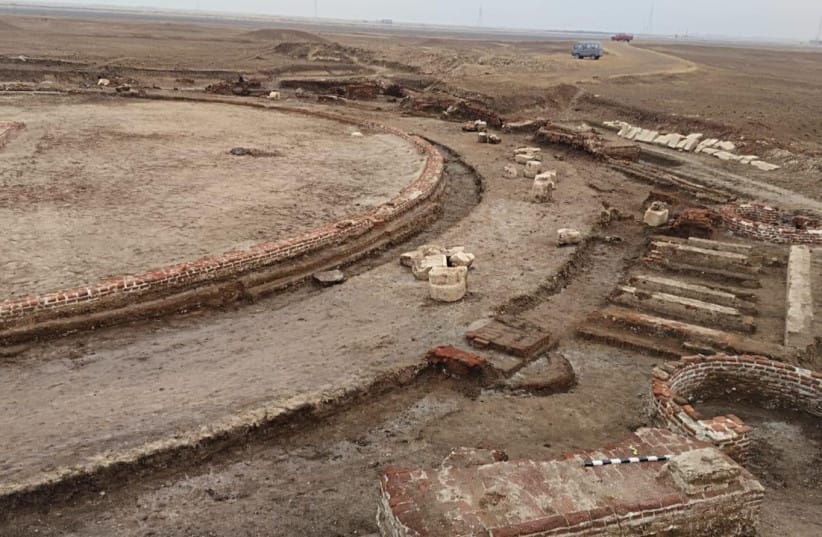
Originally thought to be Senate building
Archaeologists had discovered part of the building in 2019, explained Dr. Hisham Hussein, Head of the Central Administration of Antiquities for Lower Egypt and Sinai and mission supervisor, and had believed it to have been the city's Senate building.
However, continued excavations, in-depth field studies, and comparison with similar structures from the Hellenistic and Roman periods outside of Egypt proved this theory to be incorrect.
Egyptian Tourism and Antiquities Minister Sherif Fathy expressed his delight at the discovery, which “confirms the strategic and archaeological importance of the north Sinai region and its wealth of promising sites that still hold many secrets.”
Dr. Hisham El-Leithy, Secretary General of Egypt’s Supreme Council of Antiquities, echoed the sentiment, noting the importance of the temple's discovery as it illustrates Pelusium’s status and role in influencing religious and cultural ideas at the time.
Further, he added that the temple combines “ancient Egyptian traditions with Hellenistic and Roman styles in an exceptional embodiment of the cultural interaction between Egypt and the classical world.”