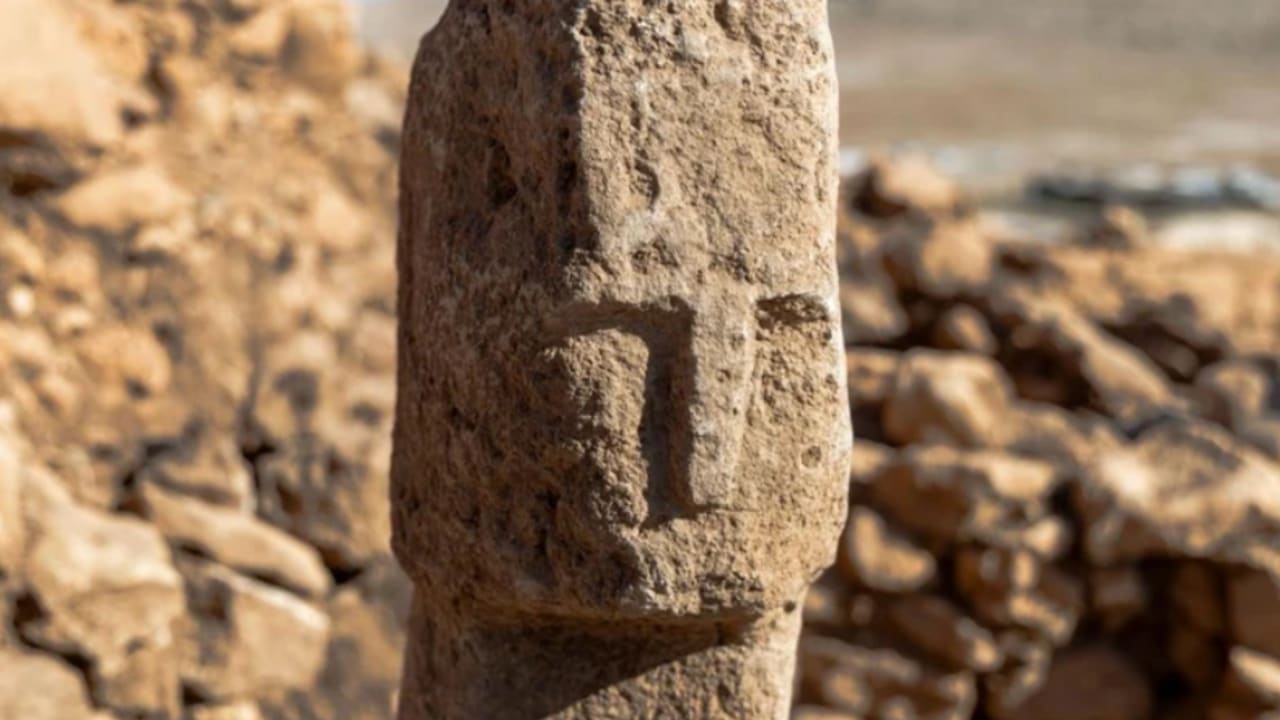
Archaeologists at Karahantepe in southeastern Turkey unearthed a limestone pillar bearing a human face with a sharp nose, deep-set eyes, and a faint smile. “Until now, we believed the stones we were unearthing represented humans, but this was the first time we found a real facial representation. It was an incredibly exciting moment,” said Necmi Karul, excavation director from Istanbul University, according to BBC News.
Excavations that began in 2019 revealed dozens of T-shaped pillars thought to have supported the roofs of communal structures, but the newly exposed monolith stood out for its clear facial features. “They not only carved a face, but they added expression. That addition of meaning points to a more complex worldview,” said Çeren Kabukçu, an archaeobotanist from the University of Liverpool, according to BBC News.
Comparable minimalist faces appeared elsewhere in the Levant. A 12,000-year-old carving uncovered at Nahal Ein Gev II in 2017 shared the same style. “When we saw the photo, we said: ‘We know that face.’ Its minimalist style is striking: a few lines forming a face, distinctive eyebrow and nose, with depth achieved through carving,” said Natalie Munro of the University of Connecticut, according to BBC News. “Our previous research indicated that this type of art moved north, from the Levant to Anatolia. The recent finding at Karahantepe shows that chain continued,” she added.
Karahantepe and nearby Göbekli Tepe were inhabited between 9600 BCE and 8000 BCE, a period of rapid cultural change in the Middle East. “It’s not just about Anatolia. This is a project for the shared history of all humanity,” said Karul, according to BBC News.
The discovery follows a broader artistic shift documented in the region. “Early carved statues mostly depicted animals. A few centuries after the transition to a sedentary life, human statues appeared, first associated with animals, then as independent figures. This suggests that humans were beginning to place themselves at the center of the universe,” said Karul, according to BBC News. Whether the pillar represented a deity or an abstract idea remains uncertain.
Located on a 140,000-square-meter limestone ridge inside a national park, Karahantepe continues to yield pillars that once supported roofs and framed ceremonial spaces, offering fresh insights into early Neolithic perceptions of humanity’s place in the world.
Produced with the assistance of a news-analysis system.