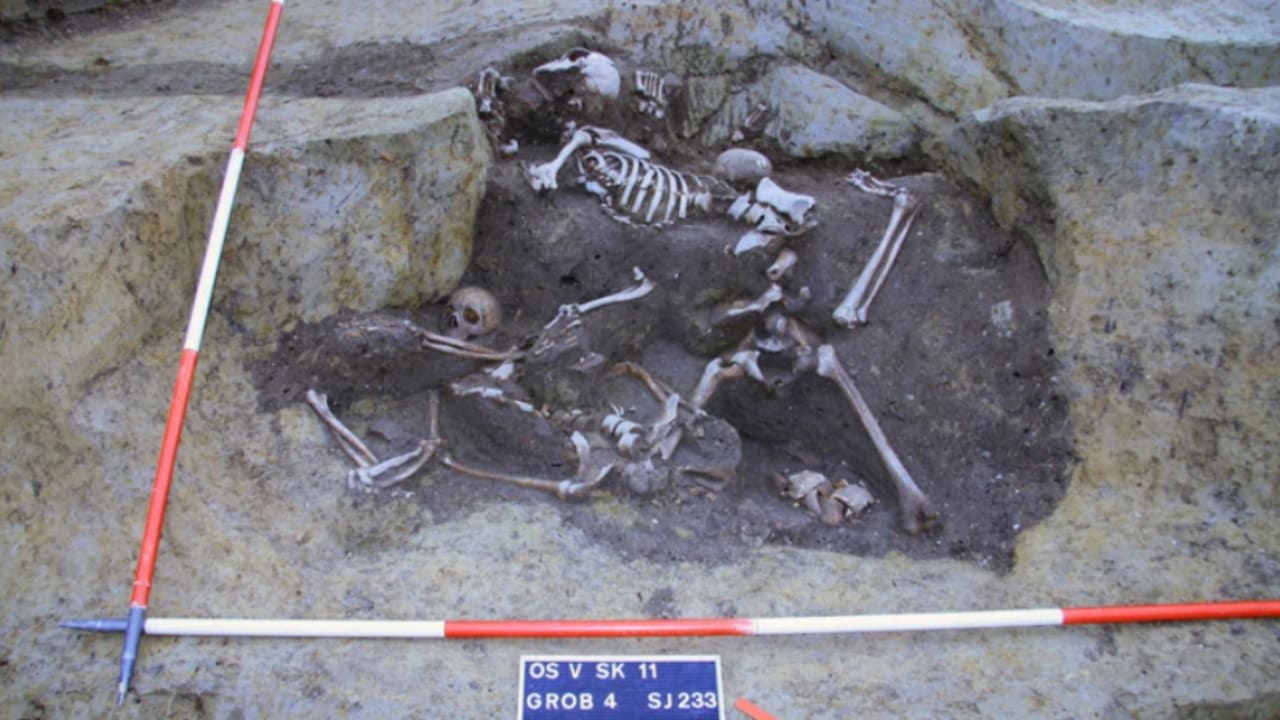
Seven Roman soldier were found in a water well in Croatia. The findings were published in the journal PLOS ONE. The research describes evidence from a mass grave in ancient Mursa—today’s Osijek, in Croatia.
The skeletons were discovered in 2011 during excavations ahead of construction at the University of Osijek, at an ancient water well cataloged as SU 233/234 that had later been used as a mass grave. The feature contained remains of at least 10 people, including seven complete skeletons. The bodies lay at different depths and in varied positions—some headfirst, others on their sides—indicating they were thrown in hastily without ritual burial. “Presumably, all of the individuals were stripped of any valuables — weapons, armor, equipment, jewelry, etc. — before they were thrown into the well,” said Mario Novak, the study’s lead author, according to a report by Vecernje Novosti.
All seven individuals were adult men: four younger adults aged 18–25 and three middle-aged adults aged 36–50. Radiocarbon dating placed the deposition between 240 and 340 CE, aligning with the only artifact recovered from the well, a Roman coin minted in 251 CE. The team linked the burial to unrest during the Crisis of the Third Century, when civil wars, foreign invasions, and economic strain destabilized the empire. Historical sources recorded battles near Mursa, including a clash in 260 CE between Emperor Gallienus and the usurper Ingenuus; sources indicated the defeated were shown no mercy, with many soldiers executed or left unburied.
Skeletal trauma included cranial blunt-force injuries, rib fractures, and puncture wounds likely caused by arrows or spears. Two individuals showed perforations consistent with arrow or spear tips, and one had blunt-force injuries to the face. “We presume these are also the remains of soldiers who lost their lives in the Battle of Mursa in 260,” said Novak, according to a report by Vecernje Novosti.
Genomic and isotopic analyses indicated the men were not local and had diverse origins. “High genetic diversity matched historical reports of late Roman armies, which often included ethnically diverse groups such as Sarmatians, Saxons, and Gauls,” according to the study in PLOS ONE. The authors reported that one individual likely came from northern or Eastern Europe and another from the Byzantine Empire.
Dietary analysis showed consumption of grains such as wheat and millet and vegetables, with little meat or seafood. New bone growth on the inner ribs suggested lower respiratory tract infections shortly before death. The men showed robust physiques alongside indicators of early-life stress, including dental wear, and were on average taller than contemporaries.
Mursa, conquered by the Romans in the first century BCE, grew into a large settlement and center of craftsmanship and trade near the Danube River, at the edge of a military border zone. The city figured prominently in third- and fourth-century upheavals. The composition of the group—young and middle-aged males with violent injuries—matched patterns seen in battle-related mass graves, such as assemblages from Napoleon’s Grand Army.
“Today, researchers from several European archaeological institutions are able to discover not only when the people lived but also how they died,” said Kathryn Marklein, a bioarchaeologist at the University of Louisville who was not involved in the study, according to Vecernje Novosti. “This research is critical to understanding the direct and violent consequences of political instability during the third century, and how this instability affected populations in the provinces and along the Roman frontiers,” said Marklein, according to Vecernje Novosti.
Novak said additional work was planned on another mass grave in a second well in Mursa that resembled the feature described in the study.
The preparation of this article relied on a news-analysis system.