Few places on Earth carry as much weight of history as Israel. Its soil has been turned over for millennia – by armies, pilgrims, shepherds, and, more recently, by archaeologists.
Since the modern state’s establishment in 1948, excavation after excavation has yielded finds that have forced scholars to confront not only the story of ancient Israel but also the development of Judaism, Christianity, and human civilization itself.
Some discoveries have confirmed elements of biblical tradition; others have complicated the picture, revealing a past more diverse than anyone had imagined. Together, these finds have transformed the field of biblical archaeology and deepened the world’s understanding of this land’s role in the tapestry of human history.
Not all the archaeological findings in the Land of Israel are tied to biblical stories, but they could nevertheless prove that those are more than just stories – they are historical accounts of ages come and gone.

Pilgrimage Road
The City of David, Jerusalem’s most intensively excavated area, has produced its own remarkable finds, such as a corner of what may have been King David’s palace, discovered by archaeologist Eilat Mazar (1956-2021). One of the most dramatic finds is Pilgrimage Road, a stepped stone street dating to the late Second Temple period.
Stretching from the Pool of Siloam up toward the Temple Mount, it would have borne tens of thousands of worshipers on festival days on their way to the Second Temple. Walking along its restored stones today gives a visceral sense of the crowds ascending to the Temple two millennia ago, a ritual moment that anchored Jewish identity in the city.
The road was officially inaugurated earlier this month after years of excavation. US Secretary of State Marco Rubio and US Ambassador to Israel Mike Huckabee attended the unveiling ceremony together with Prime Minister Benjamin Netanyahu.
Rubio described the road as “an extraordinary archaeological site.” Netanyahu said it symbolized the Jewish people’s ancient bond with Jerusalem. And Huckabee noted that opening the site to the public allowed “the stones” to “speak” about the historical Jewish presence in Jerusalem.
The Israel Antiquities Authority has led the dig with the City of David organization, which operates the national park site. The stretch of road from the Pool of Siloam up the Tyropoeon Valley to the Temple Mount is approximately 600 meters long and some eight meters wide. It is now open end to end.
Walls in the Ophel
Jerusalem itself has yielded some of the most fascinating remains. Excavations in the Ophel, the area between the City of David and the Temple Mount, have revealed massive stone walls and public structures. Some scholars contend that these walls date to the 10th century BCE and may represent fortifications from the time of King Solomon. Though the attribution is contested, the scale of the construction indicates that Jerusalem was already more than a rural hilltop village. It was a place capable of centralized planning and monumental architecture, lending weight to biblical traditions of a city at the heart of a kingdom.
Ancient restroom
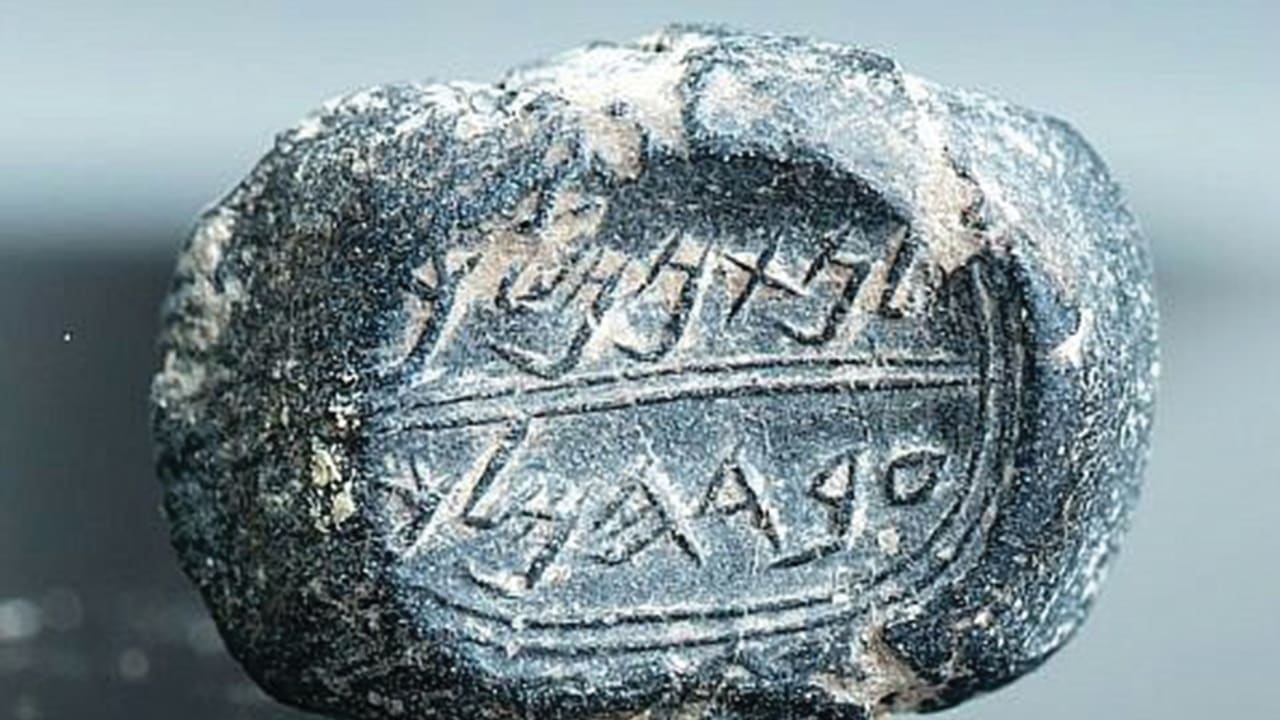
Other finds in the City of David take us even farther back. Seal impressions, or bullae, have surfaced in the area, such as one bearing the name of a royal official from the First Temple period. Such objects provide rare administrative records, linking biblical figures to the physical bureaucracy of ancient Judah.
Even more intimate was the discovery of a stone toilet inside a 7th-century BCE mansion, offering archaeologists a direct glimpse into the daily lives and diet of Jerusalem’s elite in the final years before the Babylonian conquest. These finds, ranging from public pilgrimage routes to personal sanitation, flesh out the lived experience of ancient Jerusalemites in remarkable detail.
‘House of David’
Other finds have stirred debate about Israel’s monarchy. In the early 1990s, fragments of a basalt stele were unearthed at Tel Dan, an ancient city in the North. An inscription, written in Aramaic by a rival king, boasts of victories over the “House of David.” This single phrase, carved in stone nearly 3,000 years ago, provides the first extra-biblical reference to King David or his dynasty. For years, various scholars have argued over whether or not David was a historical figure. The Tel Dan stele didn’t settle every argument, but it gave solid epigraphic evidence that a Davidic line was remembered beyond the pages of scripture.
Where David fought Goliath
Supporting evidence for an early Judahite state comes from Khirbet Qeiyafa, overlooking the Elah Valley, where David fought Goliath. Excavations between 2007 and 2012 revealed the remains of a fortified city from the Iron Age, with monumental gates, well-planned streets, and inscriptions in early Hebrew. For some archaeologists, the site suggests that Judah under David and Solomon had the capacity for urban organization and administration earlier than skeptics had thought. While debates continue about the scale of the monarchy, Khirbet Qeiyafa has become a touchstone in discussions about state formation in ancient Israel.
The Dead Sea Scrolls
Perhaps the most famous discovery came from the cliffs overlooking the Dead Sea. In the late 1940s, Bedouin shepherds stumbled upon clay jars filled with scrolls in the caves near Qumran.
What began as a chance discovery grew into one of the most important archaeological finds of the 20th century: the Dead Sea Scrolls.
Preserved for nearly 2,000 years in the arid desert air, the scrolls contain the oldest known copies of many biblical texts, along with hymns, sectarian rules, and apocalyptic writings from the Second Temple period. Their importance cannot be overstated.
Before their discovery, the earliest Hebrew Bible manuscripts were dated 1,000 years later. Suddenly scholars could compare versions, trace textual transmission, and better understand the religious environment in which both Judaism and Christianity took shape. For Israel, still in its infancy as a state, the scrolls were more than relics – they were tangible links to a spiritual heritage stretching back to antiquity.

Ketef Hinnom scrolls
If the Dead Sea Scrolls offered breadth, the tiny Ketef Hinnom scrolls provided precision. In 1979, archaeologists working in a burial cave southwest of Jerusalem uncovered two small silver amulets, no bigger than a cigarette butt. When carefully unrolled, they revealed inscriptions in paleo-Hebrew script from the priestly blessing from the Book of Numbers: “May the Lord bless you and keep you…” These fragile artifacts, dating to the 7th century BCE, are the oldest known biblical texts ever discovered. They push the existence of certain scriptural traditions back centuries earlier than many scholars had assumed, demonstrating that key elements of the Hebrew Bible were already in circulation before the Babylonian exile.
Beekeeping in Beit She’an
Other discoveries have illuminated aspects of daily life. At Tel Rehov in the Beit She’an Valley, excavators found the world’s earliest known beekeeping installation: rows of clay beehives dating to the 10th–9th centuries BCE. The presence of such an organized honey-production facility reveals not only agricultural specialization but also economic sophistication in Iron Age Israel. Honey, long prized for its sweetness and symbolic value, here becomes a window into the practical lives of farmers who maintained large-scale apiaries nearly three millennia ago.
Structure on Mount Ebal
Farther north, on Mount Ebal in the hills of Samaria, archaeologist Adam Zertal uncovered a curious stone structure in the 1980s. Filled with ash and animal bones, the installation appeared to function as an altar. Zertal controversially identified it with the altar described in the Book of Joshua, where the Israelites offered sacrifices upon entering the land. While scholars debate this identification, the structure remains one of the rare archaeological features that may correspond to early Israelite ritual practice, offering a rare glimpse into the religious life of the community during its formative years.
Judean Desert surprises
Even after decades of study, the Judean Desert continues to yield surprises. In recent years, archaeologists have returned to the caves with modern survey techniques, uncovering new scroll fragments in the so-called Cave of Horror (Me’arat Ha’Eima). Among the finds were Greek translations of the prophetic books of Zechariah and Nahum, along with haunting remnants such as the skeleton of a child, and woven baskets preserved for thousands of years. These discoveries extend the story of the Dead Sea Scrolls into the Roman era, enriching our understanding of the communities that lived – and others that perished – in these unforgiving landscapes.
Tel Hreiz, an early seawall
Not all of Israel’s great finds belong to the biblical era. Off the coast of Haifa, divers investigating the submerged site of Tel Hreiz identified one of the earliest known seawalls, constructed around 7,500 years ago. Built from large boulders, the wall represents humanity’s early attempts to combat rising sea levels and coastal erosion. Long before climate change became a contemporary concern, Neolithic villagers on Israel’s coast were engineering defenses against the encroaching sea. The discovery connects Israel’s past not just to biblical tradition but to the shared human struggle with environmental challenges.
Ancient synagogue of Huqoq
In the Galilee, excavations at the ancient synagogue of Huqoq have revealed stunning mosaics from the Byzantine era. Richly colored and remarkably preserved, the panels depict scenes such as the prophetess Deborah and the warrior Yael defeating the Canaanite general Sisera. These images challenge assumptions that Jewish art in antiquity avoided figural representation. Instead, they reveal a vibrant visual culture where sacred stories were celebrated in stone and pigment. The Huqoq mosaics remind us that Jewish communities in late antiquity expressed their faith not only in words but also in vivid, narrative art.
Milestones on a journey
Taken together, these discoveries form more than a catalog of artifacts. They are milestones in a continuing journey of exploration, each reshaping how scholars and the public understand Israel’s past. Some finds confirm biblical accounts, others complicate them, but all enrich the historical record with tangible evidence of the people who lived, prayed, and built in this land. They tell of scribes who copied sacred texts, kings who built fortresses, priests who led pilgrims, farmers who kept bees, villagers who resisted the sea, and worshipers who filled their sanctuaries with color and story.
Archaeology in Israel is not just about stones and inscriptions – it is about connecting the ancient with the living. Every scroll fragment and mosaic tessera is a reminder that history is not static but dynamic, open to revision and discovery. More than 70 years after the founding of the state, Israel remains a laboratory of the past, where each excavation promises both to answer questions and to pose new ones.
As all these discoveries show, the land’s buried secrets have the power to transform our understanding of history, faith, and the human experience.