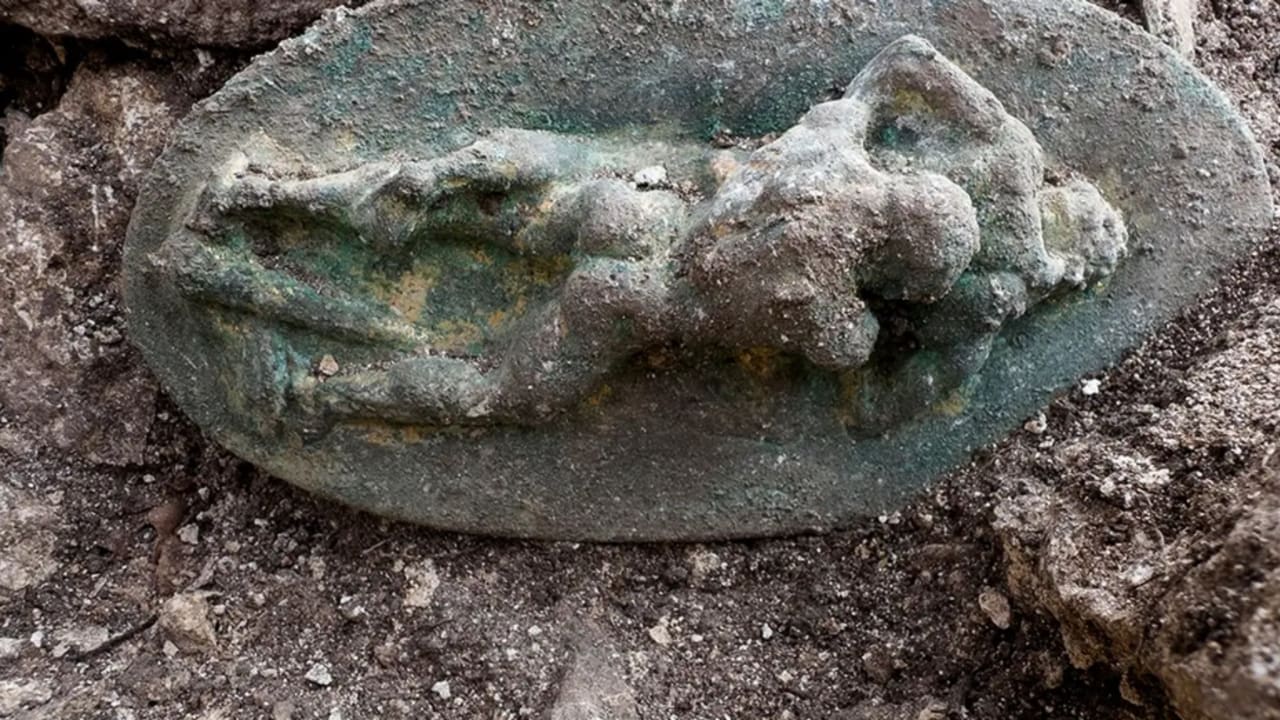
Archaeologists from the Bulgarian Academy of Sciences uncovered a late Hellenistic burial mound near the southern Bulgarian village of Kapitan Petko Voyvoda, revealing the tomb of a high-status warrior dated to the second half of the 2nd century BCE, reported HeritageDaily. The dig took place during rescue work along a cable route linking Topolovgrad to a solar power plant.
The undisturbed pit, measuring about three by three metres and one metre deep, contained the warrior, his horse, and numerous grave goods. The horse lay to the left of the deceased, adorned with gold, silver and bronze medallions. Bronze and gilded harness ornaments above the animal’s head featured reliefs of mythological scenes, including Hercules wrestling the giant Antaeus.
Objects accompanying the warrior included a silver-gilt wreath, a silver bracelet, a ring, a fibula, an iron shield boss, iron spears, and a Greek makhaira whose gold-inlaid handle was set with gemstones. Researchers estimated the man’s age at between 35 and 40 years.

The team linked the burial to a mound excavated last year about 60 metres to the north that also held a Thracian warrior. “For the second year in a row, extraordinary archaeological treasures are being discovered in the vicinity of Kapitan Petko Voyvoda,” the researchers said.
Students from Sofia University St. Kliment Ohridski assisted with the excavation, and the Topolovgrad municipality announced the discovery on its Facebook page. The finds are undergoing conservation before transfer to a new treasury at the Historical Museum in Topolovgrad, which will house artefacts from the 2024 and 2025 seasons.
The Thracians, an Indo-European people who emerged during the early Bronze Age, often served in Roman auxiliary units. The presence of aristocrats connected to Roman military forces in the same cemetery suggested an overlap of local burial customs and Roman influence. Further analysis of the grave goods, including the machaira sword, is expected to deepen understanding of Thracian social hierarchy, metalwork, and funerary practices during the late Hellenistic period.
Written with the help of a news-analysis system.