Before making aliyah in 2019 to Modi’in, Beth and Paul White had already been a volunteer-minded couple. Residents of the New York City suburb of New Rochelle, they each volunteered for the Chevra Kadisha (burial society) of Westchester County.
In addition, for many years while raising their six children, Beth was the “American address” for Yeshivat Lev HaTorah (where three of their sons did gap years) and Job Katif (an employment project of Rav Yosef Zvi Rimon). She handled tasks from check deposits and donor communications to shipping copies of Rav Rimon’s books to US contributors.
After deciding to move closer to their four children who had already made aliyah (another arrived a month after they did), the Whites were at a stage of life when they could pursue charitable endeavors. While Paul, a former surgeon, still works 30 hours a week handling tele-critical care cases, he and Beth both feel a stronger pull toward volunteering than ever before.
“When you move here, it changes you,” says Paul. “We always felt connected to Israel, but being here, the connection got much deeper.”
These grandparents of “a bevy of grandchildren” responded immediately to the overwhelming needs that arose in the wake of Oct. 7.

“For the first six to eight months, I was volunteering at Assuta Ashdod [Hospital], helping with ICU care for wounded soldiers and making rounds with the residents,” says Paul. “It was intense, and the hospital really needed extra hands. They’re not a level-one trauma center, but they would frequently get the most unstable patients who couldn’t survive the trip all the way to Sheba [Medical Center in Ramat Gan]. The team and the chief of trauma there are really exceptional. I did trauma surgery in The Bronx in New York, and it wasn’t even close to what was going on at Assuta in the early months of the war.”
WHEN FEW foreign volunteers were able to fly to Israel, Paul and Beth also joined groups of agricultural volunteers and helped pack equipment on army bases through Sar-El, a nonprofit service organization under the direction of the IDF Logistics Corps. Beth did this several days a week for some time.
Closer to home, they volunteered at the local headquarters of Lord Sandwich, making and wrapping sandwiches for soldiers until enough paid staff could be hired to take over that task.
While the need for those activities tapered off, the Whites have continued volunteering elsewhere.
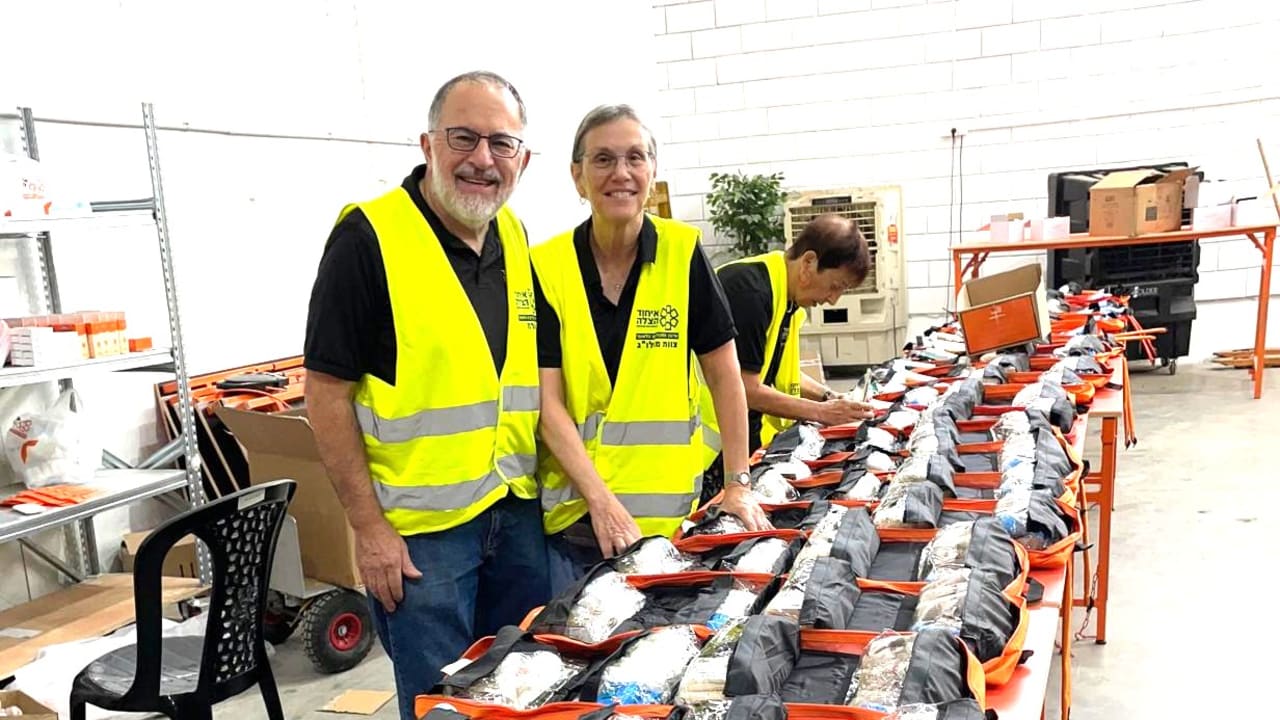
“At United Hatzalah in Beit Shemesh, we package anything from large backpacks to fanny packs with medical equipment. They always greet us and are happy to have us,” Beth relates. “Sometimes we share our opinion on how we could streamline the process, and recently one of our suggestions was implemented with great appreciation.”
Retirees volunteering in Modi'in
The Whites sometimes join a larger cadre of retirees from Modi’in who drive more than an hour weekly to Omer, near Beersheba, to pack items such as underwear, winter clothing, socks, jackets, and toiletries for soldiers, in the warehouse of IDF support nonprofit Yashar LaChayal (“directly to the soldier”). Before Rosh Hashanah and Passover, the Modi’in volunteers form an assembly line to prepare food baskets for needy soldier families through the organization.
“We would make up orders for different units to pick up, and we’d see soldiers coming in dirty uniforms right from the line [of battle],” Paul recalls of the early days. “They’d thank us profusely, and we’d say, ‘No, thank you for what you’re doing!’”
Beth notes that the Yashar LaChayal volunteers often need to perform physically demanding work. “Everyone tries to do what they can. Some of the volunteers are 10 to 15 years older than us, and you’d be amazed what they lift and schlep.”
One of her friends, Shonny Solow, began a baking project for soldiers called Savta MiModi’in (“Grandma from Modi’in”). Every week, Beth and others go to Solow’s house to bake cookies for distribution through various channels such as Grilling for the IDF.
WHEN ANY child of the volunteers is on reserve duty, the women bake extra cookies to send back to that soldier’s unit. Beth recalls that one time, when their daughter Michal was in reserves and brought cookies to her comrades, a fellow soldier asked her if these were Savta MiModi’in cookies. “Otherwise, I wouldn’t eat them,” he told Michal.
Paul got into the volunteer baking groove as well. Before the High Holy Days, he made several hundred challah rolls for soldiers in a project initiated by their synagogue, Kehillat Shaarei Yonah Menachem.
Beth estimates that the couple are currently spending seven or eight hours a week on volunteer work. She also serves on the local seniors committee that plans weekly activities.
“The war has been horrible, but what it’s allowed us to do – along with others here who’ve been volunteering even before the war – is unbelievable. We’re just a speck in that group of people. Everyone we’ve encountered in our volunteering experiences has done it b’simcha,” with joy. “And everywhere we go, we get thanked. That is one of the key things in terms of volunteering. We don’t need accolades or gifts, just a simple thank you. It’s unbelievable how much they appreciate it.”
Beth says that before making aliyah, even when they had three sons serving as lone soldiers in the IDF – and even when Sabra grandchildren began arriving on the scene – living in New Rochelle kept them at more than a physical distance from Israel.
“I think there’s a certain disconnect when you live 6,000 miles away,” she notes. “When you come here, you breathe it. And then the war just intensified everything.”
The Whites have made new friends and gotten closer with casual friends, through working side by side as volunteers. And they don’t anticipate slowing down.
“The situation is better right now, but the war isn’t over and we all want to continue after the war is over, whenever that will be,” Beth says. “It gives us meaning and purpose. We have more time at this point in our lives, and we try to use our time well.” ■
Dr. Paul White, 71 Beth White, 68 From New Rochelle, New York to Modi’in, 2019