
High school sweethearts Bonnie Wolinetz and Meir Chasan headed off to a shared life in Israel just days after marrying on October 18, 1982, in their native Chicago. Meir had already made aliyah in 1978, and Bonnie had followed suit after graduating from college.
After a couple of years in Jerusalem, the pair moved in 1984 to the then-fledgling community of Ma’ale Adumim. There, they raised five children, who have blessed them with 16 grandchildren so far.
Bonnie worked as a computer programmer; Meir was a business consultant. Even before retiring – he when COVID hit, she about a year ago – volunteering was always part of the mix for this youthful and active couple.
Active volunteers
Bonnie volunteered for the rape crisis center’s hotline. Meir donated his time to Etgarim, a nonprofit Israeli organization that empowers and socially integrates people with disabilities through outdoor-challenge sports. Every Friday for the past decade or so, Meir has participated as the front rider in tandem cycling, sponsored by Etgarim in Jerusalem. And together, Bonnie and Meir deliver boxes of groceries once every two weeks to needy families in their hometown, a program run by another local volunteer.
After retiring, their volunteer work kicked into high gear.
Bonnie started teaching piano to special-needs children, ages five to 13, at schools in Jerusalem and Ma’aleh Adumim. “I love music and have a very soft spot for special-needs children,” she explains.
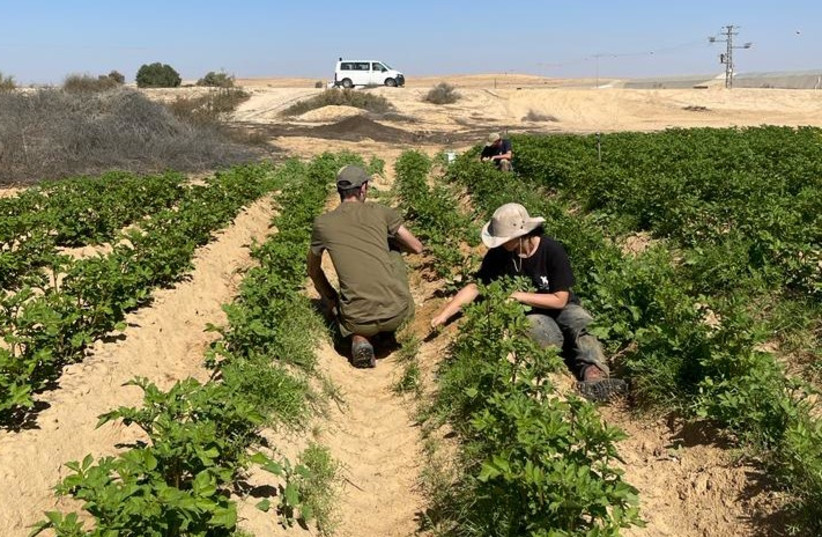
And about once a week, they travel to farms in need of volunteer labor. Meir is among the pioneers and leaders of this project. It came about unexpectedly when a member of his biking club told the group he’d volunteered on a farm. Soon, the other members of the club began volunteering, and then other friends from the neighborhood joined for what has become a weekly activity.
At first, they made their own arrangements – who goes in whose car to which farm on which day. Meir struggled to organize it all with Excel spreadsheets.
Eventually, he was contacted by Dr. Beth Goldstein, a family physician in French Hill (“I don’t know to this day how she found out about us”), who said she had a small group of volunteers and a connection with national food bank Leket Israel. If the two groups of volunteers could unite, she could get a free bus courtesy of Leket.
“And since then, we’ve been doing this together.” Leket sends a bus or minibus to pick up volunteers in Ma’aleh Adumim, Givat Hamivtar, Hemed, and Latrun every Monday and Wednesday, at no charge. “Leket is the backbone of all our projects,” says Meir.
Thanks to local volunteer Yaacov Greenstein, tourists from abroad find out about this Southern Exposure group on social media (facebook.com/groups/1114109886742502) and often join in. “A young woman in Germany brings groups to Israel and usually spends a day with us. We get some Americans also,” Meir says.
“Beth and I do the behind-the-scenes work. I interview the farmers so that we can choose where to go. Beth is in touch with Leket to organize the buses and give them feedback. I deal with the bus drivers, and she deals with the WhatsApp messages to volunteers.”
BY NOW, farmers know about Southern Exposure – one of many volunteer agricultural groups across Israel – and usually contact the group directly to request help. Meir and Beth prefer locations that are within a two-hour drive and can’t easily get volunteers, usually in the Western Negev. They also favor farmers who will be present to interact with the volunteers.
“At the beginning, farmers would tell us their Oct. 7 stories. It was very meaningful,” says Bonnie. “Now we’ve tried to reintroduce an element of hearing about the farm’s story; it ties the volunteers to the place, and they want to go back again.”
For instance, an olive farmer in Tekuma fascinated the group with the story of his Yemenite mother and Russian father establishing the grove together.
Two-plus years of experience have taught Meir that certain tasks are more attractive to volunteers than others. Most people would rather harvest than weed; others prefer to work indoors packing produce. And since nearly all the volunteers are retirees, Meir and Beth specify to the WhatsApp group if the tasks involve bending or kneeling; sometimes they recommend bringing a low stool.
The growers are extremely grateful for the assistance, says Meir. “A group of 10 recently picked 20 kg. of chili peppers, and the farmer was ecstatic.”
Southern Exposure volunteers helped a newbie farmer at a moshav on the border of Gaza and Egypt to harvest cherry tomatoes and plant a mango grove. “Our group planted 1,300 trees in one day, and we often came afterward to irrigate and weed the grove, putting supports around the growing trees using metal from old, discarded greenhouses,” Meir says.
Avocados, oranges, lemons, grapes, raspberries, cauliflower, and pineapple are among the other types of produce handled by volunteers, who often get to take some home.
“People come to work, not to socialize, although friendships have been made,” Meir says.
He thought the project was winding down because fewer volunteers participated in the summer. But more people are signing up now, and many farmers still appeal for help.
“It’s a wonderful project for people in their the golden age,” says Bonnie. “The purpose is to help the farmers and society, but there is a secondary advantage for people who’ve retired and are looking for something meaningful to do. At the beginning of the war, we all felt dysfunctional. Working at a farm, you feel you are accomplishing something very tangible. The trees are full of fruit when you arrive and empty when you leave.”
Empty nesters in good health “have to think about where they are needed and create a new space where they’re still productive,” she continues. “It’s a time in life when you want to give back. Volunteering allows you to give back and feel a sense of purpose.”■
MEIR CHASAN, 67 BONNIE CHASAN, 65 From Chicago to Ma’aleh Adumim, 1982