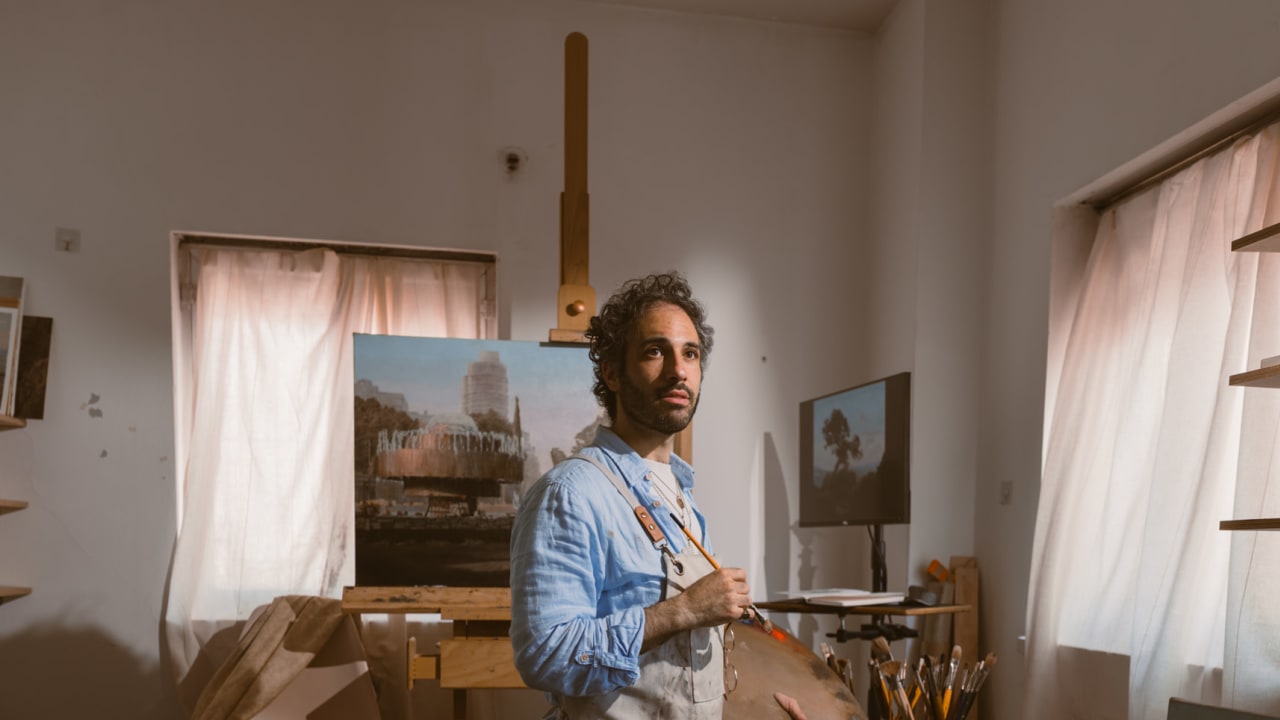
When Avraham Vofsi arrived in Israel from Melbourne, he carried little more than his brushes, a head full of questions about identity, and the beginnings of a body of work that was as personal as it was political.
“I never had Jewish friends growing up,” he says matter of factly. “Not one until I was 32. I painted everyone else’s story – Aboriginal, Indigenous, people on the margins – but never my own. That was the turning point. I realized I didn’t even know what my own story was.”
Vofsi was born in Melbourne to American parents who had moved to Australia for work. “My joke is I’m the only Australian in the family, and probably always will be,” he says with a grin. His sister has since returned to the US, but Vofsi’s own path wound through art schools, film projects, and the sometimes insular world of Melbourne’s creative scene.
Growing up, Jewish life in Victoria’s capital was vibrant but tightly clustered in a few suburbs south of the Yarra River: Caulfield, St. Kilda, and Balaclava. Vofsi’s family, however, lived north of the Yarra River, worlds away from the community’s heart. “It felt like there was a wall,” he says. “Everyone Jewish was on the south side. We were on the north. Crossing back and forth was hard, and I just wasn’t part of it.”
He attended a Reform synagogue, had a bar mitzvah, and then drifted away from religious life. His Jewishness was more a question mark than an anchor. Instead, he gravitated toward art, film, and illustration. After a stint in Los Angeles, he returned to Melbourne and enrolled in Melbourne Polytechnic. It was there, through a teacher who pushed him toward oil painting, that he found his medium.

“She made the mistake of offering to help, and I bugged her every day for 10 years,” Vofsi laughs. “She became my mentor. She changed my life.”
Painting the margins
From the start, Vofsi’s paintings were about more than color and form. His portraits gravitated toward people rarely centered in traditional fine art: Aboriginal Australians, Indigenous leaders, essential workers during the COVID-19 pandemic. “It wasn’t political, exactly,” he says, “but I kept asking: Who gets painted? Who doesn’t? Whose story is worthy of being put on canvas?”
In painting others, Vofsi found himself face to face with his own unanswered questions. His friendships with Indigenous Australians deepened that sense of searching. “Aboriginal art is some of my favorite in the world,” he explains. “Working with Indigenous friends and painting their stories helped me understand what it means to be connected to a land, to a heritage. That’s what eventually made me ask: What does it mean to be Jewish? What’s my story?”
That reckoning came to a head during the 2021 Israel-Gaza conflict, known in Israel as Operation Guardian of the Walls. At the time, Vofsi was living in Australia, active in the art world, and – by then – wearing a kippah. Suddenly, friends and colleagues turned hostile. “It was my first experience of real anti-Israel pressure,” he says. “I didn’t even understand what was happening. People acted weird around me. Online, it was brutal.”
The experience shook him. Combined with a long overdue sabbatical from his day job in an educational tech start-up, Vofsi decided to come to Israel.
At 32 – the “elderly age of Birthright,” as he jokes – Vofsi joined a Taglit-Birthright trip, then extended his stay through a Masa program that allowed him to focus solely on painting. For five months, he traveled, painted, and asked questions that would shape the rest of his career.
“I used painting to understand my connection to Israel and to Judaism,” he recalls. “That became my exhibition Bahagat, and even a documentary I made. It was the first time I felt: This is my story too.”
The energy of Israel was intoxicating compared to the quiet order of Melbourne. “Australia is beautiful, but everything is set in stone. If you didn’t go to the right art school, you’re already behind. Here, it’s electric. It’s messy, it’s dynamic. Everyone knows someone. Everyone wants to connect you to someone else. In Australia, people say yes but mean no. Here, if they say yes, they mean yes.”
Israel’s art scene is notoriously tight-knit and often difficult for newcomers, especially new immigrants. The Hebrew language barrier doesn’t help. But Vofsi has found ways in – through persistence, Instagram, and an openness to collaboration.
He now teaches, exhibits, and continues to paint portraits that combine classical technique with contemporary subject matter. In Australia, one of his most high-profile works was a finalist for the Archibald Prize, the country’s most prestigious portrait competition. His entry – a two-meter high, gold-framed portrait of Jewish media personality John Safran as David holding the head of Goliath – hung in the National Gallery of New South Wales and toured the country.
“It was a huge deal, but it also showed me how small the Australian art world really is,” he reflects. “Half the finalists come from the same Sydney art school. It made me realize I needed a bigger stage.”
In Israel, that stage is still taking shape. He recently joined a program for immigrant artists to connect with the local scene and has ongoing collaborations with figures such as Nova Peris, the Aboriginal Olympic athlete and politician, who is also outspokenly pro-Israel. Together, they are developing a portrait project that bridges Indigenous Australian identity and Jewish Israeli experience.
Ironically, Vofsi says, he never felt more Australian than after moving to Israel. “In Australia, I always felt Jewish, ostracized, different. Here, everyone’s Jewish, so suddenly, I’m the Australian. And weirdly, that gives me more clout in Jewish circles than I had back home.”
The duality shapes his work. He is currently planning a landscape project with Aboriginal communities, informed by his deepened understanding of what it means to belong to a land as a Jew in Israel. “I think I’ll circle back,” he says. “Australia taught me so much about indigeneity, about rootedness. Now that I’ve experienced that as a Jew in Israel, I want to give back through my art.”
For all the challenges of aliyah – language, bureaucracy, adjusting to Middle Eastern chaos – Vofsi has no regrets. “After Birthright, I stayed an extra two days and I just knew. I had to live here,” he says. “It was immediate.”
In Jerusalem, he has found a rhythm: teaching, painting, building connections. His studio is both a sanctuary and a launchpad, a place where portraits of essential workers sit alongside sketches of Jewish ritual and explorations of identity.
Israel’s openness continues to surprise him. “Everyone has a cousin they want to connect you with. Everyone’s willing to help. That doesn’t happen in Australia. Here, people just say, ‘Come, let’s do it.’ That’s what makes this place electric.”
The story on canvas
Looking back, Vofsi sees his artistic journey as a mirror of his personal one. From illustrating others’ stories to finally painting his own, art has been his way of making sense of belonging, displacement, and return.
“I’ve always made art to understand the world,” he says. “During COVID, I painted essential workers. In Australia, I painted Indigenous friends. And in Israel, I paint what it means to be Jewish, to belong here, to wrestle with identity. Every canvas is a way of figuring out who I am.”
As his career unfolds in Israel, Avraham Vofsi is proving that art is not just about images on canvas but about the stories they carry – stories of exile and return, marginalization and belonging, searching and homecoming. In recent months, he has taken off in live-painting weddings and hopes to grow that part of his business as well.
“Moving here was about claiming my own story,” he says. “Now when I paint, I’m not just painting others. I’m painting myself.” ■
Avraham Vofsi
From Melbourne To Tel Aviv, 2023