
On October 7, Israelis once again return to the morning that changed their country and the region forever.
They remember the communities attacked, the civilians murdered, the families shattered and the hostages taken into Gaza. They remember the fear and the profound sense that the security they had taken for granted had collapsed in a single morning.
The world should remember this too.
There should be no ambiguity about what Hamas did. The deliberate killing of civilians, the taking of hostages, and the attacks on communities were not legitimate political acts. They were brutal and inhumane crimes that deserve unequivocal condemnation.
No political cause, occupation, blockade, or historical grievance can justify deliberately targeting civilians.
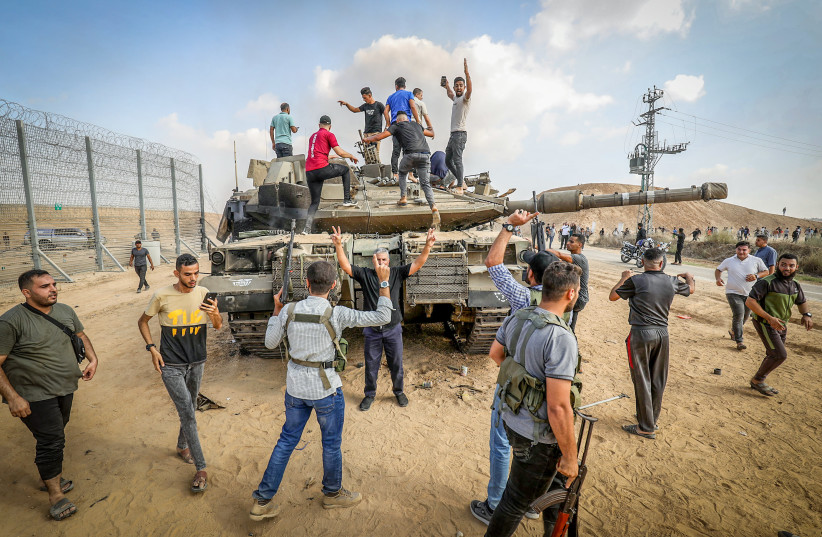
But on this October 7, there is another question that deserves to be asked: What did Hamas’s leadership do to the people of Gaza in whose name it claimed to act?
And perhaps an even more uncomfortable question: was Hamas ever synonymous with Gaza?
The answer, for anyone who listened carefully to Gaza before October 7, was no.
Long before the war, there were Palestinians in Gaza who were angry with Hamas, frustrated with its rule and exhausted by the political division between Hamas and Fatah. There were young people who wanted employment, electricity, education and a future. There were families who wanted security and dignity rather than another cycle of confrontation.
There were also Palestinians who simply wanted to live.
The slogan of the “We Want to Live” movement “Bidna Ne’ish” expressed something remarkably simple: Palestinians in Gaza wanted a normal civilian life.
They wanted to work. They wanted their children to study. They wanted functioning institutions. They wanted to be able to criticize those in power without fear.
Most importantly, they wanted their identity to be Palestinian without having to make that identity synonymous with a political faction.
That reality matters when we discuss October 7.
Hamas controlled Gaza, but control is not the same as unanimous consent.
In a society governed by an armed movement, silence cannot automatically be interpreted as political support. A person may remain silent because he agrees, but he may also remain silent because he is afraid. Someone may oppose Hamas but lack the power to challenge it publicly.
This distinction is critical.
The image of Gaza as a single political bloc behind Hamas is not only inaccurate; it also erases the Palestinian civilians who opposed the movement, feared it or simply wanted to live outside the logic of permanent conflict.
This is why one sentence should be repeated clearly on October 7:
Hamas is not Gaza, and Gaza is not Hamas.
A Palestinian who rejects Hamas is not less Palestinian.
A Palestinian who wants civilian government is not less committed to his people.
And a Palestinian who wants peace with Israelis does not automatically abandon Palestinian rights.
These distinctions are essential if the international community genuinely wants to understand Gaza.
Yahya Sinwar was not merely another Hamas commander. He became one of the central figures of the movement’s leadership and one of the defining symbols of its strategy of confrontation with Israel.
His legacy cannot be separated from October 7 and the catastrophe that followed.
This is where the image of Samson comes to mind.
In the biblical story, Samson brings the temple down upon his enemies but the temple collapses upon him as well.
Was Sinwar the Samson of Gaza?
The metaphor may sound harsh, but it captures a political reality that deserves examination.
A strategy that seeks victory through destruction can eventually destroy the society it claims to liberate.
Hamas may have believed that October 7 would fundamentally change the strategic equation with Israel. But for the people of Gaza, the consequences were devastating.
Homes were destroyed. Families were displaced. Children lost parents and parents lost children. Schools, universities, hospitals and civilian infrastructure were devastated. An entire generation saw its future narrowed by war.
None of this erases the suffering of Israelis on October 7.
And none of it excuses Hamas.
It makes the question even more urgent: who had the right to make such a decision on behalf of millions of civilians?
October 7 was a decision made by Hamas’s leadership.
The consequences were borne by an entire population.
This distinction is at the heart of the Palestinian question.
There is also an important Israeli dimension.
The people living in the communities surrounding Gaza are not simply political symbols. They are civilians. They have families, homes, memories and fears. Many experienced October 7 as the destruction of the most basic assumption of modern life: that your home is a place where you are safe.
At the same time, Palestinian civilians in Gaza have lived for years with a different but equally painful reality: the knowledge that whenever the conflict escalates, their homes and lives can be transformed overnight.
Both societies have suffered.
But recognizing Palestinian suffering does not require minimizing Israeli suffering, just as recognizing Israeli suffering does not require ignoring Palestinian civilians.
The principle should be universal.
A civilian is a civilian.
A child is a child.
A hostage is a hostage.
And murder does not become legitimate because it is committed in the name of a political cause.

If October 7 taught Israel that its security assumptions could no longer be taken for granted, the war that followed should also teach Palestinians and the international community that Gaza cannot continue indefinitely under the logic of armed factions deciding the fate of an entire civilian population.
The question therefore cannot only be who will govern Gaza.
The deeper question is what kind of government Gaza needs.
Does Gaza need another armed faction?
Another political monopoly?
Another generation raised to believe that war is inevitable?
Or does Gaza need civilian leadership accountable to its own people?
This is where the voices that existed before October 7 matter.
The people who marched under the slogan “We Want to Live” were not asking for another war. They were asking for dignity.
They were asking for a future.
Their message deserves to be heard again.
Because preventing another October 7 cannot be achieved only through military measures.
Israel needs security, but long-term Israeli security also requires a Palestinian society with a political alternative to Hamas.
Palestinians need freedom and dignity, but those goals cannot be achieved by allowing armed movements to repeatedly turn civilian society into a battlefield.
The two realities are connected.
There are Israeli civilians living near Gaza who want to raise their children without fear of another attack.
There are Palestinian civilians in Gaza who want to raise their children without fear of another war.
These people may have different histories, different memories and different political views.
But they share something fundamental.
They want to live.
For too long, the civilian voices on both sides have been overshadowed by armed organizations, political leaders and international actors speaking on their behalf.
Perhaps the lesson of October 7 is that the civilians themselves must finally become part of the political equation.
Gaza should not be defined exclusively by Hamas.
Israel should not be defined exclusively by its conflict with Hamas.
The future of both societies cannot remain permanently hostage to the logic of October 7.
On this anniversary, Israelis should remember their dead and demand justice for the hostages and their families. That memory should never be erased.
But the world should also listen to Palestinians in Gaza who say that Hamas does not speak for all of them.
There are Palestinians who reject Hamas.
There are Palestinians who reject Fatah.
There are Palestinians who reject the politics of armed factions altogether.
There are Palestinians who want civilian government, economic opportunity, security and a future.
Their voices are not a footnote.
They may be the beginning of a different future.
This is why the question surrounding Sinwar and October 7 is ultimately larger than the man himself.
If Samson brought down the temple upon his enemies and himself, perhaps the real tragedy of Sinwar’s strategy is that the people who paid the greatest price were not necessarily the people who made the decision.
So on October 7, the question should not only be who started the war, who won a battle or who lost.
The question should be:
Who will have the courage to end the cycle?
Gaza may not need another Samson.
It may need civilian leaders who listen to their own people.
And Israel may need to look beyond the immediate question of defeating Hamas toward the longer-term question of what kind of Palestinian society can exist beside Israel without threatening its security.
The future will not be built by pretending that October 7 did not happen.
Nor will it be built by ensuring that October 7 happens again in another form.
It will be built when Israelis and Palestinians can finally say something more powerful than the language of war:
We want to live.
The writer is a Palestinian peace activist from Gaza who advocates for Israeli-Palestinian coexistence and amplifying the voices of Palestinians who reject violence.