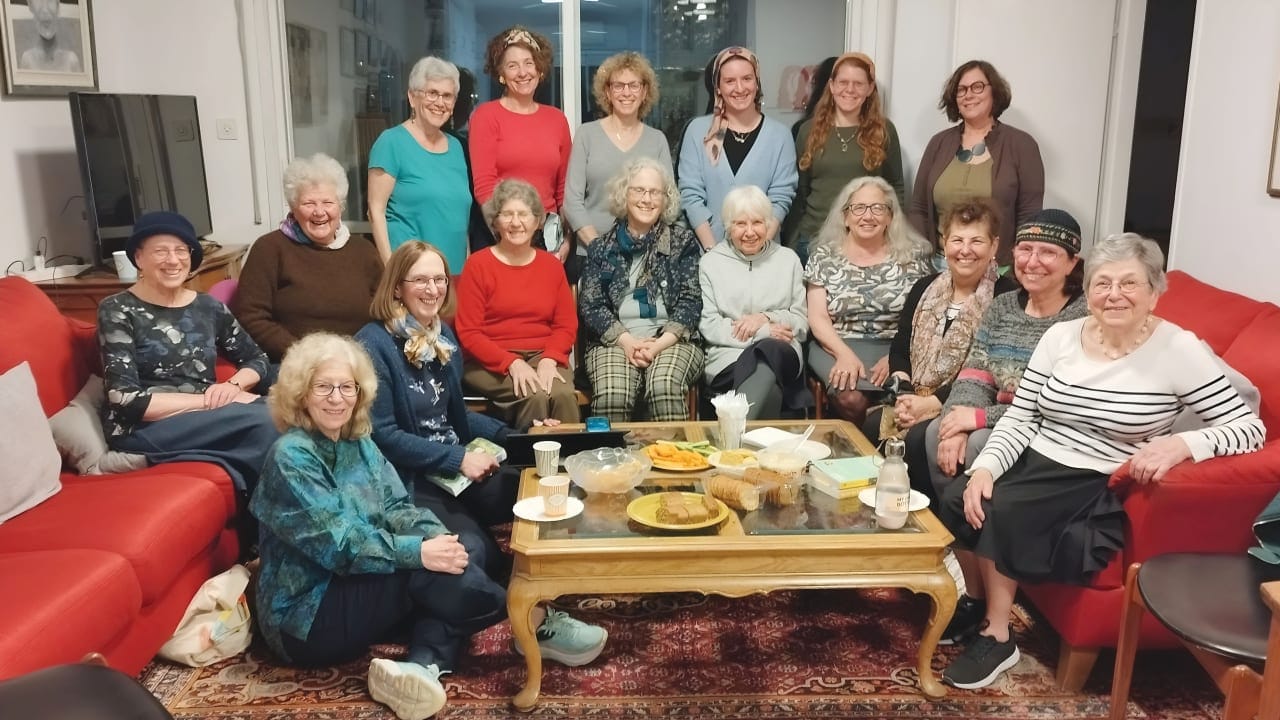
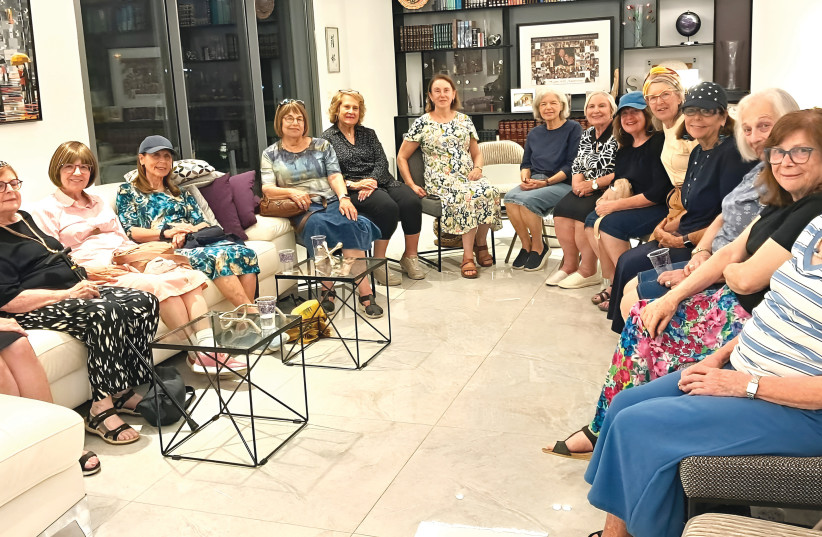
The Women of the Book in Nof Ayalon chose Wild Dark Shore by Charlotte McConaghy as their 100th title since the club began nearly 21 years ago. Set on an island near Antarctica, this novel neatly fits the theme of the club.
“We focus on armchair traveling around the world,” explains founder and discussion leader Tzippi Sha-ked.
The book club has explored nearly 60 diverse locales through literature. Sometimes hosts serve cuisine related to the place or story. Sha-ked made kimchi for the group’s discussion of Pachinko, a novel by Min Jin Lee about Korean refugees in Japan.
At each meeting, every six to eight weeks, participants give their take on the book in a round-robin fashion. “Then I launch into a discussion about the author and the writing process, followed by an analysis of the country we’re covering in terms of its Jewish denizens and its relationship to Israel. Then we have a broader discussion,” says Sha-ked.
Book clubs for Anglos dot the map across Israel, providing a social and intellectual outlet for English-speakers – mostly middle-aged and older women – revolving around their love of the written word in their native tongue.
Focal point for friendship
“I started the book club as a way to connect with the Anglos here in Nof Ayalon,” says Sha-ked, the author of The Jews of South Africa: What Future? and co-author of Three Ladies Three Lattes: Percolating Discussions in the Holy Land.
“I literally want to be on the same page and share experiences with friends. When you’re all reading and discussing the same book, it becomes a focal point for friendship.”
Women of the Book member Chani Hadad agrees. “For many years, the book club was a key part of my social life, the only time I got together with grownups. It was an anchor for all of us. During COVID, the book club kept me sane. Now we’re all basically empty-nesters, and it keeps me socially grounded with like-minded women.”
Hadad, who has a PhD in English literature, says she belongs to other book communities online, but they’re not tailored in the same way.
“Tzippi does so much research and customizes the discussions for our group. Each woman engages in the book on a different level. We connect; we disagree – which is what a book club should be. It’s just perfect for me.”
The toy we share
Jacqueline Zivor recently started a book club in Zichron Ya’acov, where she has lived for 12 years.
“It’s a nice way to share what you’re reading and thinking about,” she says. “It’s hard for adults to make friends; we need a ‘toy’ to play with together. This is the toy we’re going to share.”
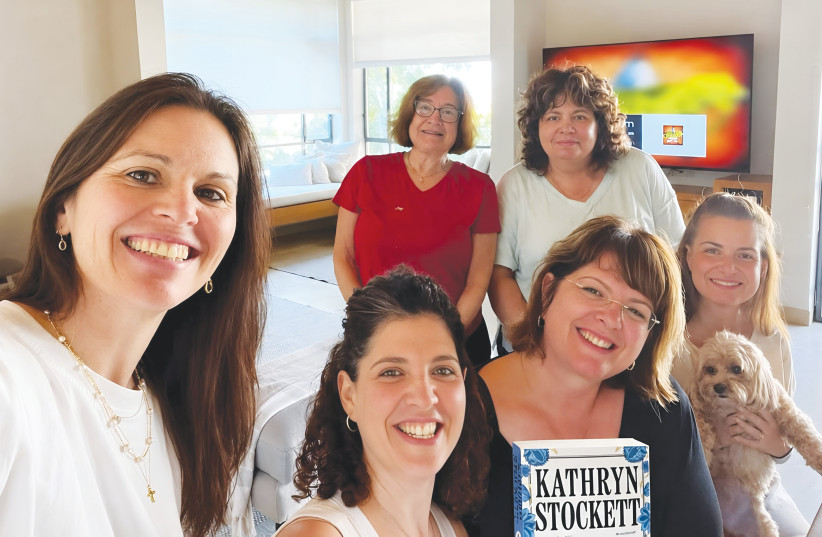
Zivor got many responses to her Facebook post gauging interest in the new club and built a WhatsApp group with more than 40 members, who vote on which of three nominated books to read each month.
Although only a handful came to the first meeting to discuss The Calamity Club by Kathryn Stockett, numbers began picking up with the second title, Land, by Maggie O’Farrell.
“I know once people step foot out of the door they will enjoy it; they just need to get started,” Zivor says.
To encourage people to engage at different levels of comfort and from afar, Zivor created a Padlet – an interactive digital noticeboard – with questions about the book that people can comment on. “People have contacted me from New York, England, and Germany to say that they want to join when they come to Israel.”
Many Anglo book club members in Israel prefer hard copies, even if that requires ordering or physically bringing books from abroad. Most of Zivor’s group, which skews a little younger, orders books instantaneously on digital reading systems such as Kindle.
“Our members like historical fiction, and there seems to be an interest in female writers,” says Zivor, a play therapist and dyslexia specialist who heads the English-speakers’ program at the Keshet Democratic Pluralistic School in her community.
She noted that few men seem interested in book clubs. Perhaps that’s because for many women the clubs are “much more about socializing than about the book.”
Sisterhood of readers
Indeed, Ashkelon resident Beth Newmark says the group she attends “is more of a sisterhood” than a book club.
“It has been in existence since sometime in the 1980s. After we moved here seven years ago, I joined Weight Watchers and the instructor told me there were two other English speakers in the group, one Scottish and one American. They’d been in Ashkelon for 30-plus years,” says Newmark.
“Through them, I met about 15 Anglo women, most of them married to Israelis. They were each other’s lifeline, like a support group.
“They extended their hand in friendship and told me about their book club, whose original purpose was to pool their limited collections of English-language books – not to discuss the books. They hadn’t had new members in many years, and I feel so privileged that they brought me in.”
Following the flood of Anglos relocating to Ashkelon in the past decade, she adds, “another woman is now starting a more traditional book club for the newcomers, and I’m part of that too.”
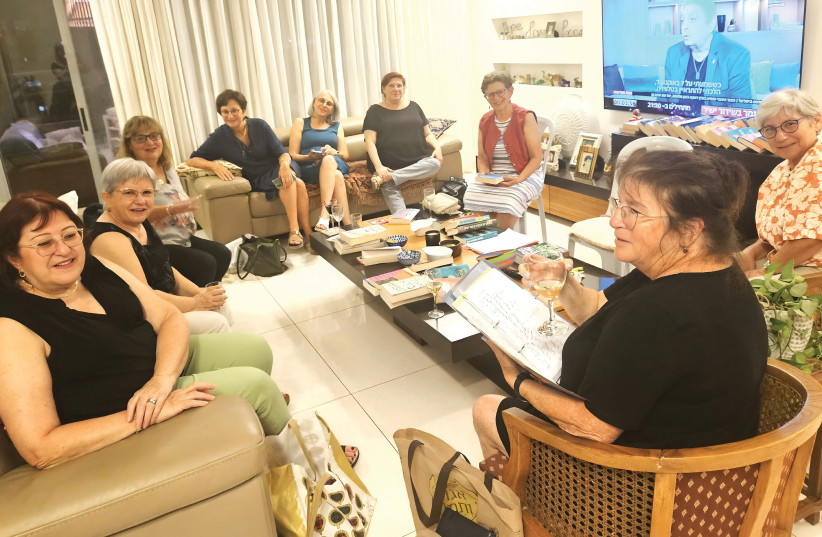
But the veteran group remains active. Approximately 12 members meet every five weeks for dinner at their homes on a rotating basis. These gatherings still center around milk crates full of books for the members to choose from.
“The books draw everyone together,” says Newmark. “Women even reschedule vacations to be at these meetings.”
To each her own book
The Rehovot Area Book Group operates on a similar lending-library model. Members borrow books to read individually and summarize orally at the next meeting.
“I started this group soon after I came on aliyah in 1999,” says coordinator Rosalie Brosilow. “I’ve always been a big reader. Someone invited me to a book group, and I found it unfriendly. My daughter said, ‘Why don’t you start your own?’
“We began with three people, and it’s been going ever since. We have a list of 18 members; about 12 come every month without fail.”
Participants include Americans, South Africans, Brits, and even a few sabras who enjoy reading in English. The age range is early 50s to early 90s. To keep the selection fresh, every member gets a turn choosing a new book to add to the collection, with money chipped in by everyone.
“Each person has different preferences. This way, we get a broad perspective,” says Brosilow.
“I chair the meeting with a very light hand. Everyone gets about five minutes to report on the book they’ve taken to read the previous month. Then they put it back and take another,” she explains.
“We initially met in a different person’s home each time, but that became difficult because it meant schlepping books from house to house. Now a different family hosts the group for a six-month period.”
‘We’re people to whom ideas matter’
At the Jerusalem Barnard Book Club, composed of graduates of Columbia University’s college for women, the emphasis is more cerebral than social.
“We do socialize outside of our monthly meetings – and sometimes we go to plays and movies related to the books we’ve read – but the social part grew out of the group,” says veteran member Marcia Gelpe, Barnard class of 1965.
“We devote the full hour and a half of our meetings not to eating or chit chat but to discussing the book. We tend to read more serious books that lend themselves to intellectual discussion.”
The list of more than 275 books under their belts thus far includes classics such as Jane Austen’s Northanger Abbey as well as contemporary titles such as Hillbilly Elegy by JD Vance. The current selection is Warlight, a 2018 novel by Michael Ondaatje.
About 30 participants in the club’s WhatsApp group suggest titles to be voted upon for the following year. “We have a tradition that each year we read six modern fiction, three classics, and three nonfiction works. Three of those are by Israeli authors; some of our members read them in the original Hebrew.”
Gelpe, a retired law professor living in Israel since 1991, joined the book club soon after its founding in October 2001. The age range in this group is unusually wide – the newest member is a recent Barnard alumna and the oldest is in her 90s. Members take turns leading the monthly discussion.
Bringing people together
Both the Jerusalem and the Nof Ayalon clubs occasionally invite authors to join their meetings.
The Barnard group has welcomed locals such as Benjamin Balint, author of Bruno Schultz: An Artist, A Murder, and the Hijacking of History; and Matti Friedman, author of Pumpkinflowers.
Women of the Book hosts authors in person, such as Rachel Kadosh (The Weight of Ink), and on Zoom, such as American author Joyce Maynard (The Bird Hotel) and Egyptian author Hussein Aboubakr Mansour (A Minority of One: The Unchaining of an Arab Mind).
The Nof Ayalon group, like many others, moved its meetings to Zoom during the pandemic, and retained that option. In addition to about a dozen in-person members, the meetings are attended virtually by a few women in South Africa, Austria, Germany, and the United States.
“This has a side benefit of introducing the world to Nof Ayalon, and that’s very important to me,” says Sha-ked, who has master’s degrees in administration and leadership as well as creative writing, and runs a matchmaking group called Points of Contact.
“The main theme for me is that I want to build bridges and bring people together.”
Kira Sirote of Ra’anana is perhaps the best example of fostering connections.
“One of the club’s original members is a distant relative of ours, and she set up my son with the daughter of another member of the book club,” she explains. “At the engagement party 11 years ago, Tzippi came over to me and invited me to join the book club. I read a lot, so I said okay, I’ll give it a try.
“Four years later, my other son married the daughter of another member of the book club. Then my daughter married a close friend of Tzippi’s daughter.”
Women of the Book has become a literal extended family.
Important to Anglos
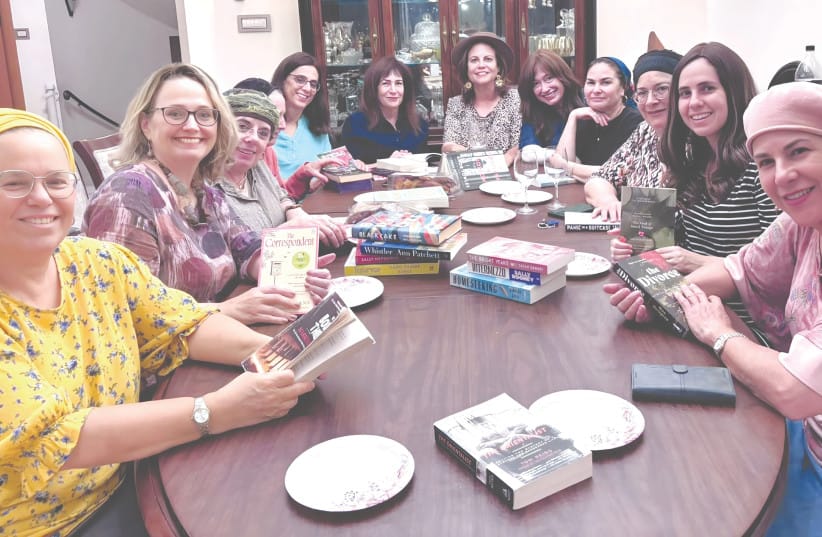
Terry Mischel, cofounder and leader of a constantly growing book club in Modi’in that’s been meeting for nearly 15 years, finds the discussions not only enhance everyone’s individual reading experience but also serve as a social glue for English speakers.
“It’s wonderful to talk to other women, mostly in the same age bracket, about the books we read,” she says, citing examples such as Isola by Allegra Goodman; The Correspondent by Virginia Evans; June in the Garden by Eleanor Wilde; and books translated from Hebrew such as Aleppo Tales by Haim Sabato.
“Sometimes we can’t imagine where the topics will lead us. Often, people have very different reactions.”
Mischel says she feels that making aliyah 17 years ago with her husband “was the best thing we’ve ever done in our lives, and I didn’t have to give up anything – including reading in my native tongue and talking about the books with like-minded people.
“Some members of our group have lived in Israel for 40 years and they could read the books in Hebrew, yet they love to come to our group. It’s very important to all of us.”■