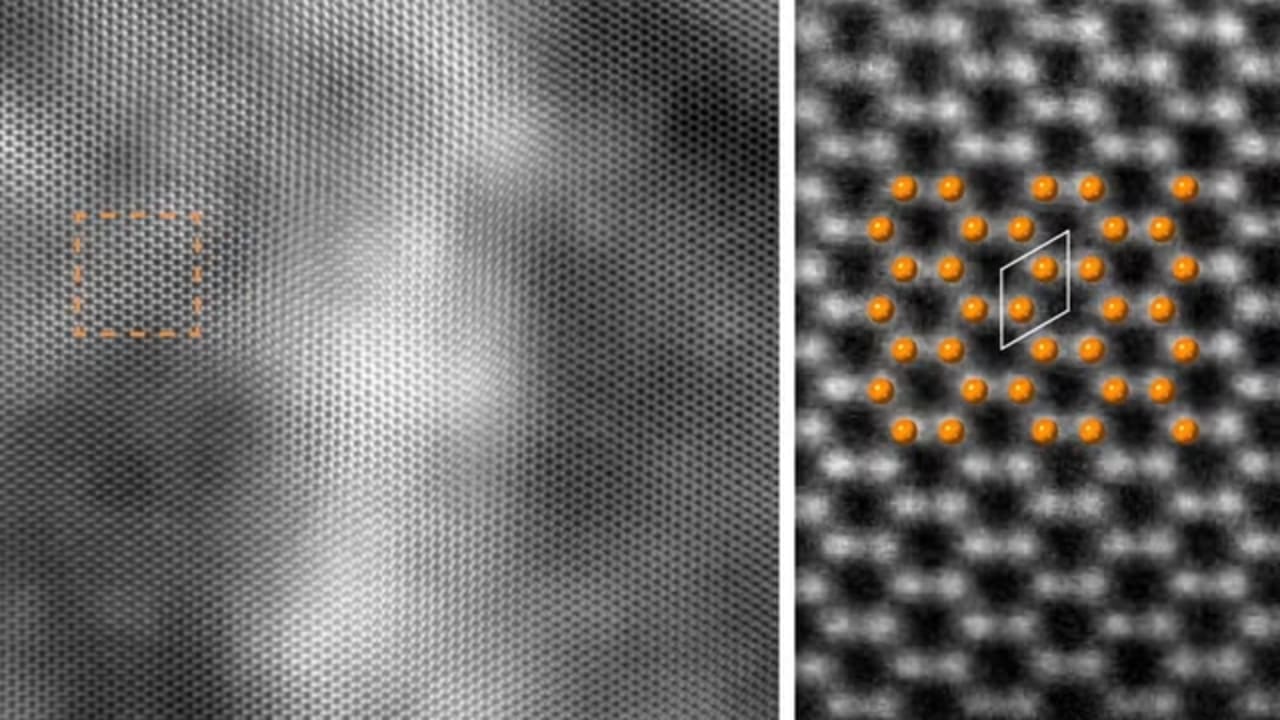
Chinese researchers have synthesized pure hexagonal diamond, also known as lonsdaleite, in the laboratory for the first time. They produced structurally pure crystals large enough for direct mechanical testing and analysis. The team created measurable samples about 1.5 millimeters in diameter, an unprecedented size for this elusive form of carbon whose existence had been contested for decades.
By preparing well-ordered starting material, applying carefully controlled pressure and heat, and verifying the outcome with X-ray diffraction and advanced microscopy, the researchers report material that is definitively hexagonal rather than the conventional cubic form of diamond. Measurements show the new crystals resist deformation more than ordinary diamond, endure higher temperatures, and provide stronger protection against oxidation, with one micro-indentation test under a 9.8-newton load reaching about 114 gigapascals along one direction.
200,000 times the atmospheric pressure
To synthesize the crystals, the team compressed highly ordered pyrolytic graphite to pressures as high as 20 gigapascals, roughly 200,000 times the atmospheric pressure at Earth’s surface. They heated it between 1300 and 1900 degrees Celsius for ten hours. Under these conditions, the carbon reorganized from layered graphite into a three-dimensional diamond lattice with hexagonal symmetry, in contrast to the cubic symmetry found in standard diamond.
The resulting grains, around 1.5 millimeters across, are large enough for direct measurement of hardness and other mechanical properties.
The results back theories positioning hexagonal diamonds as theoretically stiffer, harder, and more resistant to deformation than traditional cubic diamond. The material also tolerates higher temperatures and provides improved oxidation resistance, according to The Independent.
A long-standing scientific puzzle
The breakthrough builds on a decades-long scientific puzzle. Hexagonal diamond was first proposed in 1962 and reported in 1967 in meteorites and impact debris, where extreme shock conditions were thought to transform carbon into the hexagonal phase. Many early identifications came from tiny grains mixed with graphite and other carbon forms, leaving room for debate over whether features attributed to lonsdaleite were defects or stacking faults in conventional cubic diamond. In recent years, additional meteorite samples, including material believed to originate in shattered dwarf planets, offered fresh evidence of the hexagonal phase. Natural crystal sizes generally remained on the micron scale, making direct measurement of intrinsic properties difficult and sustaining the controversy.
The new synthetic samples are large and pure enough to characterize unambiguously. They address questions that have persisted since the first meteorite findings and the original 1960s proposal, according to Earth.com.
The next generation of high-performance electronics
Hexagonal diamonds are candidates for ultra-hard cutting tools, drill bits, and polishing abrasives that must operate in extreme environments. The material’s resistance to mechanical load and oxidation suggests longer lifetimes and greater reliability for industrial components exposed to heat, stress, and corrosive conditions. Researchers also highlight that diamond’s superior thermal conductivity and robustness at very high temperatures, high voltages, and under intense radiation could make it an important semiconductor platform for the next generation of high-performance electronics. Anticipated applications range from power semiconductors that manage energy flow in electric vehicles to components used in satellite communications. Looking ahead to communications standards projected for the 2030s, diamond-based devices are expected to play roles in elements of sixth-generation (6G) mobile systems.
The extreme hardness and thermal control capabilities could be critical for quantum sensing technologies, where stable operation in harsh conditions is essential. In parallel, academic efforts continue to explore the broader landscape of ultra-hard carbon phases. A project at the Australian National University sought to design a diamond variant predicted to surpass jeweler’s diamond in hardness for cutting ultra-hard materials at mining sites.