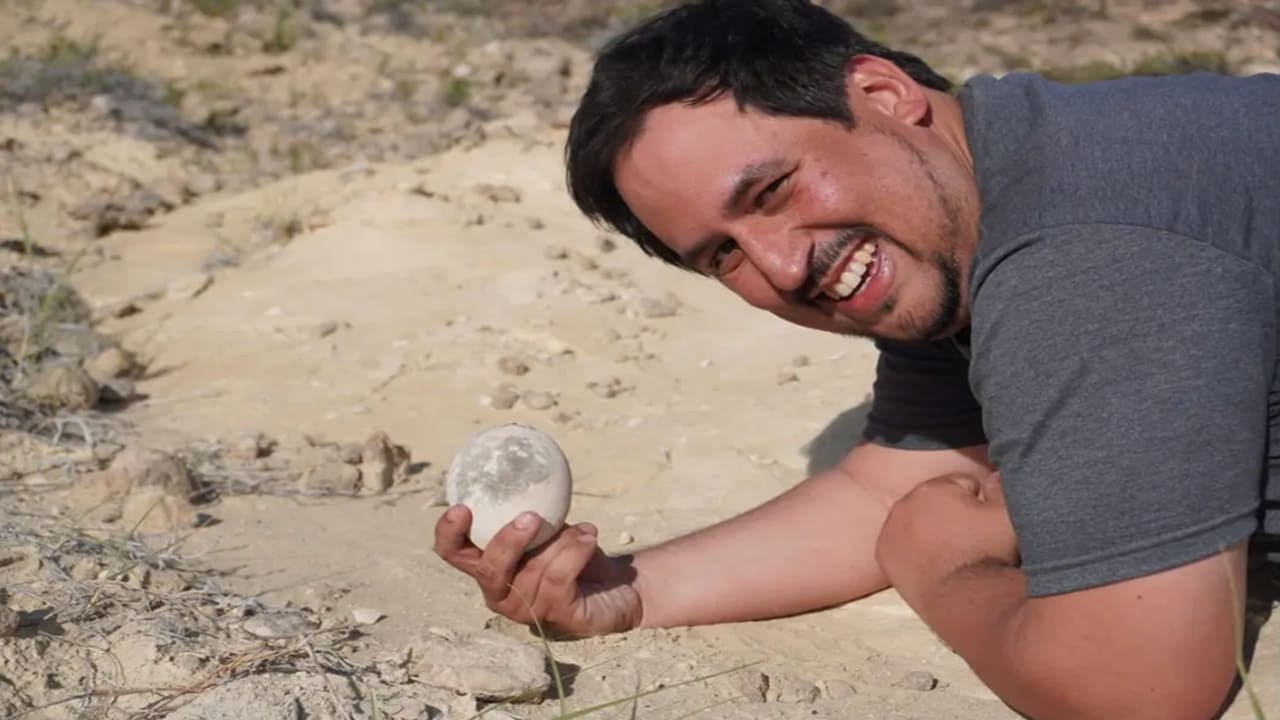
A collective gasp swept through the livestream when cameras from the Cretaceous Expedition I zoomed in on a football-sized, stone-grey oval lying a few centimetres beneath the sand in Patagonia’s Río Negro province. Viewers around the globe watched Argentine researchers realise they were looking at a perfectly preserved dinosaur egg as shouts and applause echoed over the microphones.
The field party—20 scientists from CONICET and the Argentine Museum of Natural Sciences, led by vertebrate anatomist Dr Federico Agnolín—had been surveying near the city of General Roca when three members spotted what they first mistook for an emu egg. A quick brush-off revealed a shell roughly 70 million years old; an accompanying Instagram post read, “As you can see, this fossil is over 70,000,000 years old, and he wasn't alone, we found a nest."
Preliminary study indicated the egg belonged to Bonapartenykus, a small alvarezsaurid theropod described in Patagonia in 2012. “It was a total and absolute surprise. It’s not common to find an egg of a possible carnivorous dinosaur, much less in that state,” said vertebrate paleontologist Gonzalo Leonel Muñoz, according to the New York Post. “The joy the team experienced was indescribable,” he added.
The nearly uncracked shell “looked hard-boiled” and “looked like it had been laid quite recently,” another researcher remarked. Muñoz noted that carnivorous dinosaur eggs were scarce because thin, bird-like shells were “more prone to destruction.”
The preparation of this article relied on a news-analysis system.
Given the pristine exterior, the team planned micro-computed tomography and 3-D scanning to search for embryonic material. “If scans confirm an embryo, it would open a unique window on the reproductive biology of carnivorous dinosaurs and their connection with modern birds,” the researchers said in a written statement. Confirmation would make it one of the few documented carnivorous dinosaur embryos in South America.
Around the egg, paleontologists documented fragments of other nests, tiny mammal teeth, snake vertebrae, and scattered bones, suggesting the site once served as a Cretaceous nursery. The Allen Formation had already yielded a Bonapartenykus ultimus claw in 2024, adding to Patagonia’s reputation among fossil hunters. Although Argentina ranks third worldwide for identified dinosaur species, most regional eggs belong to long-necked herbivores whose thick shells endure far better. “Finding these types of eggs is difficult. That’s why this discovery is spectacular,” Muñoz said.
High-speed satellite internet let the crew broadcast every shovel stroke, and schools as far away as Israel tuned in. “Science can now reach all parts of the world at the same time. People are watching science live,” said Agnolín.
After on-site documentation, the egg and associated fossils were jacketed in plaster and air-lifted to the Argentine Museum of Natural Sciences in Buenos Aires. Specialists at the Laboratory of Comparative Anatomy and Vertebrate Evolution will run the scans before transferring the specimen to the Patagonian Museum in Río Negro for permanent exhibition, where visitors will see what scientists already hail as the best-preserved carnivorous dinosaur egg yet found.