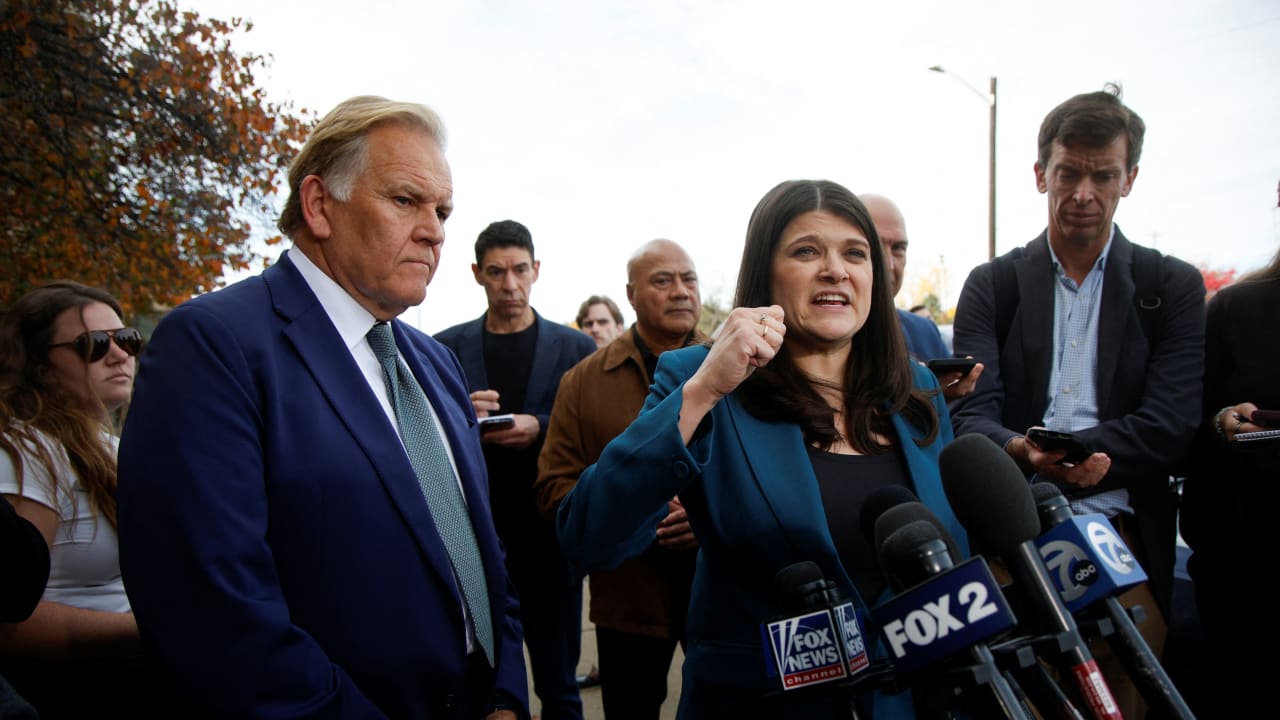
Haley Stevens is the Boy George of the Democratic Party.
At the President’s Residence in Jerusalem on Monday, the singer told Isaac Herzog what happened after he released “We Will Dance Again,” his song inspired by the survivors of the Nova music festival massacre. In it, he sings, “You say genocide, I say war.”
“In some ways, the old Boy George no longer exists, because some people don’t see me in the way they used to, and a lot of other people see me in a new way,” he said, adding that he had lost a lot of friends.
“Some of them haven’t even said goodbye. They’ve just gone quiet.”
Stevens should be so lucky.
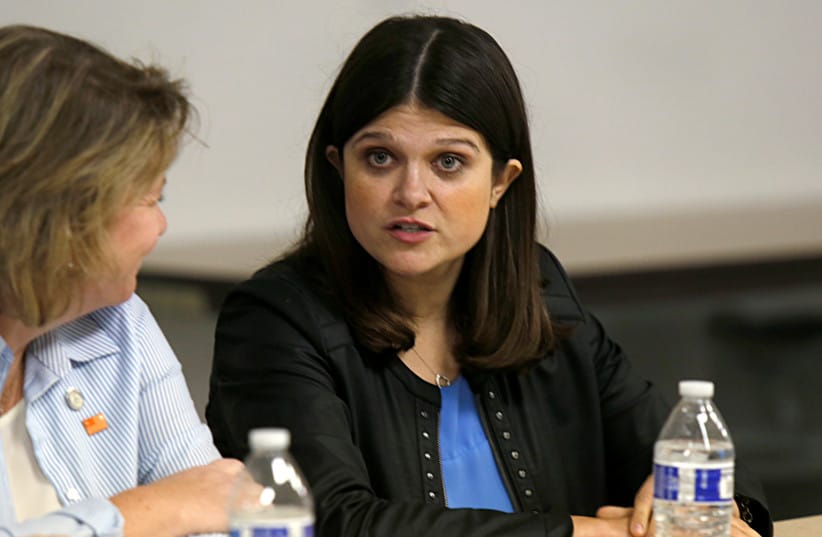
Democrats condemn Stevens
When the Michigan congresswoman withdrew her endorsement of Democratic Senate nominee Abdul El-Sayed on Sunday and crossed party lines to back Republican Mike Rogers, the people she fell out with made sure she heard about it.
One of the things that drove Stevens to break with El-Sayed was a recent ad from a group backing him that blamed American aid to Israel for the price of groceries in Michigan. On Tuesday, with Michiganders already voting in a race that could determine control of the Senate, US President Donald Trump weighed in with his own answer to that line of attack: end the aid.
Calling in to Fox & Friends, Trump said he and Prime Minister Benjamin Netanyahu had agreed months ago to end nearly $4 billion in annual US military aid to Israel by the end of the year. Netanyahu had brought it up, Trump said. Israel could still buy American weapons, and the United States would still help if necessary.
Where did Trump go to explain the political appeal of ending an arrangement that has underpinned US-Israel defense ties for decades? To Michigan. Specifically, to El-Sayed and his repeated attacks on the billions Washington gives Israel.
“You take that off the table,” Trump said.
In the run-up to Tuesday’s midterms, El-Sayed and some other Democratic candidates put that $4 billion figure next to a grocery bill, a child-care bill, or a school budget, as though every dollar Washington spent on Israel was a dollar it took from a family in Michigan.
This is not done in relation to the billions of dollars Washington spends keeping US troops in Japan, South Korea, and elsewhere; it’s only aid to Israel that El-Sayed and his allies chose to blame for the price of bananas in Detroit.
That turns a foreign-policy debate into a cost-of-living issue and puts Republicans on the defensive every time affordability came up. By announcing the cutoff while Michiganders were voting, Trump was trying to blunt that attack.
Whether the aid ends by year’s end is another matter. The current 10-year agreement, which runs through 2028, provides Israel with $3.8 billion in annual military aid. At this point, Israel must spend all but $200 million of that aid in the United States.
Netanyahu had previously talked about phasing out the aid over roughly a decade. Trump was talking about weeks. He gave no details about what would happen to money Congress had already appropriated or whether joint missile-defense programs would continue.
Trump wanted to deprive Democrats of a talking point. Stevens wanted Democrats to reckon with how their nominee was normalizing hate with that talking point.
Stevens initially endorsed El-Sayed
Stevens, a pro-Israel representative, lost the August primary to El-Sayed by 15,000 votes, or about one percentage point, and went on to endorse him. She knew where he stood on Israel, but put the party first. A Democratic victory in Michigan was key to the party’s hopes of capturing the Senate, and she hoped the two camps could move forward together.
Then came the grocery ad. El-Sayed eventually said he disagreed with it, but as Stevens pointed out, the group that produced it was picking up a theme he had sounded throughout the campaign.
“Abdul promises to get money out of politics,” Stevens wrote. “He can begin by getting Israel out of his explanation for everything Michigan cannot afford.”
There is a perfectly legitimate argument to be had over how much America spends on foreign military aid, what conditions it should attach, and whether Israel needs the money at all.
But when the Jewish state keeps turning up as the reason Americans can’t afford everything from child care to a carton of eggs, the argument has moved from what Washington spends to whom voters should blame. That’s the antisemitic dog whistle. Trump can take away the dollar figure. Democrats still have to confront why some of their own found that argument so useful in the first place – and that is something that goes to the soul of the Democratic Party.
Then there was the antisemitic Hasan Piker, whom El-Sayed took with him to campaign on college campuses. Piker later compared efforts to win over Jewish voters in West Bloomfield, a heavily Jewish Detroit suburb, to canvassing a KKK neighborhood. While El-Sayed denounced the comparison, he still has to answer for the judgment that led him to take Piker on the campaign trail in the first place.
And there was El-Sayed’s own campaign ad featuring none other than another podcast antisemite: Tucker Carlson.
“Reasonable people can disagree about Israel, Gaza, and American foreign policy. But blaming Israel for the price of eggs and elevating Tucker Carlson are not the way to build trust or bring people together,” Stevens wrote in a social media post explaining her endorsement of Rogers.
Stevens pointed to Carlson’s record of anti-Black rhetoric as well, and said she heard complaints from both Black and Jewish voters about the campaign’s choices.
Imagine a Democratic candidate who said all the right things about abortion, immigration, and equal pay, then repeatedly played on anti-Black prejudice. Would party leaders give him the same latitude? Would they save their harshest words for the Democrat who called him out?
Remember the sequence. Stevens endorsed the candidate who defeated her. She even planned to join him at a campaign event on Sunday, provided he repudiated the two ads. According to Stevens, she was told she was no longer welcome at his campaign events. She then endorsed Rogers.
Once she did, the Democratic wrath began, and it was brutal.
Former House Speaker Nancy Pelosi accused her of betraying Michigan families. Senate Minority Leader Chuck Schumer called her move a “despicable betrayal.”
New York Republican Rep. Mike Lawler turned that accusation back on Schumer, who is Jewish, saying that, for the senator, “being a Democrat matters more than standing up for the Jewish people.” Lawler is Catholic.
With control of the Senate potentially in the balance, it’s clear why Democrats were furious. What’s less clear is why the party showed so little fury at the stridently anti-Israel rhetoric and the antisemitic dog whistles that ran through this campaign.
Boy George sang, “If you’re ever confused, I stand with the Jews.” He told Herzog he had no regrets. “I think somebody needed to do it.”
Stevens told The Free Press she was at peace with her decision. “I am not wrestling with this,” she said.
But those calling her principled stand a betrayal should be wrestling with this question. Who, exactly, is betraying whom?