
It ain’t over till the proverbial fat lady sings, so I’m taking a bit of a risk writing about the Eurovision Song Contest before the final stage of the competition in Vienna on Saturday night. But this year, more than any other, the events leading up to the competition are as important as the world’s biggest song contest itself – especially for Israel. Never has the Eurovision’s slogan “United by music” sounded so hollow.
Noam Bettan’s song “Michelle,” with lyrics mostly in French and Hebrew, is about a toxic love relationship. It might be symbolic.
Consider that five countries – Ireland, Spain, the Netherlands, Slovenia, and Iceland – refused to take part in this year’s Eurovision because they can’t stand sharing the stage with an Israeli contestant – and Israel is the one being accused of “racism.”
Ireland, Spain, and Slovenia even announced that they would not broadcast the Eurovision, to protest Israel’s participation. The show, it seems, doesn’t always go on.
To its credit, the Austrian broadcaster ORF reportedly refused to host the event if Israel was barred.
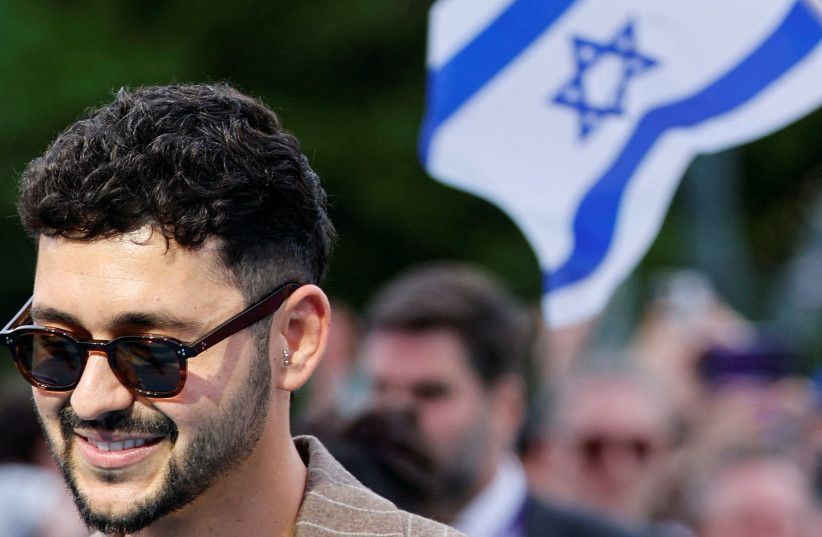
Israel’s public broadcaster KAN, whose membership in the European Broadcasting Union is the key to Israel’s participation in the event, is exhibiting “Eurovision fever” with a week of special broadcasts, from interviews with former participants to a trivia show dedicated to the Eurovision theme.
Incidentally, although Israel has won the competition four times, the overall number of winners in the country is going up, even without Bettan’s success. KAN’s European correspondent, Dov Gil-Har, covered the move to Israel by Lenny Kuhr, who won the 1969 Eurovision representing the Netherlands with the song “De Troubadour.”
Kuhr, who converted to Judaism, has two daughters and grandchildren living in Israel. She told Gil-Har that the timing of her aliyah was prompted by the rise in antisemitism, particularly after recent concerts when she was called a “terrorist” by pro-Palestinian hecklers. Many Jews do not feel welcome or safe in Europe 2026. Listen to the music – or the chants of “Globalize the Intifada” – and you’ll understand why.
In another report, Gil-Har noted that Vienna’s famed coffee houses had been paired with the fans from the 35 participating countries. Initially, not one cafe could be found willing to admit Jews – or at least to openly identify with Israel. This seems to have been mainly due to the fear of a backlash by pro-Palestinian protesters and the security threat.
At the last minute, Righteous Gentiles stood up and took a stand. MQ Kantine, located in the city’s fashionable Museumsquartier, opened its hearts and doors to Bettan’s fans. The Euromix website quoted the restaurant statement declaring: “Everyone is warmly welcome, and we want to stress that this is not about politics; during these days, everything revolves around music, culture, eating, drinking, dancing, and singing together.” Music to the ears, indeed.
Clearly, not everyone got the message that Eurovision should be about coming together to put on a show. Security was extremely tight. Keep in mind that it is not Israel that presents a threat; it’s Israel’s enemies, and enemies of the West in general. In 2024, Taylor Swift’s Eras Tour was canceled in the Austrian capital following a thwarted mass-terror plot by ISIS.
Pro-Palestinian demonstrators are rallying in support of the perpetrators of the ISIS-style invasion and mega-atrocity on October 7, 2023, when some 1,200 were murdered, 251 abducted, some 5,000 wounded, and tens of thousands displaced.
I wonder if any other delegation has to practice singing through boos and heckling while rehearsals were disrupted by rocket attacks? Israel’s contestants in the past two years, Eden Golan and Nova massacre survivor Yuval Raphael (who co-wrote the lyrics of this year’s song), both did well in the popular vote – Golan coming in fifth place overall and Raphael coming second to Austria, but winning the top place in the public voting.
The “concerns” that Israel could again do well in the public vote led to a change in the voting procedures.
The New York Times decided to make a song and dance about Israel’s desire to win. Under the headline “How Israel turned Eurovision’s stage into a soft power tool,” the newspaper declared: “To the Israeli government, Eurovision became more than just a celebration of glittery outfits, gay pride, and pyrotechnic staging. It became a chance, through strong showings by its singers, to burnish the country’s flagging reputation and rally international support.”
New York Times readers are certainly familiar with charges leveled at Israel at every opportunity – this week, columnist Nicholas Kristof claimed that Israel trained dogs to rape Palestinian prisoners – but they’re probably less familiar with the Eurovision Song Contest itself. It’s doubtful they even care about it except as another way to bash Israel. Israel wants Eurovision votes; The New York Times wants to attract readers, and considers a page-one piece against Israel the way to do it.
The paper (once) of record, grudgingly admitted that “Buying advertisements and coordinating social media messaging is not illegal. Eurovision is, after all, just a singing contest – albeit the world’s largest” but declared: “While governments often try to capitalize on the publicity their singers provide, no government-led promotional effort has been as extensive and controversial as Israel’s.” It cited the fact that President Isaac Herzog had “raised the boycott issue in meetings with world leaders last year.” Apparently, Israel is not meant to defend itself in any sphere, let alone win.
AHEAD OF this year’s contest, the Ministry of Diaspora Affairs and Combating Antisemitism issued a special report warning of incitement and likely antisemitic incidents surrounding the event. It noted some 46,500 antisemitic posts had been identified on X in Austria alone, between January 1 and May 10:
“There is a broad campaign involving digital activity, targeted pressure on artists, visual propaganda, and organized protests. Over 1,100 artists and cultural figures, including Roger Waters, Peter Gabriel, and Macklemore, have signed an open letter calling for a boycott of the competition as long as Israel participates. Calls have been made to replace the broadcast with a special schedule titled ‘Voice of Palestine’ in Slovenia.”
So much for living in harmony
There has also been an effort to brand the Eurovision as “Genovision.” So much for living in harmony.
Alternative events and pro-Palestinian demonstrations have been planned, particularly focusing on “Nakba Day,” May 15, marking “The Catastrophe” of Israel’s creation in 1948. Adding to the tension, this year, May 15 is being celebrated in Israel as Jerusalem Day, the 59th anniversary of the reunification of the Israeli capital following the Six Day War.
Eurovision is celebrating its 70th anniversary. It’s come a long way from the laid-back music of my youth – Kuhr’s “De Troubadour” wouldn’t stand a chance today, not because of her religion but because everything is faster and glitzier. Attention spans and tastes have changed over the decades.
When Israel first competed, in 1973, Ilanit stood on the simple stage to sing “Ei Sham” (Somewhere). In contrast, Bettan’s performance involves a massive diamond-shaped construction and five dancers.
But there’s no need for unnecessary romanticism about the “good old days.” In the wake of the 1972 Munich Olympic massacre, the first international event to be hijacked by Palestinian terrorists, there were fears of an attack, particularly on the Israeli singer. As the late Terry Wogan, the UK’s long-serving Eurovision commentator, quipped, security was so tight that the floor manager advised the audience to remain seated while applauding or risk being shot by counter-terrorist forces.
Ofra Haza’s song performed in 1983’s Eurovision in Munich was aptly named “Chai” (Alive), and although it came in second place in the song contest, it is still considered an anthem of survival in Israel today.
There is a concentrated effort to ban Israel from everything from cultural and sporting events to academic conferences. It’s extraordinary what is being done to the one Jewish state in the name of world peace and human rights. It is the threat from Shi’ite Iran and Sunni jihadists that is creating a new reality in the Middle East and beyond. But don’t wait for The New York Times to run an exposé on who funds this campaign, whose incitement and venom lead to a wave of antisemitic attacks globally.
Israel-haters can’t stand to face the truth – or face the music.