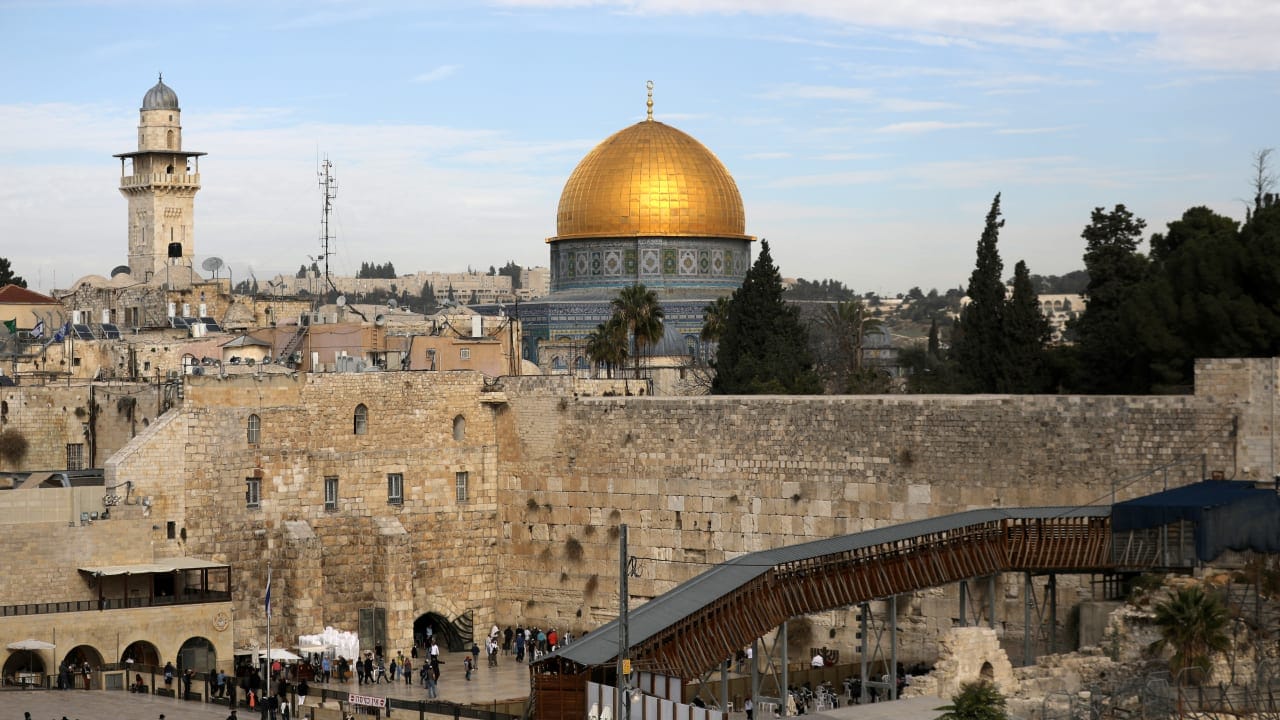
There are moments in the history of our nation when the great clock of history seems to stand still, and the beating of the Jewish heart becomes the very rhythm of reality itself.
Such was the festival of Shavuot in the year 5727 (1967). Just days after the sound of the shofar echoed through the alleyways of the Old City and the proclamation “The Temple Mount is in our hands” shook our very foundations, the Western Wall was opened to the public for the first time.
Hundreds of thousands, whose souls had long yearned and pined for the holy site, streamed on foot to the remnant of the Temple. It was a pilgrimage the likes of which had not been seen since the destruction of the Temple. Barriers fell, boundaries dissolved, and the nation of Israel rediscovered its deepest point of connection.
I did not merit to witness that moment with my own eyes; I was born in Jerusalem three years later. Yet I grew up on the stories of my father and mother, who vividly described that wondrous day of return to the sacred treasures of our nation. Recently, however, I felt as though those days had come alive again.
During the war with Iran, for more than five long and nerve-racking weeks, the Western Wall stood desolate. The gates of the holy site were locked by order of the Home Front Command, and the longing for the ancient stones became a prayer from afar.

But when the gates were reopened, a sight unfolded before my astonished eyes that I never imagined I would witness in my lifetime: within just 12 hours, nearly 50 thousand people visited the Western Wall Plaza.
This number is not merely a dry statistic; it is a declaration of faith by an entire people. It is a living testimony that Jerusalem is not only a historical site wrapped in ancient memories, but that it is a living, breathing place that resides in the hearts of Jews from all corners of the world.
This return to the Western Wall, so reminiscent of that historic Shavuot of 1967, revealed to me the depth of longing among the Jewish masses for the Western Wall – a place that is as vital to them as the air they breathe, and like that air, its absence is felt all the more intensely.
The importance of Jerusalem Day
Jerusalem Day this year carries a double significance. On the one hand, it is a day of immense gratitude to the Holy One, blessed be He, for the privilege granted to us to return to the inheritance of our forefathers, for the manifest and hidden miracles that have accompanied us in the difficult struggle for our existence from then until today.
At the same time, Jerusalem Day is also a day for soul-searching.
Our sages taught: “Jerusalem, built as a city that is joined together, makes all of Israel companions.” Jerusalem is the one place where all sectoral divisions, political disagreements, and differences in outlook fade in the face of its sanctity.
Now, when Israeli society so deeply needs unity as a remedy for its wounds, we must ask ourselves: What have we done to bring the message of Jerusalem to those near and far? How do we connect the next generation to heavenly Jerusalem, to a city of values and meaning? How do we create a connection to Jerusalem that is one of identity and belonging to the Jewish chain of generations?
Throughout the generations, when our fathers and mothers prayed, “Return in mercy to Jerusalem, Your city,” they sought to return not only to the built city, but also to their inner essence – to the source from which they drew the strength to endure.
We, the generation privileged to reach the Western Wall and to pray before the remnant of our Temple, must be worthy of this gift.
We must learn from Jerusalem the secret of togetherness and bring the spirit of the Western Wall – a spirit of prayer, hope, and shared destiny – into our daily lives. We must strive to make Jerusalem truly a city joined together.
May it be God’s will that we merit to see the complete rebuilding of Jerusalem, which is also our own rebuilding, through peace within us and tranquility in our dwellings.
The writer is rabbi of the Western Wall and Holy Sites.