On May 4, Iran fired 12 ballistic missiles, three cruise missiles, and four drones into the United Arab Emirates. This latest attack came in response to US President Donald Trump’s effort to ensure free navigation for commercial shipping through the Strait of Hormuz.
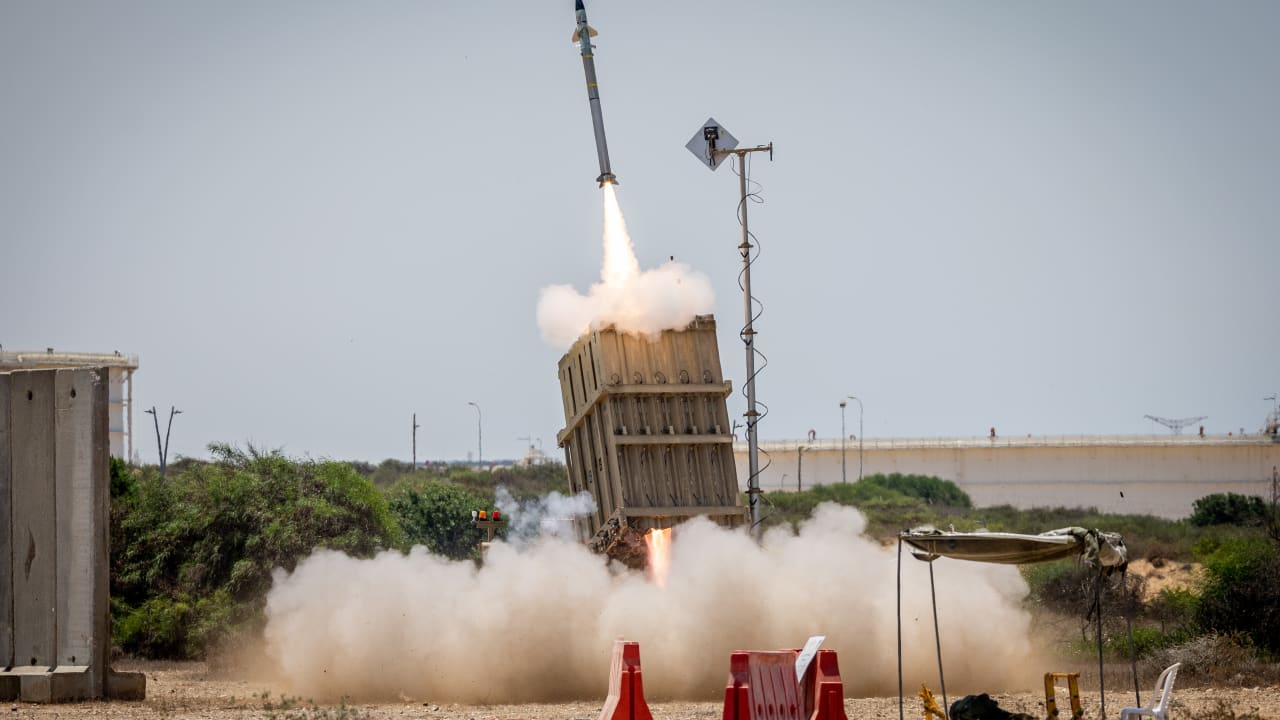
Initially kept secret, and later disclosed only through limited specialist reporting, is the interesting information that IDF personnel operated Israel’s Iron Dome anti-missile system to intercept the incoming Iranian missiles – but from within the UAE.
Not much has been made of it in the media, but this was the first time that Israel’s advanced technology has been deployed and used operationally on foreign soil.
It proves, if proof were needed, that Israel-UAE military cooperation is a rapidly maturing strategic partnership. Embedded in the Abraham Accords framework, the collaboration is driven above all by a shared perception of the threat posed by Iran.
Early in the war, at the request of UAE President Mohammed bin Zayed in a direct conversation with Benjamin Netanyahu, Israel quietly deployed an Iron Dome battery plus IDF personnel to the UAE.

Reports indicate that Israeli crews have since intercepted dozens of Iranian missiles and drones aimed at UAE targets.
In parallel, the IAF carried out strikes on short-range missile launch sites in Iran that were assessed as threats to the UAE and other Gulf states, linking Israeli offensive operations directly to Emirati defense.
Yet even before the current Iran war, there was a clear trend of growing military and defense-industrial cooperation between Israel and the UAE.
It was back in August 2025 that the Washington Institute for Near East Policy published a survey titled “Israel-UAE Defense Cooperation Grows under the Abraham Accords.”
It included reference to a possible forthcoming deal in which the UAE’s Edge Group would procure the Hermes 900 unmanned aerial vehicle (UAV) from the Israeli company Elbit Systems, including transfer of technology and localized production. That would, it said, potentially shift “the geopolitical balance in the Gulf.”
If this deal was indeed finalized, it has not, on the grounds of industrial confidentiality, been made public. Reports have appeared, though, of multi-million dollar sales of the Hermes UAV to undisclosed customers.
What is known is that since normalization in 2020, the UAE has acquired Israeli-made Barak and Spyder air-defense systems, embedding Israeli technology in its force structure.
In October 2022, an Israeli-made Barak system was deployed in the UAE, and by 2023, the two states conducted their first bilateral naval exercise and unveiled a jointly developed unmanned surface vessel.
In 2025, UAE Mirage 2000-9s flew alongside Israeli and US aircraft in a multinational exercise in Greece, signaling that Emirati participation in exercises that openly include Israel has become routine.
Put together with the deployment of an Iron Dome system within the UAE itself, what emerges, if not quite a mutual defense treaty, is close to the collaboration expected in a signed and sealed security partnership.
WAY BACK in 2017, three years before the Abraham Accords, a senior UAE military figure publicly described the UAE and Israel as “like brothers.” In an interview with the US outlet Defense & Aerospace Report, UAE Maj.-Gen. Abdullah al-Hashmi described the US as the “older brother,” overseeing any differences between them.
So can Israel and the UAE fairly be called brothers-in-arms?
Israeli and Emirati forces have now fought on the same side in the same live theater, with Israelis directly defending Emirati territory from Iranian attacks and coordinating offensive action against Iranian launch sites.
The UAE hosts and operates Israeli air-defense and early-warning systems and trains regularly with Israeli forces, which is the kind of shoulder-to-shoulder activity many would intuitively associate with brothers-in-arms.
The cooperation, though, is framed around the specific threat posed by Iran. There is no formal or explicit public commitment that either state would come to the other’s aid in future conflicts. Above all, the relationship remains constrained by wider Arab public opinion, and the UAE’s need to preserve maneuvering room with other regional actors.
All the same, Israel and the UAE have crossed a previously unbridgeable Rubicon. Israeli troops, Iron Dome, and even – it is reliably reported – state-of-the-art Israeli prototype Iron Beam and Spectro systems have been deployed in combat from Emirati soil, with real-time Israeli intelligence guiding UAE and coalition responses. All of which makes it politically and operationally easier, next time, to set up joint structures previously almost unimaginable – the permanent basing outside of Israel of some Israeli systems, joint missile-defense planning, and regularized trilateral planning with US Central Command.
In fact, that model is already beginning to appear, in uneven ways, across the Abraham Accords bloc. It could, if the war drags on, become the basis of a looser regional security architecture focused on Iran and its projectiles rather than on broader Arab-Israeli peace.
Among the Abraham Accords states, the UAE and Bahrain are emerging as front-line adopters of the new model. They openly normalize with Israel, quietly integrate Israeli air- and missile-defense, intelligence, and naval cooperation, and plug this into US-led multilateral drills and emerging regional defense schemes aimed squarely at Iran and its projectiles.
By contrast, Morocco – and Sudan before the civil war – were “selective adopters,” taking Israeli UAVs, air-defense systems, intelligence and doctrine sharing, but applying them primarily to their own local rivalries like Algeria and Western Sahara.
Introduced in the US Senate in March 2026 was a bill for an Abraham Accords Defense Cooperation Act. If passed, it would create a formal Pentagon-run “US–Abraham Accords Defense Cooperation Initiative,” deepening military cooperation with Abraham Accords countries specifically to deter Iran and its proxies.
The bill is still at the very start of the legislative process. Still, commentators believe that current political dynamics in Congress give it a real – though by no means guaranteed– chance of being folded into this year’s annual US defense bill.
A possible outcome of this Israel-UAE brothers-in-arms moment is a US-enabled security ecosystem in which Israel and the UAE collaborate closely when Iran is the adversary, and other Accords states plug in more selectively – in short, a tighter, closer, more secure partnership.
The writer, a former senior civil servant, is the Middle East correspondent for Eurasia Review. Follow him at: www.a-mid-east-journal.blogspot.com