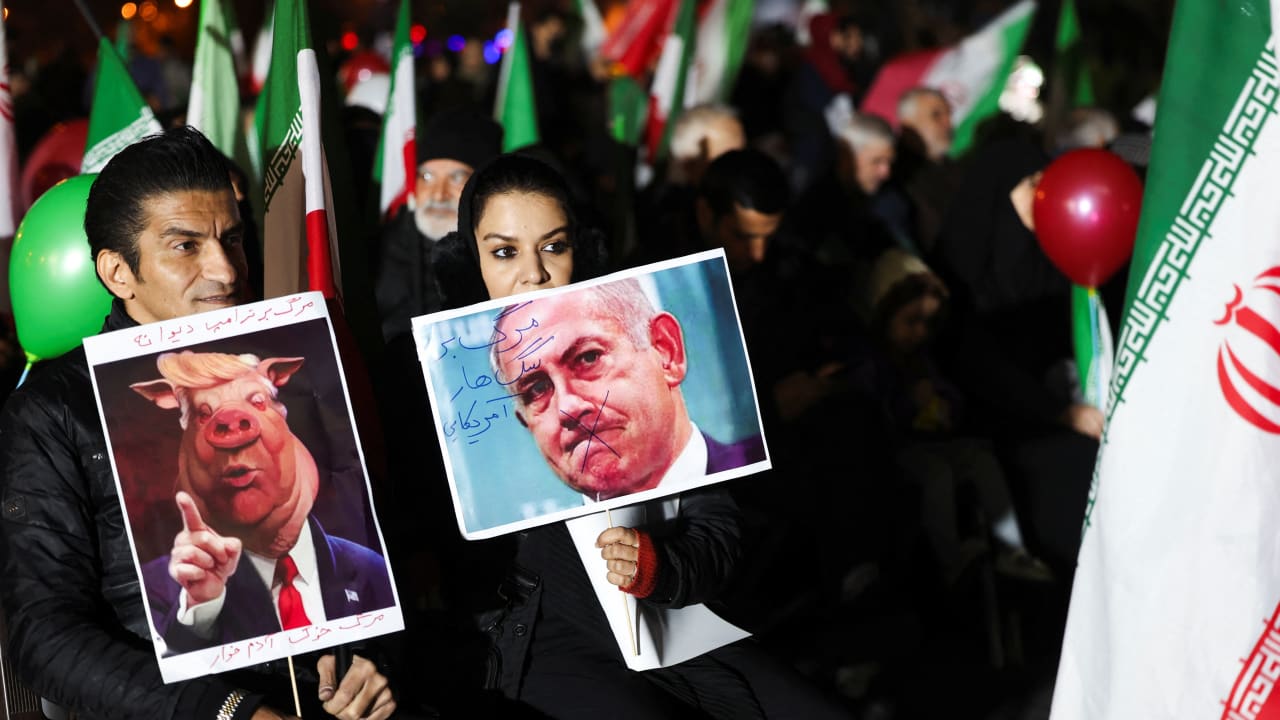
Parts of the American media have termed the war against Iran a “War of Choice” both for the United States and Israel, namely a war that was launched without imminent threats to vital interests, which could have been replaced by peaceful options such as diplomacy and sanctions, ignoring the fact that both these options were tried without results and were exploited by the ayatollahs to further advance their aims.
The supposedly fundamental difference between “wars of choice” and “wars of necessity” is largely conceptual and depends on the views and motives of the parties involved – or by history with hindsight.
For Israel, Iran’s repeated threats of annihilation and efforts to achieve its goal by different means makes this indeed a clean-cut case of necessity. International law recognizes it as such: Article 2(4) of the United Nations’ charter clearly defines the very threat against another state as a breach of law, and it is considered a peremptory norm.
For the US, too, there are acute economic and geopolitical interests at stake, both directly related to its own positions and to those of her allies. Still, Karl Rove, who was the deputy White House chief of staff under president George W. Bush and probably knows more about American politics than anyone else, thinks that President Donald Trump needs to do more to make the case to the public. “This can’t be just left to the Truth Social video or to a few brief calls by him to journalists.”

Wars of choice or preventative wars
Some 300 years ago, the Prussian military philosopher Carl von Clausewitz explained that “war is the continuation of policy by other means,” which can be construed to mean both “wars of choice” whose purpose is to achieve political and other objectives and wars of necessity to prevent the other side from achieving its aggressive objectives, including “preventative” or “preemptive” wars.
The Washington Post published a poll showing that most of the American public does not support the war. It also shows that views in this respect are dictated by the political allegiance of the respondents – Democrats against and Republicans (though not all) for. Actually, the picture is more complex since both the radical Democrats and the extreme isolationists in the MAGA right wing of the Republican party, inspired among others by the media personality Tucker Carlson, have formed a common front against the war whose main link is antisemitism. Trump, to his credit, is ignoring both.
America has known similar controversies in the past, with most Americans believing that their country, located north and south between two friendly neighbors, Canada and Mexico, and west and east between two oceans, is so secure and stable that it should not be dragged into wars that are supposedly better left alone.
It took the sinking of the passenger liner Lusitania and the Zimmermann telegram about a proposed German-Mexican plot against the US in World War I, and the Japanese attack on Pearl Harbor in World War II, plus the clear-eyed leadership respectively of presidents Woodrow Wilson and Franklin D. Roosevelt, to recognize that whatever happens in the world also affects them.
The history of Israel's wars
All Israel’s wars, except perhaps the Sinai Campaign, were “wars of necessity,” being defensive wars both in the immediate and the longer term. Even if the outcome of some wars led to the broadening of its borders, this does not change their definition as defensive wars or detract from their objective of secure and defensible borders in order to prevent future aggressions.
The two Lebanese wars were such, and although they failed to achieve all their objectives, partly due to strategic and military errors on the Israeli side, the actual decision to go to war was justified. Superfluous to note that the War of Independence and the Yom Kippur War (and now the Israel-Hamas War) were clear cases of “wars of necessity” or wars forced upon us.
One might also speculate that had the government of Golda Meir not ignored the warnings, even among its own ranks, Egypt would not in the long run tolerate the situation created on its territory by the Six Day War, and the 1973 war might have been prevented. In the case of Gaza, without the “concept” nurtured by most of Israel’s politicians on all sides and its security establishment, the situation that led to war may not have arisen in the first place.
As to the war against Iran, history will show that it was one of clear and immediate necessity, whatever its critics claim today.